Updated: August 24, 2026
Seasonal and holiday campaigns are where most social media calendars either shine or quietly fall apart. The dates are predictable months in advance — Black Friday, Valentine’s Day, back-to-school, the winter holidays — yet businesses routinely scramble in the final week because content that was planned never actually got scheduled everywhere it needed to go. RSS automation doesn’t help you come up with seasonal ideas, but it solves the exact failure point that sinks most seasonal calendars: content that’s written in advance but never reliably distributed on the day it matters.
The typical seasonal campaign failure isn’t a lack of planning — most marketing teams do sit down and map out a holiday content calendar weeks in advance. It’s execution: the person responsible for manually posting each piece on its scheduled day is also juggling a dozen other seasonal priorities, and a content calendar sitting in a spreadsheet doesn’t publish itself. By the time someone remembers to post the Black Friday announcement, it’s Black Friday afternoon instead of the strategically-timed morning slot the plan called for. Automation removes that single point of failure by turning “remember to post this on the 24th” into “this publishes itself on the 24th, guaranteed.”
The workflow that works well: write and schedule your seasonal content on your own site (a WordPress blog, a scheduled page publish, or a dated feed entry) well ahead of the actual campaign, using your site’s native scheduling to set each piece to go live at the exact date and time you want. Because PostRSS watches your feed continuously and picks up new items the moment they publish — not when you originally wrote them — a Black Friday post scheduled to go live on your site at 6 AM on Black Friday automatically triggers the same-moment distribution to Facebook, X, LinkedIn, and Pinterest, without anyone needing to be awake and manually posting at 6 AM to make it happen.
Different platforms carry different optimal timing windows even for the same seasonal moment — a Black Friday post might perform best hitting Facebook and Pinterest well before the day itself (since Pinterest users plan holiday shopping searches weeks in advance) while X benefits more from same-day, real-time posting as the event unfolds. Because RSS automation distributes to every connected platform simultaneously from one feed item, the practical approach is to accept that simultaneous, reliable distribution beats hand-tuned per-platform timing for most seasonal content — consistent same-moment posting across all platforms is a significant improvement over the manual alternative even if it isn’t perfectly optimized per platform.
Most seasonal campaigns repeat every year with only modest changes — the same general Black Friday structure, updated with this year’s specific offer. Once you’ve built a seasonal content calendar and automation workflow once, next year’s version is mostly a matter of updating dates, offers, and any creative refresh, rather than rebuilding the entire process from scratch. Keeping a simple record of what worked (which posts got scheduled when, and how they performed) turns each year’s seasonal campaign into a faster, more refined version of the last, instead of starting over from a blank calendar every time.
Automation handles reliable, on-time distribution — it doesn’t decide what your seasonal offer should be, write compelling holiday copy, or manage inventory and fulfillment questions a big promotional push raises. It also won’t catch a factual error in a pre-scheduled post (a wrong date, an expired discount code) — that still requires someone reviewing scheduled content before it goes live, the same diligence any pre-scheduled campaign requires regardless of how it’s distributed.
A retailer’s seasonal calendar centers on shopping holidays — Black Friday, Cyber Monday, the winter gift season, back-to-school — where timing precision around a single high-stakes day matters most. A professional services firm’s seasonal calendar looks different: tax-deadline reminders, open-enrollment periods, fiscal year-end content, and industry conference season, where the “seasonal” moment is less about a single shopping day and more about a recurring business deadline your audience is already tracking. A hospitality or travel business has yet another shape, built around booking-season peaks (spring break planning, summer vacation booking, holiday travel) that often need content live weeks before the actual travel dates, since booking decisions happen well in advance. In every case, the underlying automation workflow is identical — only the specific dates and content types change, which is exactly why building the workflow once and reusing it across different seasonal shapes each year is so much more efficient than treating every campaign as a one-off project.
Many seasonal campaigns pair organic social content with paid advertising running the same offer, and a common failure mode is the organic post going out a day late while the paid campaign is already live, creating a mismatched customer experience. Because RSS automation publishes the moment your source content goes live rather than depending on someone remembering to post manually, it’s much easier to align organic distribution with a paid campaign’s exact start time — schedule both to reference the same launch moment, and the organic side no longer risks trailing behind the paid side by hours or days due to a missed manual step.
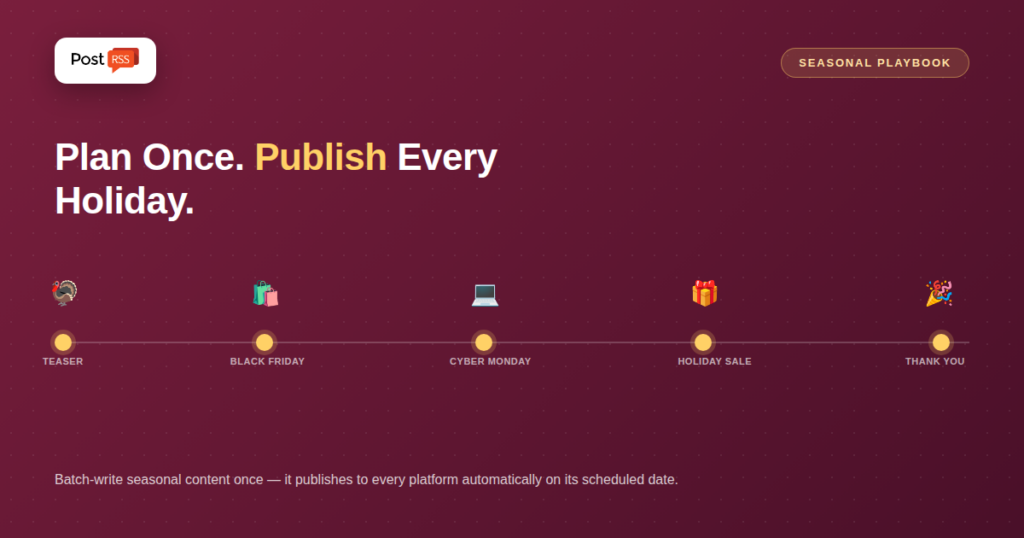
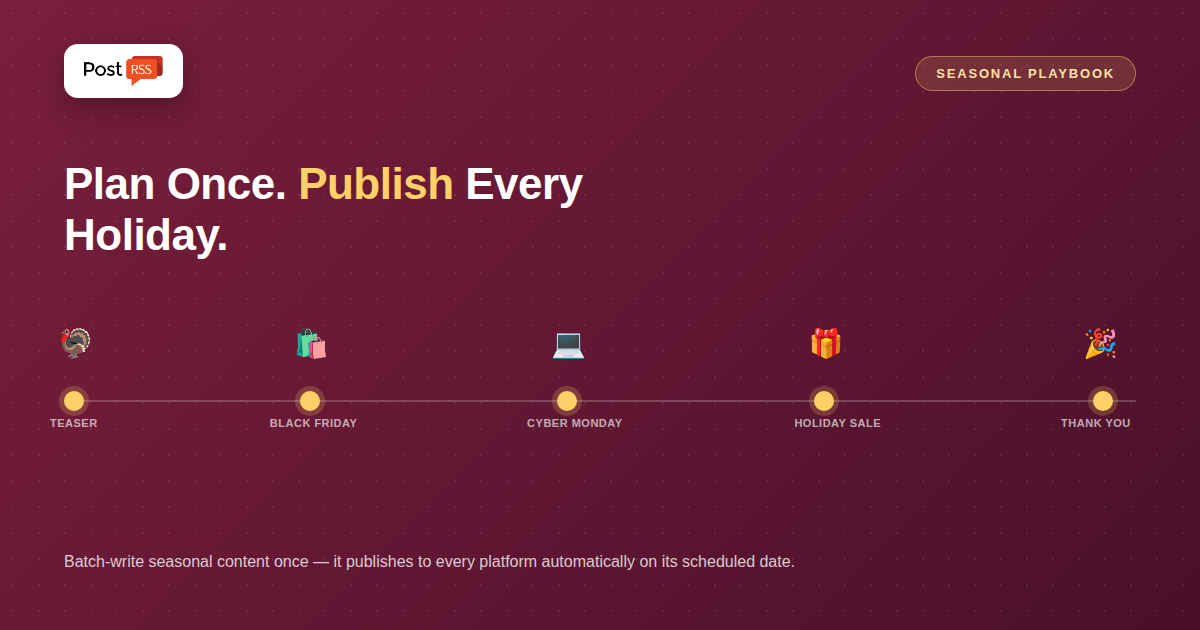
A retailer plans eight pieces of seasonal content across a six-week holiday season — an early-bird teaser, a Black Friday announcement, a Cyber Monday reminder, three mid-season promotional pushes, a last-minute-shipping-deadline reminder, and a post-holiday thank-you. All eight are written and scheduled on the company’s site in a single planning session in October. Each one automatically reaches Facebook, X, LinkedIn, and Pinterest at its scheduled moment through December, without a single manual post during the season’s busiest operational weeks — freeing the marketing team to focus on customer service and fulfillment questions instead of remembering to log into four apps on Black Friday morning.
Once a seasonal campaign wraps, the automation’s publishing log itself becomes useful raw material for next year’s planning: a clean record of exactly what published, when, and to which platforms, without relying on anyone’s memory of how the season actually went. Pairing that publishing record with each platform’s engagement data for the same period shows which specific pieces of seasonal content performed best — the countdown posts, the day-of announcement, the last-chance reminder — so next year’s calendar can lean further into what worked rather than repeating the full slate uniformly. This turns seasonal planning into a genuinely iterative process instead of a fresh guess every year.
Teams already running a WordPress site or similar platform with native post scheduling can connect an RSS feed to PostRSS well ahead of their next seasonal push, testing the workflow on a free plan before scaling to cover a full campaign calendar. See our setup guide for connection steps, and our pricing breakdown for choosing a plan that fits your seasonal platform mix.
Yes — as long as your site publishes the post at its scheduled time, PostRSS picks it up and distributes it automatically from that moment, regardless of how far in advance it was originally written.
Editing the post on your own site before its scheduled publish time works normally; automation only distributes what’s actually published, so changes made before that moment carry through to what goes out.
Yes — the same approach applies to any predictable seasonal or promotional date, whether that’s a major shopping holiday or an industry-specific recurring event unique to your business.
For major seasons like winter holidays, four to six weeks of advance planning is common; for smaller recurring promotions, even a week or two of lead time is enough once the workflow itself is already set up.
They typically run through different systems (paid campaigns through ad platforms, organic through RSS automation), but timing them to launch at the same scheduled moment keeps the customer experience consistent across both.
Nothing changes — the same feed connection keeps distributing whatever regular content you publish year-round; seasonal campaigns are simply additional scheduled content flowing through the same ongoing setup.
The businesses that execute seasonal campaigns well aren’t necessarily the ones with the most creative ideas — they’re the ones whose good ideas actually reach their audience on schedule, every time, without depending on someone remembering to hit publish during the busiest week of the quarter. RSS automation turns a seasonal content calendar from a plan that depends on manual follow-through into one that executes itself, freeing your team’s attention for the parts of a seasonal campaign that genuinely need it.