Every few years, someone declares RSS dead — and every few years, that turns out to be wrong. Google Reader’s 2013 shutdown is the moment most people point to, but RSS itself never actually went anywhere; what disappeared was one popular reader app, not the underlying format. If you’re evaluating RSS-to-social automation in 2026 and wondering whether you’re building on outdated technology, the short answer is: RSS itself is as stable as it’s ever been. What actually changes — constantly — is the social media side of the equation: the APIs that let automation tools post to Facebook, X, LinkedIn, and everywhere else.
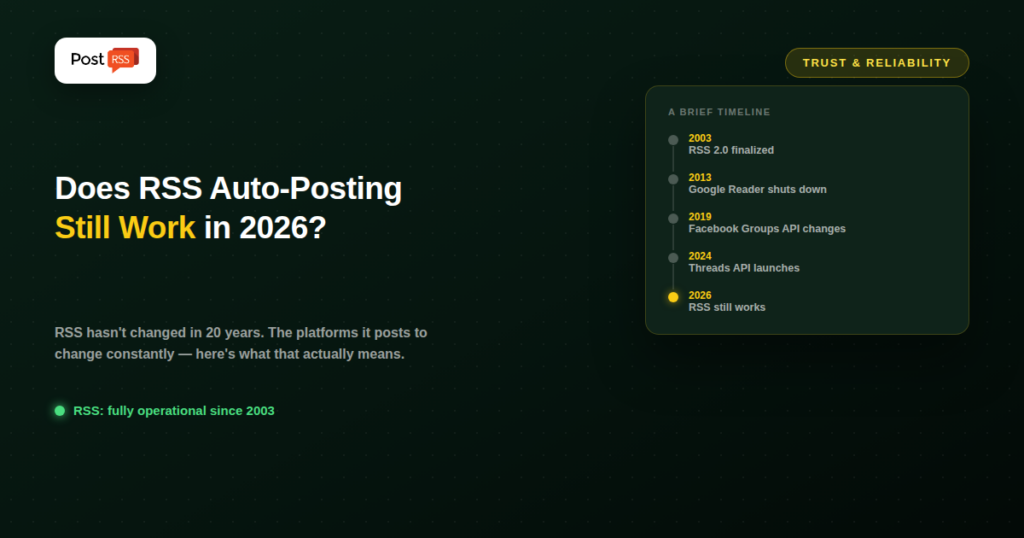
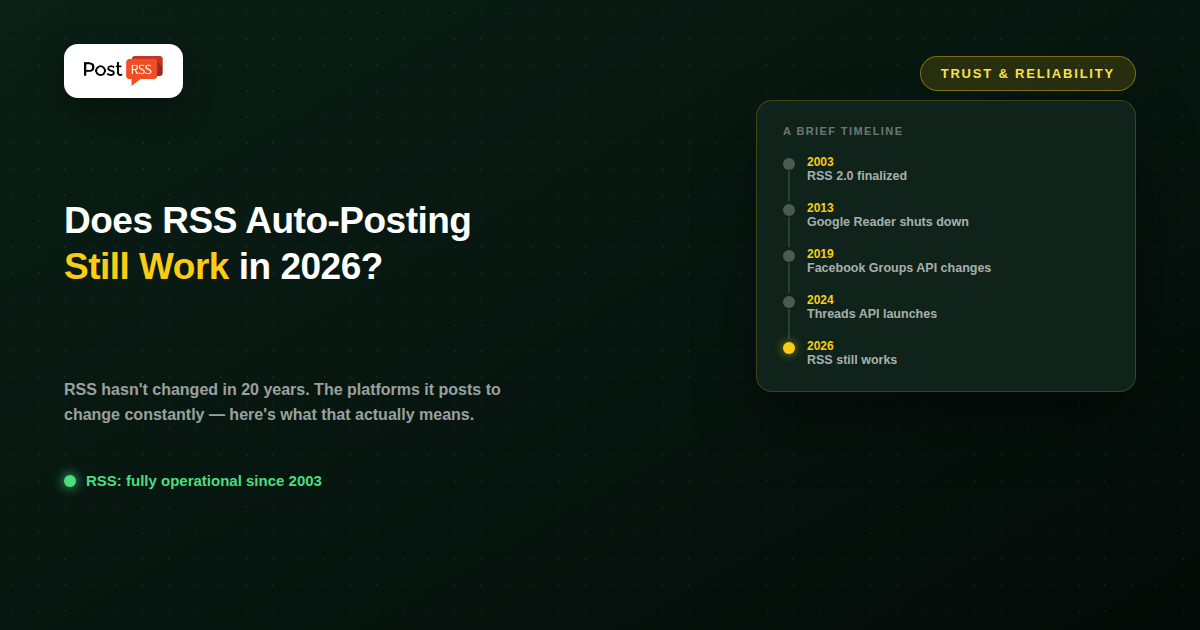
RSS 2.0, the version almost every site still uses, was finalized in 2003 and hasn’t meaningfully changed since. That’s not neglect — it’s a feature. RSS is a deliberately simple, plain-XML format: a list of items, each with a title, link, description, and publish date. There’s very little surface area for it to “break” in the way a complex API can, and virtually every CMS, blogging platform, and publishing tool still generates it automatically, whether or not anyone’s actively promoting it. WordPress, Ghost, Substack, Medium, podcast platforms, and most e-commerce systems all output valid RSS by default today, in 2026, exactly as they did a decade ago.
The instability in this space has never really been about RSS — it’s about what happens after the feed is read. Social platforms change their posting APIs regularly, sometimes for legitimate security and spam-prevention reasons, sometimes as part of broader platform strategy shifts. This series has already covered several current examples: Meta’s Tech Provider Verification requirement for Threads, TikTok’s mandatory app audit and 24-hour token expiration, and Instagram’s Business-account-only posting restriction. Facebook itself has gone through multiple rounds of API tightening over the years — Facebook Groups auto-posting, for instance, was discontinued entirely at the API level, breaking automations that had relied on it for years, regardless of how well-built they were.
If you built a custom script or a simple integration against a social platform’s API a few years ago and haven’t touched it since, there’s a real chance part of it has quietly broken — not because RSS failed, but because the destination platform changed its requirements and nobody updated the integration to match. This is the actual failure mode worth worrying about, and it’s a maintenance problem, not an RSS problem. The fix isn’t avoiding RSS automation; it’s making sure whatever handles the platform-facing side of the pipeline is actively maintained against current API requirements.
It’s worth being specific about what “platforms change” means in practice, rather than treating it as a vague warning:
None of these changes had anything to do with RSS as a format — every one of them was a decision made by the receiving platform about how it wants third-party posting to work. That’s the actual pattern worth understanding: the risk in this space has always lived on the social platform side, not the RSS side.
There’s a counterintuitive point worth making here: because RSS decouples “reading your content” from “posting to a platform,” an RSS-driven automation pipeline is often more resilient to change than a tighter, more direct integration would be. Your RSS feed keeps working exactly the same way regardless of what any social platform does — WordPress, Ghost, or whatever generates your feed doesn’t need to know or care that TikTok added an audit requirement, because the feed’s job stops at “here is my content in a standard format.” All the platform-specific complexity lives on the posting side of the pipeline, isolated from the content side. That separation is architecturally sound in exactly the way that matters here: it means platform changes require updates to one specific integration, not to your entire publishing workflow.
There’s no reason to expect the pattern of the past decade to reverse: social platforms will keep adjusting their APIs — sometimes tightening access for security reasons, sometimes loosening it to attract more third-party integrations (Bluesky’s notably open approach, covered elsewhere in this series, shows platforms don’t universally trend toward more restriction). RSS itself, meanwhile, has survived multiple platform shutdowns, several “RSS is dead” news cycles, and two full decades of internet history essentially unchanged, because it solves a genuinely simple problem in a genuinely simple way that doesn’t need reinventing. Betting on RSS continuing to work as a content source is a safe bet by any reasonable historical standard; the only real variable is which specific destinations a given automation tool keeps up to date.
PostRSS’s core mechanism — reading an RSS feed and posting to Facebook, X, LinkedIn, Pinterest, and VKontakte — is maintained specifically against each of those platforms’ current API requirements, which is the actual work involved in staying “still working” in a space where the platforms, not the RSS format, are the moving target. When a supported platform changes something on its end, that’s an update PostRSS handles as part of the product, not something a customer needs to notice, diagnose, and fix in their own integration. That maintenance burden is exactly what you’re paying a hosted service to carry, rather than owning it yourself in a custom script that quietly stops working the next time a platform ships a breaking change.
No — RSS remains a widely supported, actively used format across publishing platforms in 2026. What occasionally gets discontinued are specific reader products or apps (Google Reader being the most famous historical example), not the RSS format or the practice of publishing feeds, which remains standard across WordPress, Ghost, Substack, and most other content platforms.
This is almost always a platform-side API change or an expired authentication token, not an RSS problem. Check whether the affected platform has announced any developer-facing changes recently, and confirm your connected account credentials haven’t expired — both are far more common causes than an issue with the feed itself.
It varies significantly by platform, but meaningful changes — new verification requirements, revised rate limits, deprecated endpoints — happen at least a few times a year across the major platforms combined. This is exactly why using an actively maintained tool matters more in this space than in most other kinds of software automation.
For a single platform and a simple use case, a custom script is achievable — but you’re taking on the ongoing responsibility of monitoring for API changes and updating your code whenever a platform ships one, indefinitely. For most businesses, that maintenance burden costs more in time than a dedicated tool costs in subscription fees.
RSS auto-posting absolutely still works in 2026 — the format itself hasn’t meaningfully changed in over two decades, and virtually every publishing platform still generates it by default. What requires ongoing attention isn’t RSS; it’s the social platforms on the receiving end, which change their APIs, account requirements, and verification processes on their own schedules. The practical takeaway isn’t to distrust RSS automation — it’s to make sure whatever tool you’re using is actively maintained against those changes, so platform-side updates are the tool’s problem to solve, not yours to discover the hard way.