Updated: 2026-09-27
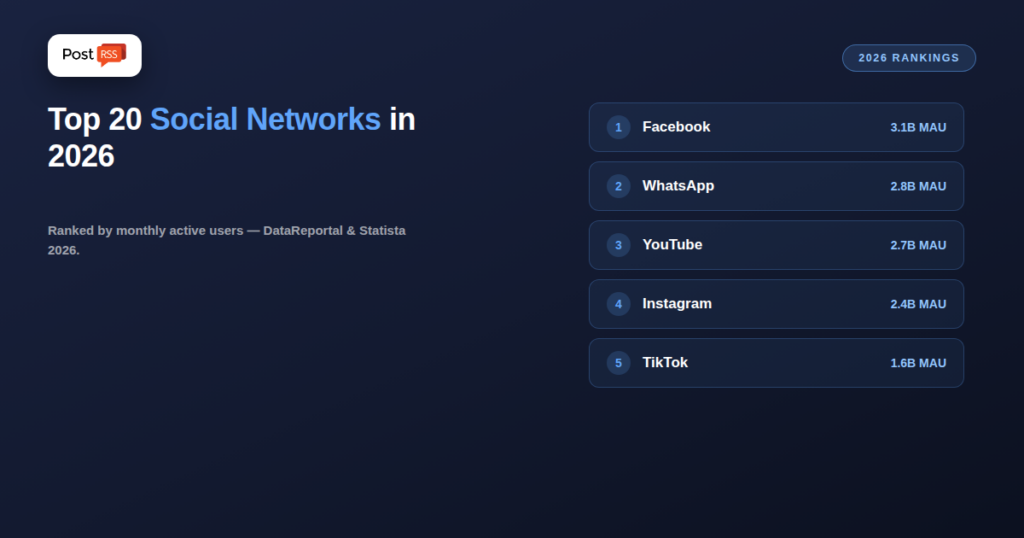
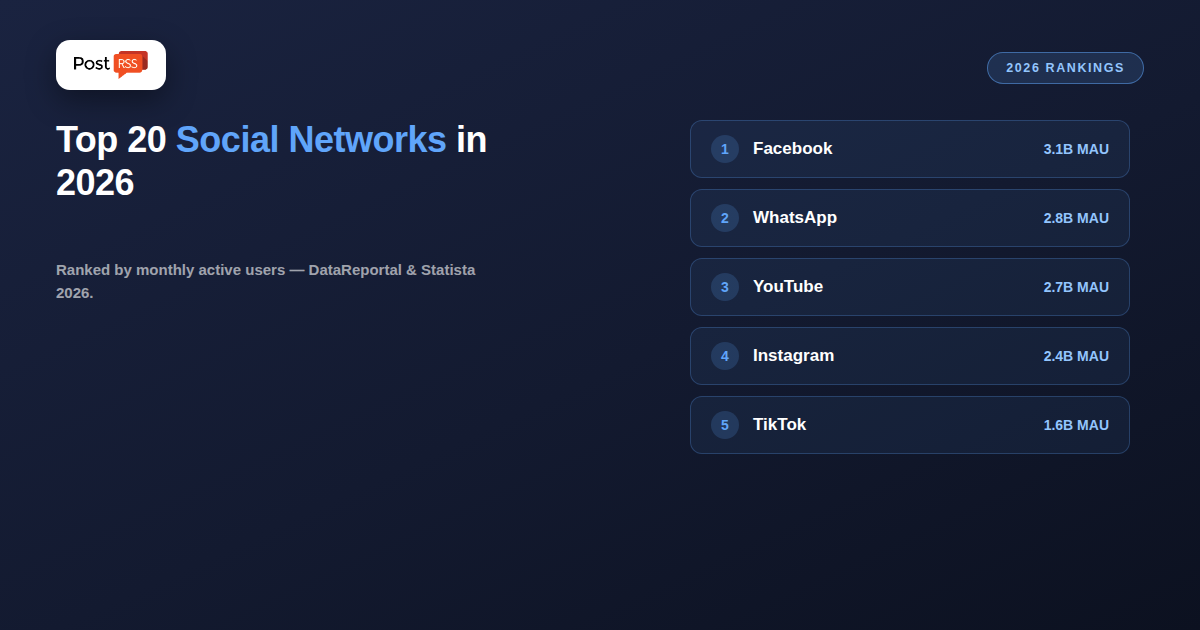
Short answer: Facebook (3.1 billion), WhatsApp, YouTube and Instagram are the only platforms above 2 billion monthly active users in 2026; below that tier the right choice depends on your audience rather than raw size. Of the 20 ranked here, the ones with stable publishing APIs — Facebook Pages, X, LinkedIn, Pinterest, Threads, Bluesky, Mastodon, Telegram and Discord — can be fed automatically from an RSS feed. PostRSS does that for 66 networks in all, free for one Facebook Page.
Ranked by monthly active users (MAU) from public 2026 data (DataReportal’s Digital 2026 Global Overview, Statista, and each platform’s own investor disclosures where available), here are the 20 social networks that actually matter right now — what each one is, how many people use it, and what it’s genuinely good for.
Still the largest social platform on Earth. Skews older in North America and Europe, younger across South Asia and Africa. Organic reach for Pages is weak, but its ad-targeting engine remains one of the most sophisticated available, and it’s still the default for local businesses and community groups.
A messaging app rather than a public feed, but it’s where brands and customers actually talk in Latin America, India, and Southeast Asia. Growth comes through direct contact and WhatsApp Business catalogs, not discovery — there’s no public post to auto-publish to.
Over a billion hours watched daily. Functions almost like a search engine, which makes long-form, evergreen video (tutorials, explainers, deep dives) compound in value for years after upload. Shorts now compete directly with TikTok for short-form discovery.
Visual-first, millennial and Gen Z-heavy. Reels now drive most organic reach; static feed posts have declined. Strong native e-commerce via Shopping makes it a default for lifestyle and visually-driven brands.
Short-form video with unusually generous discovery — a brand-new account can still reach six figures of views on one good post. Skews young but expanding. Weakest fit for slow-moving B2B content.
China’s dominant super-app, combining social, payments, e-commerce, and identity into one platform. Essential if you sell into China; largely irrelevant otherwise, since there’s no meaningful path to auto-posting from outside the country.
Privacy-focused messaging with broadcast Channels, strong in Eastern Europe, Russia, and the Middle East. Channels work like a chronological newsletter with no algorithmic filtering — whatever you post, subscribers see.
Ephemeral messaging and AR filters, concentrated in the under-25 audience. Reach has plateaued rather than grown, but engagement among the users who are there remains high.
Real-time discussion concentrated in tech, finance, journalism, and policy circles — a smaller but higher-value audience than its 2022 peak. Its open-source ranking algorithm makes it unusually predictable to optimize for compared to other major platforms.
Organized into topic-specific subreddits with strong community norms; broadcast-style marketing is actively punished by moderation. Genuinely useful contributions get rewarded, and Reddit threads increasingly rank prominently in Google search results.
Visual discovery with unusually strong purchase intent — users actively plan home, fashion, and food purchases on the platform. Skews female. A poor fit for most service-based or B2B businesses.
Q&A format that rewards patient, expertise-driven answers over quick posts. Answers compound in Google search visibility over years rather than delivering immediate reach, making it a slow-burn thought-leadership play.
The default professional network, and by far the highest-value B2B audience on this list despite a smaller MAU than the consumer giants. Personal profiles substantially outperform company pages for reach on identical content.
Meta’s text-based platform, growing faster than expected by tapping directly into Instagram’s existing social graph. Worth a presence mainly if you’re already active on Instagram.
Live streaming, originally gaming-focused but now broader. Rewards real-time engagement and builds unusually loyal, parasocial audiences — at the cost of being a high time-investment, live-only format most brands can’t sustain.
Community servers, functionally closer to Slack than to a social feed. Rewards consistent presence, moderation, and events rather than one-off broadcast posts — a fit for creator communities and software products with active users.
Microblogging with unusually strong niche and fandom communities. Smaller audience overall, but engagement runs high when content genuinely fits the platform’s creative, indie culture.
Long-form text publishing, best for founder essays and in-depth thought leadership. Distribution depends heavily on which topic publication picks up your piece, and strong articles carry real SEO and Google Discover value.
A decentralized, text-based platform on the open AT Protocol that grew quickly by absorbing part of X’s migrating user base. Popular among journalists and tech-policy audiences; its simpler, mostly-chronological algorithm makes organic growth easier than on the major incumbents.
The smallest platform on this list by user count, running on the decentralized, open-source ActivityPub protocol (the “Fediverse”). Small audience, but unusually high signal in privacy-focused, open-source, and academic communities.
Of the 20 platforms above, the ones with stable public publishing APIs suitable for RSS-based automation include Facebook Pages, X, LinkedIn, Pinterest, Threads, Bluesky, Mastodon, Telegram channels and Discord (via webhooks). PostRSS connects to those and to 66 networks in all, including Tumblr, VKontakte communities, Matrix, Nostr, LINE, WeChat, WordPress, Blogger, Instapaper and a generic webhook; Reddit is on the list but temporarily unavailable, TikTok is live from the Professional plan as a draft you publish, and Instagram is still in testing rather than live on a plan. The rest are either messaging-first with no public feed (WhatsApp, WeChat, Snapchat), or don’t currently offer the kind of open publishing API that reliable third-party automation depends on (YouTube requires video-specific workflows rather than a simple feed-to-post model; Instagram has partial, restricted support). For most sites, the practical approach is auto-posting the platforms with real APIs from your RSS feed, and handling the handful of messaging-first or video-native platforms manually.
Facebook, at roughly 3.1 billion monthly active users — followed closely by WhatsApp, YouTube, and Instagram, all of which sit above 2 billion.
Among text-based platforms, Threads and Bluesky show the strongest growth, largely by absorbing users migrating from X. TikTok also continues adding users steadily in non-US markets.
No — for almost every business, 3 to 5 platforms that genuinely match your audience outperform a thin presence spread across all 20. Pick a primary platform, one complementary secondary, and skip the rest unless a specific one clearly fits your audience.
Facebook, WhatsApp, YouTube, and Instagram remain the four platforms with genuinely mass-scale reach in 2026, each above 2 billion monthly active users. Below that tier, the right platforms depend entirely on your audience, not raw user counts — and for the ones with real publishing APIs, RSS-based automation remains the simplest way to keep all of them updated from a single source without manual, per-platform posting.
What changed in the networks, what broke, and how to fix it before it costs you reach.
Built by Internet Solutions, the team behind PostRSS. Each product saves you time in its own way.
 English
 Lietuviškai
 Deutsch
 Français
 Русский
 Español
 Polski
 Italiano
 Українська
 Čeština
 Português
 日本語
日本語 Latviešu valoda
 Eesti
Eesti Magyar
 Bahasa Indonesia
 Türkçe
 हिन्दी
 Ελληνικά
 العربية
 ไทย
ไทย Tiếng Việt
 Română
 Bahasa Melayu
 বাংলা
বাংলা