Chiropractic and physical therapy practices sit in an unusual spot for marketing: the work is deeply personal and regulated, which makes generic social media advice — post daily, be spontaneous, jump on trends — a poor fit. What actually works for these practices is consistent, educational, trust-building content: injury prevention tips, explanations of common conditions, clinic announcements, and the occasional (de-identified, consent-based) success story. The challenge is rarely coming up with that content, since most practices already write about these topics for their own website; it’s finding the time, week after week, to post it everywhere it needs to go. RSS auto-posting solves that by publishing straight from the clinic’s own website to every connected platform automatically.
Patients researching a new chiropractor or physical therapist behave differently than someone comparing restaurants — they’re often dealing with pain or a specific injury, actively searching for reassurance that a practice knows what it’s doing before ever booking a consultation. A clinic’s blog and social presence function as a kind of extended waiting room: educational posts about back pain, post-surgical recovery timelines, or common sports injuries build exactly the credibility a prospective patient is looking for during that research phase.
Most clinics already maintain a website with a blog for exactly this purpose — SEO-driven articles about conditions and treatments are standard practice in this industry — but that content routinely stops at the website. Connecting the blog’s feed to an RSS automation tool extends every article’s reach onto Facebook and LinkedIn automatically, turning content that was already being written for search visibility into ongoing social presence at no additional writing cost.
Nearly all chiropractic and PT practice websites, whether built on WordPress or a healthcare-specific CMS, generate a feed for their blog by default. Multi-location practices should confirm whether each location has its own feed or shares one central blog, since that determines whether social accounts need to be connected per location or centrally.
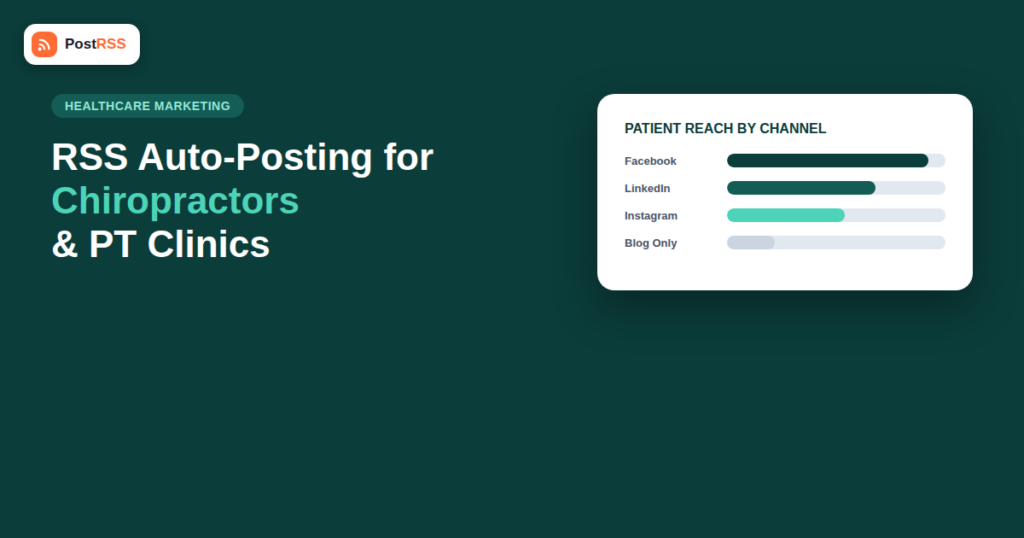
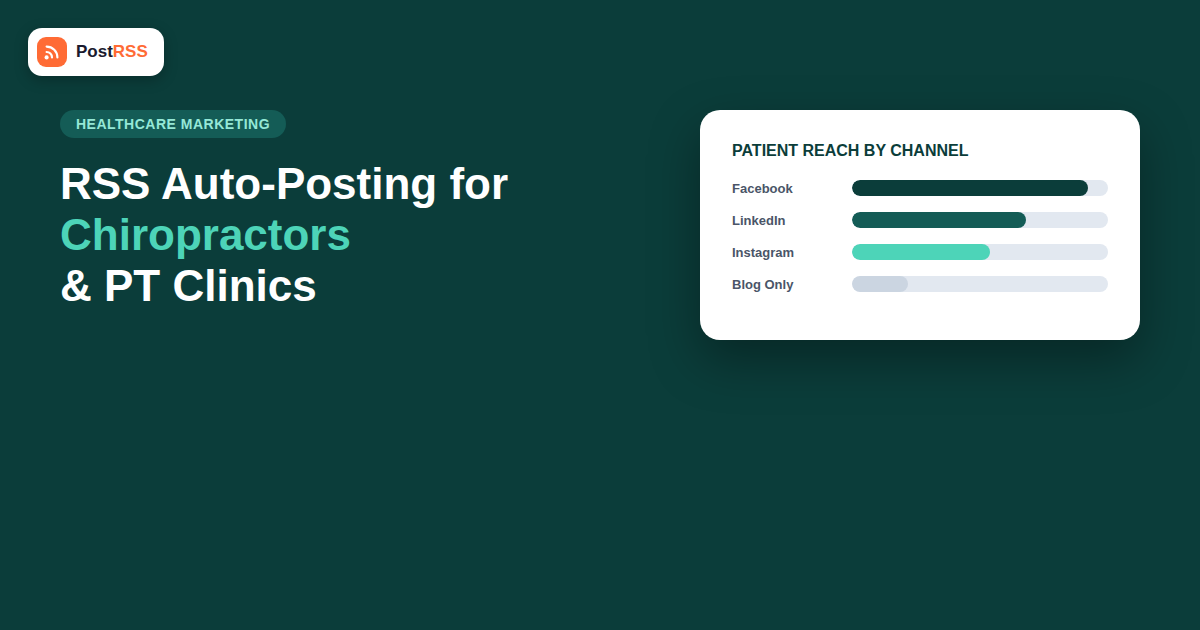
Facebook remains the strongest platform for most chiropractic and PT patient demographics, particularly for reaching an audience that skews somewhat older and still actively uses Facebook for local recommendations. LinkedIn is worth adding if the practice does any B2B work — treating corporate wellness programs, or partnering with local businesses on ergonomics consulting. Instagram can work well specifically for practices that lean into fitness, sports medicine, or a younger athletic patient base.
Healthcare audiences respond better to a steady drip of genuinely useful content than a high-volume posting schedule. One or two educational posts a week, supplemented by timely clinic announcements, tends to outperform daily posting that starts to feel like noise.
| Manual Posting | RSS Auto-Posting |
|---|---|
| Front-desk staff or the practitioner posts between patients, inconsistently | Every published blog post or announcement goes out automatically |
| SEO-focused blog content rarely makes it to social media at all | Blog content automatically extends to Facebook, LinkedIn, and beyond |
| Multi-location practices post unevenly across locations | A single feed connection can cover every location consistently |
| No clear record of what was posted, when, or where | A dashboard tracks exactly what went out and to which platform |
Healthcare marketing carries real regulatory considerations that a landscaping company or coffee shop doesn’t have to think about. Any content involving specific patient stories requires documented consent and careful de-identification; general educational content about conditions and treatments doesn’t require the same level of scrutiny but should still avoid making specific medical claims that could be read as guarantees of outcomes. This is worth building into the clinic’s content review process before publishing — automation distributes whatever gets published quickly and to every connected platform at once, which makes it more important, not less, that what goes on the website has already cleared whatever internal compliance review the practice normally applies.
Because RSS auto-posting distributes from the website outward, keeping compliance review focused on the website’s publishing step — rather than trying to separately review each social platform’s version of the same post — is both simpler and more reliable, since there’s only one place content needs to be checked before it goes anywhere.
| Content Type | Frequency | Best Platforms |
|---|---|---|
| Educational blog post on a condition or treatment | 2-4x per month | Facebook, LinkedIn |
| Injury prevention / seasonal wellness tip | 1-2x per month | Facebook, Instagram |
| Clinic announcement (new provider, hours, location) | As needed | Facebook, LinkedIn |
| Community involvement post | 1x per month or as events occur | Facebook, Instagram |
The most frequent mistake is writing blog content purely for search engines — dense, technical, keyword-heavy articles — without considering how it reads once auto-posted as a social caption. A strong opening sentence that works as a standalone hook matters more for social distribution than it does for a page a search engine is simply indexing, so it’s worth writing the first sentence or two of any blog post with both audiences in mind.
A second common issue is silence between blog posts. Practices that publish educational content only quarterly will see that same sparse cadence reflected on social media, since automation distributes what exists rather than generating new content. Supplementing occasional long-form blog posts with shorter, more frequent updates — a quick seasonal tip, a clinic announcement — keeps the feed active between the bigger pieces.
The most common technical issue for clinic websites is a blog feed that outputs only a truncated excerpt instead of a full, well-formed summary — some healthcare CMS platforms default to a generic “Read more about [condition]” excerpt rather than a genuinely descriptive first sentence, which produces a flat, low-engagement auto-posted caption. Writing a clear, specific opening sentence for every blog post, rather than relying on an auto-generated excerpt, fixes this at the source and improves both the social post and the page’s own search snippet at the same time.
Multi-provider practices sometimes run into a feed-attribution issue, where posts written by different practitioners for different specialties (spinal care, sports rehab, pediatric PT) all get distributed identically to every connected platform regardless of relevance. Most auto-posting tools support filtering by category or tag, which is worth setting up so that, for example, pediatric-focused content can route to a Facebook parenting-adjacent audience segment while sports injury content goes to an Instagram account with a more athletic following, rather than blending everything into one undifferentiated stream.
It’s also worth periodically checking that featured images are actually attached to blog posts, since some clinic CMS templates don’t require one, and a post with no image tends to auto-post as a bare link with far lower visibility than one with a relevant photo or simple graphic attached. A quick RSS troubleshooting pass — confirming feed items are outputting titles, excerpts, and images correctly — once a quarter catches most of these issues before they quietly reduce reach for months.
For a clinic, the metric that matters is new patient bookings traceable back to a specific piece of content, not raw engagement. Tagging auto-posted links with UTM parameters and reviewing, monthly, which blog topics correlate with an uptick in contact-form submissions or booking-page visits gives a much clearer signal than likes or shares — a post about sciatica that drives five booking inquiries is more valuable to the practice than a post with fifty likes and no follow-through.
Because automation removes the labor of manually cross-posting to every platform, the time that would have gone into that repetitive task can be redirected toward writing genuinely better source content — more specific, more locally relevant, more directly answering the questions prospective patients are actually searching for — which compounds in value across every platform the content reaches automatically.
The automation itself is simply a distribution tool — it doesn’t create content or make claims on its own. Compliance depends entirely on what’s published to the website in the first place, which is why review should happen at that stage, before anything is written, rather than trying to audit each social platform separately afterward.
Yes, as long as proper documented consent has been obtained and any identifying details are handled according to the practice’s existing policy — the same standard that would apply to publishing a testimonial anywhere else. The automation doesn’t change what’s appropriate to publish; it only affects how quickly and widely it’s distributed once it’s approved.
Facebook tends to perform well across most locations since patients often search there for local providers, and it supports separate location pages that can each be connected individually if the practice wants distinct social presences per location rather than one shared account.
There’s no strict requirement, but a steady cadence of even one or two posts a month, supplemented by shorter updates, tends to produce a more consistent social presence than sporadic bursts of several posts followed by long gaps.
Yes — this is arguably where automation helps most, since a solo practitioner has the least spare time to manually post to multiple platforms between seeing patients all day. Writing one blog post and letting automation handle distribution is far less time-consuming than manually posting to Facebook, LinkedIn, and Instagram separately, every single time something new is published.
Most practices apply at least a light internal review to any content making claims about conditions or treatments, even general educational material, simply as good practice — not necessarily because every sentence carries regulatory risk, but because it’s the same review a practice would want in place regardless of whether the content is being automated to social media or not, or simply published on the website for search visibility alone.
Yes — writing seasonal content ahead of time, like fall-prevention tips published in early winter, and scheduling the underlying blog post for that date is a common approach that still benefits from automatic distribution once it goes live, without requiring anyone to remember to manually post it on the day it’s meant to appear.
Healthcare marketing regulations do vary somewhat by state and by licensing board, particularly around testimonials and specific claims, so a practice’s compliance review should reflect whatever standard already applies to its own marketing, regardless of how the content is eventually distributed. The automation layer doesn’t change what’s appropriate to publish in a given state — it only affects how far and how quickly approved content travels once it’s live on the site.
Chiropractic and physical therapy practices already produce the kind of educational, trust-building content that works well on social media — it just rarely makes it past the practice’s own website. Connecting the clinic’s blog feed to RSS auto-posting extends that existing content automatically to Facebook, LinkedIn, and beyond, turning search-focused blog writing into consistent social presence without adding a new task to a schedule that’s already full of patients. The content quality bar stays exactly where the practice’s compliance review already sets it — automation only affects how far that approved content travels once it’s published, not what gets approved in the first place.