For local businesses, Nextdoor occupies a similar space to Google Business Profile — a hyperlocal platform where showing up matters as much as, or more than, broader social reach. So it’s a reasonable question: can you connect an RSS feed and have new content automatically appear as Nextdoor posts, the way it can on Facebook or LinkedIn? Here, the honest answer is more restrictive than almost any other platform covered in this series, for a different reason than the video-only or verification-gated platforms discussed elsewhere.
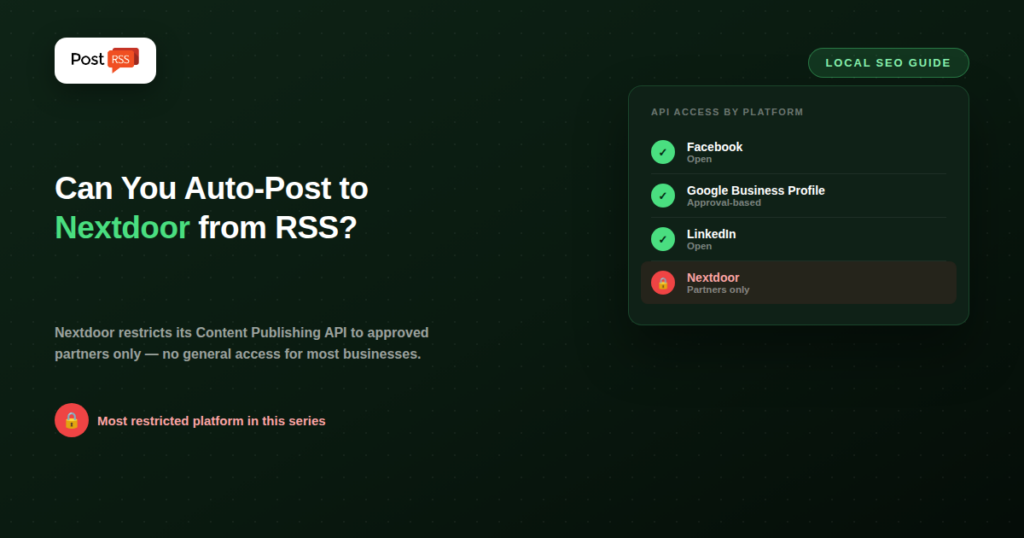
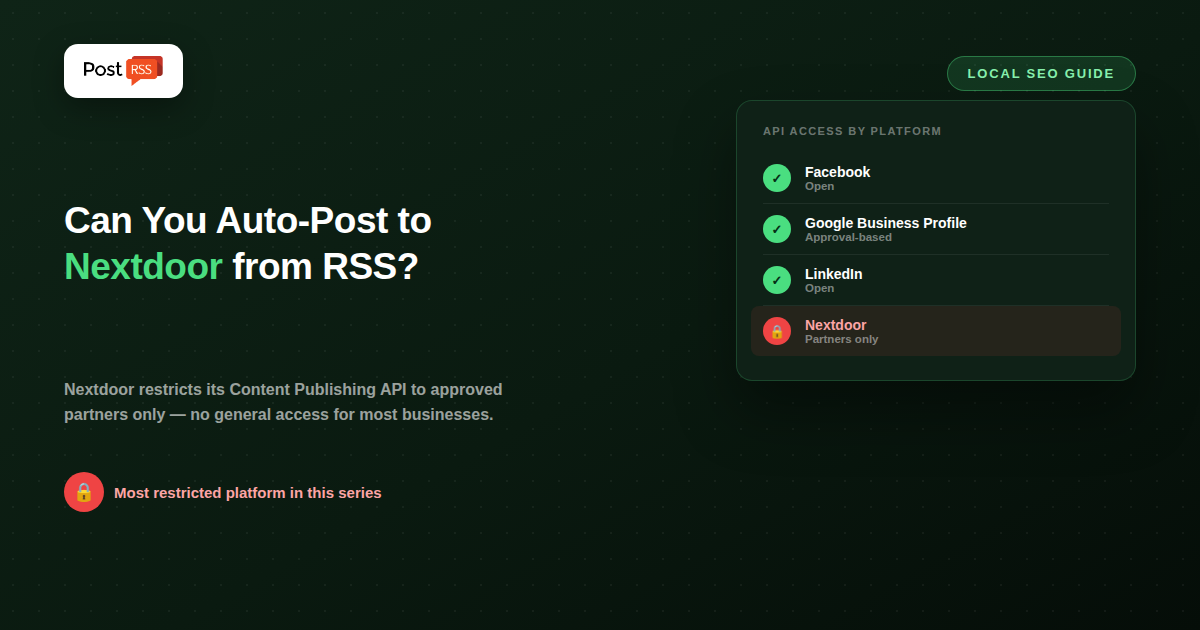
Nextdoor does maintain developer APIs — an Advertise API, a Content Publishing API that lets approved apps post, edit, and comment on behalf of users, and a Public Agency Feed API for government and public-safety organizations. The critical detail is access: unlike Facebook, LinkedIn, or even the more gated platforms like Threads, Nextdoor’s Content Publishing API isn’t something any developer or business can apply for and reasonably expect to receive. Access is application-gated and limited to specific approved partner categories — verified local businesses and organizations in some cases, but broadly reserved for partners Nextdoor has specifically vetted, not a general-purpose developer program open to any RSS automation tool that wants to add support.
Checking the current landscape of RSS-to-social automation tools — dlvr.it, Buffer, Hootsuite, and the dozens of similar platforms covered elsewhere in comparisons on this site — none currently document Nextdoor as a supported destination. This isn’t a coincidence or an oversight on the part of any individual tool; it reflects Nextdoor’s deliberately narrow API access policy. Where Instagram and TikTok are technically restrictive (content format, account type, review process) but ultimately reachable by any developer willing to do the work, Nextdoor’s restriction operates at a different layer entirely: the access itself isn’t generally available, regardless of how much engineering effort you’re willing to invest.
If you’re a large local media organization, a public agency, or a business with a scale and relationship that fits Nextdoor’s partner categories, applying directly through developer.nextdoor.com and contacting Nextdoor’s developer support is the only real path to programmatic posting access. This is not a realistic option for a typical small business or an independent RSS automation tool.
For the overwhelming majority of local businesses, manual posting through Nextdoor’s own business page tools remains the only available option today. Nextdoor’s business posting interface is designed for exactly this — direct, manual updates, offers, and event posts from a verified local business page.
Given the access restriction, the more productive strategy for most local businesses is automating the platforms that do support RSS-driven posting — Facebook, Google Business Profile (via existing third-party tools), X, and others covered elsewhere in this series — and treating Nextdoor as a manual, intentional channel specifically because automation isn’t currently a realistic option there.
| Requirement | Nextdoor | Google Business Profile | |
|---|---|---|---|
| General developer access available | No | Yes, with approval | Yes, with standard review |
| Third-party automation tools available | None found | Several (Zapier, Make, Circleboom, dlvr.it) | Many, including PostRSS |
| Realistic path for a typical small business | Manual posting only | Automated via existing tool | Automated via existing tool |
This table makes the practical reality clear: of the three major local-business-relevant platforms, Nextdoor is the outlier where automation simply isn’t a live option for almost anyone, regardless of budget or technical skill.
Given that manual posting is the realistic path for the foreseeable future, it’s worth being selective about what actually goes there rather than trying to replicate a full automated feed by hand. Content that tends to perform well on Nextdoor specifically includes local event announcements, neighborhood-relevant offers or promotions, hiring announcements for local roles, and updates that speak directly to the surrounding community rather than general company news. Since you’re not automating this channel, treating it as a lower-frequency, more curated posting destination — rather than trying to manually mirror everything your RSS feed publishes — is usually a more sustainable approach than attempting full parity with your automated channels.
Nextdoor’s restricted access affects some business categories more than others. Local service businesses — contractors, restaurants, salons, medical practices, real estate agents — often see Nextdoor as one of their highest-value channels precisely because its audience is hyperlocal and high-intent, which makes the lack of automation support a more meaningful gap for them than it would be for, say, a national e-commerce brand where Nextdoor was never a priority channel to begin with. If your business falls into that first category, budgeting dedicated (if infrequent) manual time for Nextdoor is a more deliberate strategic choice than it might be for other business types covered elsewhere in this series.
PostRSS doesn’t support Nextdoor, and given the current state of Nextdoor’s partner-only API access, that’s unlikely to change without Nextdoor itself opening broader developer access — a decision entirely outside any individual tool’s control. What PostRSS does support today — 66 networks, including Facebook, X, LinkedIn, Pinterest, Threads, Bluesky, Mastodon, Telegram, Discord, Tumblr, VKontakte, Matrix, Webhook and Instapaper — covers the platforms where automation is actually achievable, letting local businesses focus their manual effort specifically on the one channel (Nextdoor) that currently requires it, rather than spreading manual work across every platform.
The manual-posting reality is manageable for a single-location business — one Nextdoor page, checked and updated occasionally. It becomes a materially bigger operational problem for franchises and multi-location brands, where the same manual posting task multiplies across every location’s individual Nextdoor neighborhood page. Unlike Facebook or Google Business Profile, where a franchise can at least centralize automation through an approved tool even at scale, Nextdoor offers no equivalent path today — each location’s posting genuinely has to be done by a human, one page at a time, unless the franchise itself is large enough to qualify for and pursue Nextdoor’s direct partner program.
For franchise operators evaluating where to invest local marketing effort, this is worth factoring into realistic planning: Nextdoor may be worth the manual overhead for locations with strong neighborhood engagement, while lower-priority locations might reasonably skip it rather than committing to an ongoing manual task that doesn’t scale the way automated channels do.
Platform API access policies do change over time — this entire series has documented examples of both tightening (TikTok’s audit requirement, Threads’ verification process) and loosening (Bluesky’s genuinely open model). Nextdoor’s current partner-only stance isn’t necessarily permanent, and it’s reasonable to periodically check developer.nextdoor.com or watch for announcements if Nextdoor automation matters enough to your business to track. For now, though, planning around continued manual posting is the realistic, safe assumption rather than betting on a policy change that hasn’t been announced.
Not a legitimate one. Nextdoor’s terms of service govern how its platform can be accessed, and unofficial workarounds around API restrictions risk violating those terms and jeopardizing your business page. The only sanctioned path to automated posting is Nextdoor’s own partner approval process.
Nextdoor’s platform is built around verified local identity and neighborhood-level trust, which likely factors into a more conservative approach to third-party access compared to platforms built around broader public content sharing. This is a platform policy decision, not a technical limitation.
Based on current documentation from major RSS-to-social and local-business marketing tools, no mainstream automation platform currently lists Nextdoor as a supported destination. If a specific tool claims otherwise, verify directly with Nextdoor whether that integration is officially sanctioned before relying on it.
That depends entirely on how much of your local audience is active there — Nextdoor remains a meaningful platform for many local businesses regardless of automation availability. The practical takeaway isn’t to skip Nextdoor, it’s to budget manual time for it specifically, while automating everywhere that supports it.
Nextdoor doesn’t publish a clear, self-service eligibility checklist — the realistic path is contacting Nextdoor’s developer support directly through developer.nextdoor.com and describing your use case, since approval is evaluated case by case within their defined partner categories rather than against a fixed, publicly documented bar.
Nextdoor is the most access-restricted platform in this series — not because of a content format mismatch or a verification process any developer can eventually clear, but because programmatic posting access is reserved for a narrow set of approved partners by design. For nearly every local business, that means Nextdoor stays a manual channel for the foreseeable future. The practical strategy is to automate the platforms that support it — PostRSS covers 66 networks, free for one Facebook Page and $20/month on Professional Plus for the full lineup — and reserve manual effort specifically for the one channel where automation genuinely isn’t available yet.
What changed in the networks, what broke, and how to fix it before it costs you reach.
Built by Internet Solutions, the team behind PostRSS. Each product saves you time in its own way.
 English
 Lietuviškai
 Deutsch
 Français
 Русский
 Español
 Polski
 Italiano
 Українська
 Čeština
 Português
 日本語
日本語 Latviešu valoda
 Eesti
Eesti Magyar
 Bahasa Indonesia
 Türkçe
 हिन्दी
 Ελληνικά
 العربية
 ไทย
ไทย Tiếng Việt
 Română
 Bahasa Melayu
 বাংলা
বাংলা