Updated data: (2026-08-20).
This post originally announced Google+ integration back in 2014. Google+ never became the platform it was expected to be, and Google officially discontinued the consumer version on April 2, 2019. We’re keeping this page updated with what actually matters today: how to keep your content visible now that Google+ is gone.
Back in 2014, Google+ looked like the next major frontier for content distribution. Brands and publishers were racing to claim their handles, businesses were building “Google+ pages” the same way they’d built Facebook pages a few years earlier, and marketers were told that integrating with Google’s social network would soon be essential for visibility. That future never fully arrived. Google+ struggled to gain the traction of Facebook or Twitter, and in April 2019, Google officially shut the consumer version down for good.
It’s a useful reminder for anyone doing content marketing today: platforms rise and fall, but the underlying problem — getting your content in front of the right audience, reliably and without manual effort — never goes away. If anything, that problem has gotten harder. The number of channels worth publishing to has multiplied, algorithms change constantly, and audiences now expect a steady drumbeat of content rather than occasional updates.
This is exactly the gap that RSS-based automation tools like PostRSS are built to close. Instead of betting on a single platform’s future, the smarter long-term strategy is building a distribution system that can plug into whichever channels matter today — and adapt as the landscape shifts.
Every publisher, blogger, and online business faces the same recurring task: you write something, and then you have to tell people it exists. That second part — the distribution — is where most content marketing effort quietly leaks away. Manually copying a new blog post’s title, writing a caption, resizing an image, and pasting the link into five different platforms is repetitive, time-consuming, and easy to let slide when things get busy.
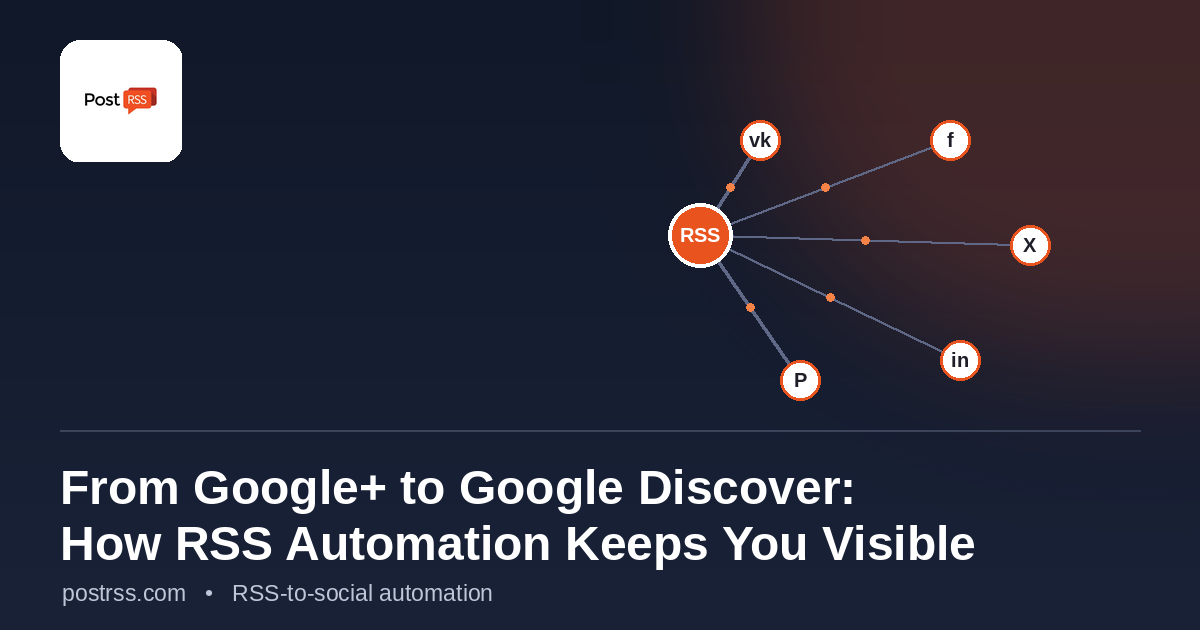
RSS feed automation solves this by treating your website’s RSS feed as a single source of truth. The moment you publish a new post, an automation tool reads the feed, formats a platform-appropriate update, and pushes it out — automatically, consistently, and without you touching a dozen different apps.
The benefit isn’t just saved time. Consistency itself is a ranking and engagement signal. Search engines and social algorithms both tend to reward accounts and sites that publish and share on a predictable cadence. A content calendar that depends entirely on a person remembering to hit “share” is a content calendar that will eventually have gaps. Automation removes that risk.
Google+ may be gone, but Google itself is more central to content discovery than ever — just through different mechanisms. Two are particularly relevant for anyone thinking about distribution strategy in 2026:
1. Google Discover. This is the personalized content feed that appears on the Google app and mobile homepage for billions of users, surfacing articles based on a reader’s interests rather than a specific search query. Discover rewards sites that publish fresh, well-structured, engaging content regularly — which lines up neatly with an automated publishing cadence. Sites that update often and get shared and clicked frequently tend to perform better in Discover over time.
2. Search visibility through backlinks and social signals. While social shares aren’t a direct Google ranking factor in the way they were once assumed to be, distribution still matters indirectly. Content that gets seen gets linked to, cited, and talked about — and that activity is what actually drives search authority. A post that sits unseen on your blog with zero distribution has little chance of earning the links and mentions that improve its search performance.
In other words, automated distribution doesn’t replace SEO — it feeds it. Getting a new article in front of more eyes, faster, across more channels, increases the odds it gets picked up, shared, and linked to elsewhere.
A decade ago, “coming soon” platform integrations were often manual, clunky, or limited to a single network. Today, a well-built RSS automation platform like PostRSS can distribute a single new post across an entire portfolio of channels simultaneously:
The core idea across all of these integrations is the same: your RSS feed is the trigger, and the platform handles the formatting and posting logic for each destination. You publish once; your audience finds it everywhere.
Given how quickly platforms can change — or disappear entirely, as Google+ did — it’s worth building a distribution strategy that isn’t overly dependent on any single channel. A few practical principles:
Rather than putting all your distribution effort into one network, spread it across a handful of platforms where your specific audience actually spends time. A B2B software company might prioritize LinkedIn and X, while a lifestyle or recipe blog might lean heavily on Pinterest and Facebook.
Automation is best used for the mechanical work — formatting, timing, and posting. The strategic decisions (which channels to prioritize, what your posting cadence should be, how to phrase your evergreen content differently for LinkedIn versus X) are worth thinking through deliberately, then letting automation execute consistently.
Since your feed is the single point that automation tools read from, it’s worth double-checking that it’s clean, complete, and includes the elements (featured images, full excerpts, categories) that downstream platforms need to generate good-looking posts.
Automation removes manual grunt work, but it shouldn’t remove oversight. Periodically reviewing which platforms are driving engagement — and adjusting your channel mix accordingly — keeps your distribution strategy aligned with where your actual audience is, not where it used to be.
There’s a reason we’re revisiting this topic more than a decade after Google+ first launched: the pattern repeats. New platforms emerge with a lot of hype, some earn a permanent place in the content ecosystem, and others quietly fade. Betting your entire distribution strategy on any single platform — however dominant it seems at the time — carries real risk.
The more resilient approach is building a distribution engine centered on your own content (your RSS feed) rather than any one destination. When a platform gains momentum, you plug it in. When a platform declines, you can deprioritize it without rebuilding your whole workflow. This is precisely the architecture behind tools like PostRSS: the feed stays constant, and the list of destinations can evolve.
If you’re publishing content regularly and still manually sharing it to social platforms one by one, that’s the exact gap automated RSS distribution is designed to close. The setup is straightforward:
Google+ promised to be one more place your content needed to show up. It didn’t work out that way, but the underlying need it hinted at — being visible across the platforms where your audience actually spends their time — is more relevant today than it was in 2014. The tools have just gotten a lot better at solving it.
Our Facebook auto poster page handles the Facebook configuration end to end.
Google officially discontinued the consumer version of Google+ on April 2, 2019. This page originally announced a Google+ integration in 2014 and is now kept up to date with what matters for content distribution today.
Yes. PostRSS can post to Blogger and to Google Chat spaces. Google Business Profile is built and currently being tested while it waits for Google’s approval.
Not directly. Discover surfaces fresh, well-structured content, and automated distribution helps your new articles get seen, shared and linked sooner, which supports your visibility indirectly.
Treat your RSS feed as the single source and connect it to several destinations. With PostRSS one feed can post to many targets, so you can add a rising platform or drop a declining one without rebuilding your workflow.
What changed in the networks, what broke, and how to fix it before it costs you reach.
Built by Internet Solutions, the team behind PostRSS. Each product saves you time in its own way.
 English
 Lietuviškai
 Deutsch
 Français
 Русский
 Español
 Polski
 Italiano
 Українська
 Čeština
 Português
 日本語
日本語 Latviešu valoda
 Eesti
Eesti Magyar
 Bahasa Indonesia
 Türkçe
 हिन्दी
 Ελληνικά
 العربية
 ไทย
ไทย Tiếng Việt
 Română
 Bahasa Melayu
 বাংলা
বাংলা
