Tumblr occupies an odd spot in the “can I automate this platform” conversation: it’s not gated behind Meta-style business verification, but it’s also not as instantly open as Bluesky’s app-password model. It sits in the middle — a self-serve developer application, then a straightforward API that was, for years, one of the more RSS-friendly platforms around.
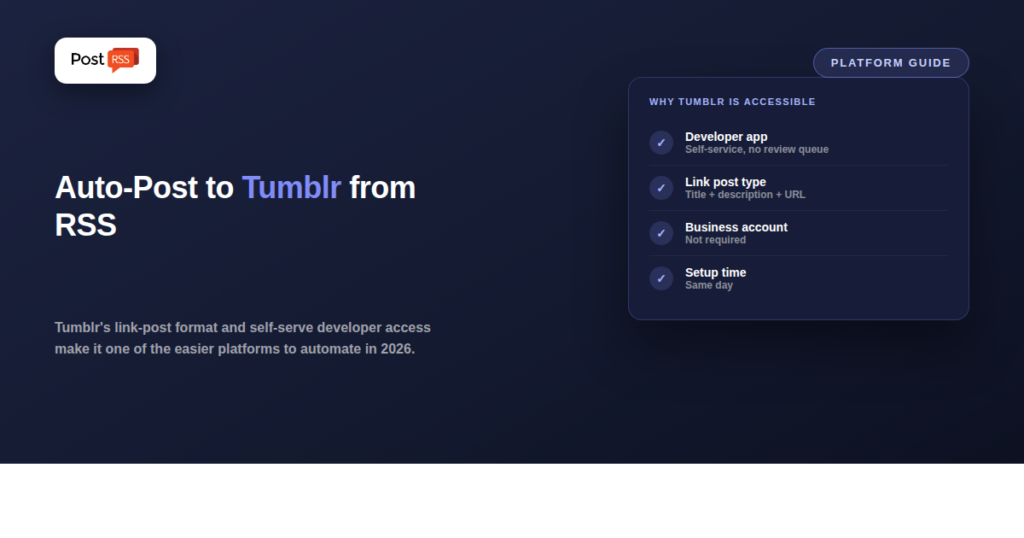
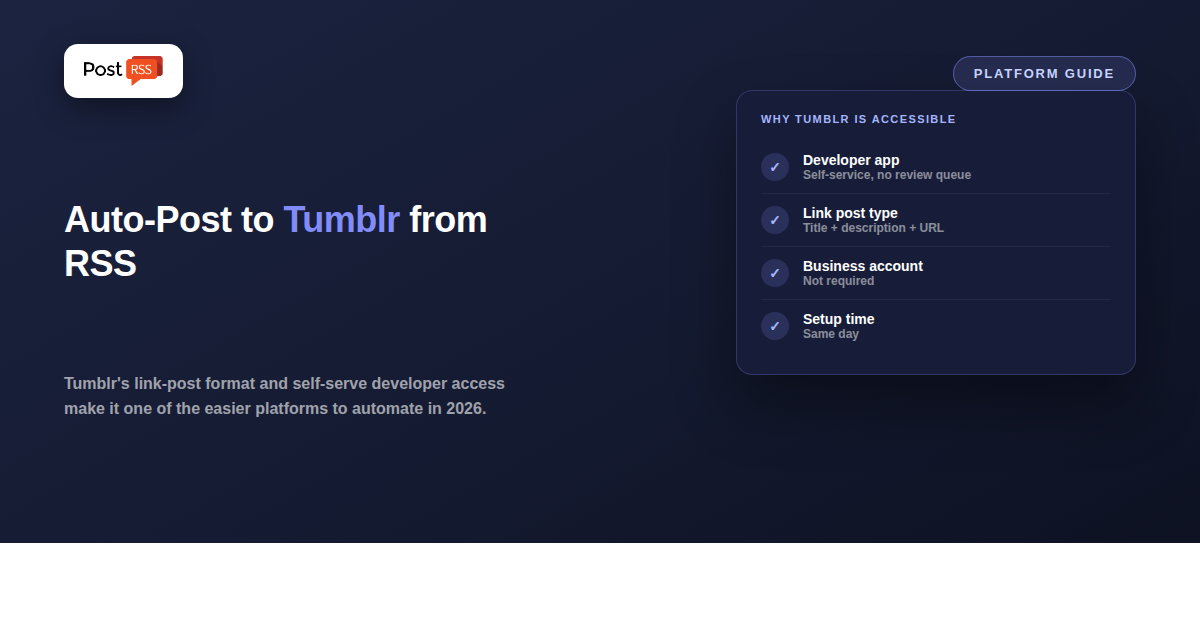
Posting to Tumblr programmatically requires registering an application at Tumblr’s developer portal to get an OAuth consumer key and secret — a self-service form, not a business-verification review queue. Once that’s done, the API supports several post types: text, photo, link, quote, and chat. The “link” post type — a URL, a title, and a description — maps almost exactly onto what an RSS feed item already contains, which is the same reason link-post-friendly platforms like Facebook and X are easy to automate.
A handful of tools already support this route. IFTTT has a long-standing “new RSS feed item posts to Tumblr” applet, one of its oldest and most-used RSS integrations. Zapier supports Tumblr as an action step, so a “new item in RSS feed” trigger can create a Tumblr post automatically. dlvr.it has historically listed Tumblr as a supported destination for RSS-sourced auto-posting as well. None of these require anything close to the weeks-long review process that gates Instagram or TikTok.
| Requirement | Tumblr | Bluesky | |
|---|---|---|---|
| Business/Creator account required | No | No | Yes |
| Access method | Self-service developer app (OAuth) | App passwords, no app registration | Standard app review |
| Native link + title + description post type | Yes (Link post) | Yes (text + auto link card) | No |
| Time to first automated post | Same day, once app is registered | Minutes | Same-day, once account type is set |
PostRSS doesn’t currently support Tumblr as a destination — its platform list today covers Facebook, X, LinkedIn, Pinterest, and VKontakte. Tumblr isn’t blocked by anything structural the way Instagram or TikTok’s video-only formats are; it’s simply not yet on the supported list. If Tumblr is a priority destination right now, IFTTT or Zapier already cover it directly. If your distribution priorities line up with PostRSS’s current five platforms, the automation works the same way everywhere else in this series — a $5/month plan, one feed URL, no manual posting.
Tumblr’s overall reach has shrunk since its mid-2010s peak, but it retains a genuinely engaged niche audience — fandom communities, art and design blogs, and a resurgence of interest tied to broader platform migration away from algorithm-heavy feeds toward chronological, tag-browsable ones. If your content already fits that kind of audience (visual, tag-driven, community-specific), the low setup cost of Tumblr automation makes it worth testing even without a large existing following there.
No — those tools already maintain their own registered Tumblr apps. You only connect your Tumblr account to the tool via a standard login; the developer-app registration step is only necessary if you’re building a custom integration yourself.
Most RSS-to-Tumblr tools use the “link” post type, which pairs a title and description with the source URL — functionally similar to how a link preview card behaves on Facebook or X.
Some tools support pulling a feed item’s featured image into a Tumblr photo post, though support varies by tool; a link post with title, description, and URL is the more universally supported mapping.
PostRSS’s current platform list is Facebook, X, LinkedIn, Pinterest, and VKontakte — there’s no public timeline for additional platforms, but nothing about Tumblr’s API presents a structural barrier the way Meta’s business-verification requirements do for Instagram or TikTok.
The underlying mechanism is comparable — a feed poll triggers a link-post creation via API — but fewer general-purpose automation tools actively maintain Tumblr integrations compared to the largest platforms, so it’s worth testing your specific tool’s Tumblr connection before relying on it for anything time-sensitive.
Tumblr’s link-post format and self-service developer access make it a reasonably low-friction platform to automate from an RSS feed — closer to Bluesky’s openness than to Meta’s verification gauntlet, even if the setup isn’t quite as instant. IFTTT and Zapier both support it directly today. PostRSS doesn’t yet, but like Bluesky and Mastodon elsewhere in this series, that’s a matter of platform-list scope rather than a technical wall.