Updated: August 24, 2026
Financial advisors and insurance agents operate under a constraint most social media advice ignores entirely: every public post is potentially subject to review, retention, and regulatory scrutiny. FINRA, SEC, and state insurance regulators all expect firms to supervise what representatives post publicly, which means “just post more often” — the standard growth advice for every other industry — runs headlong into compliance requirements that slow most advisors down to posting rarely, or not at all. RSS-based automation offers a way to stay consistent without turning every post into a manual approval bottleneck, provided it’s built around your existing compliance workflow rather than around it.
A retail brand can post whatever it wants the moment inspiration strikes. A registered investment advisor generally cannot: content that could be construed as investment advice, performance claims, or testimonials is subject to review requirements that vary by firm and regulator, and many firms require every public post to be pre-approved and archived before it goes live. That review step is exactly what makes manual social media unsustainable for most advisory practices — by the time a post clears compliance, the moment has often passed, and the advisor has moved on to other work instead of actually publishing it.
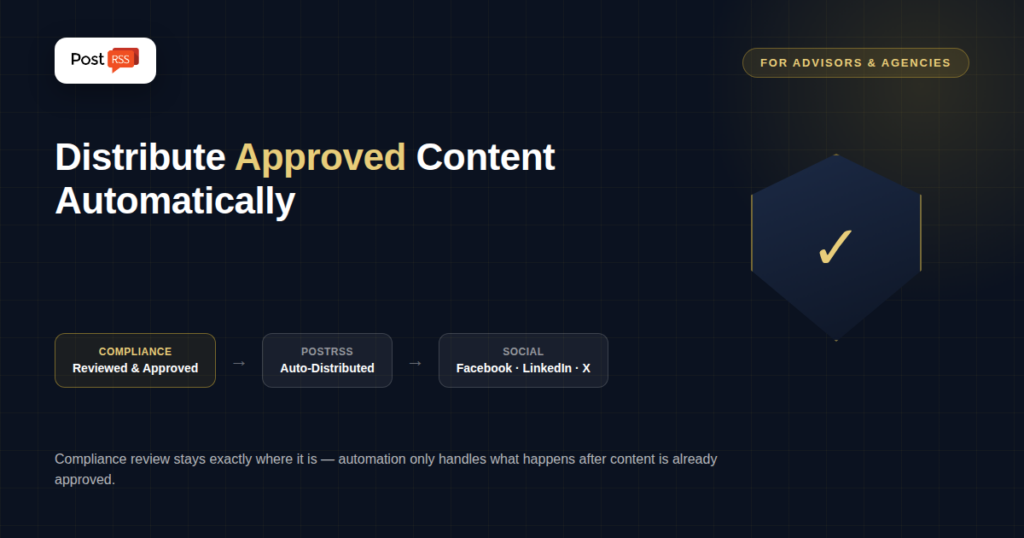
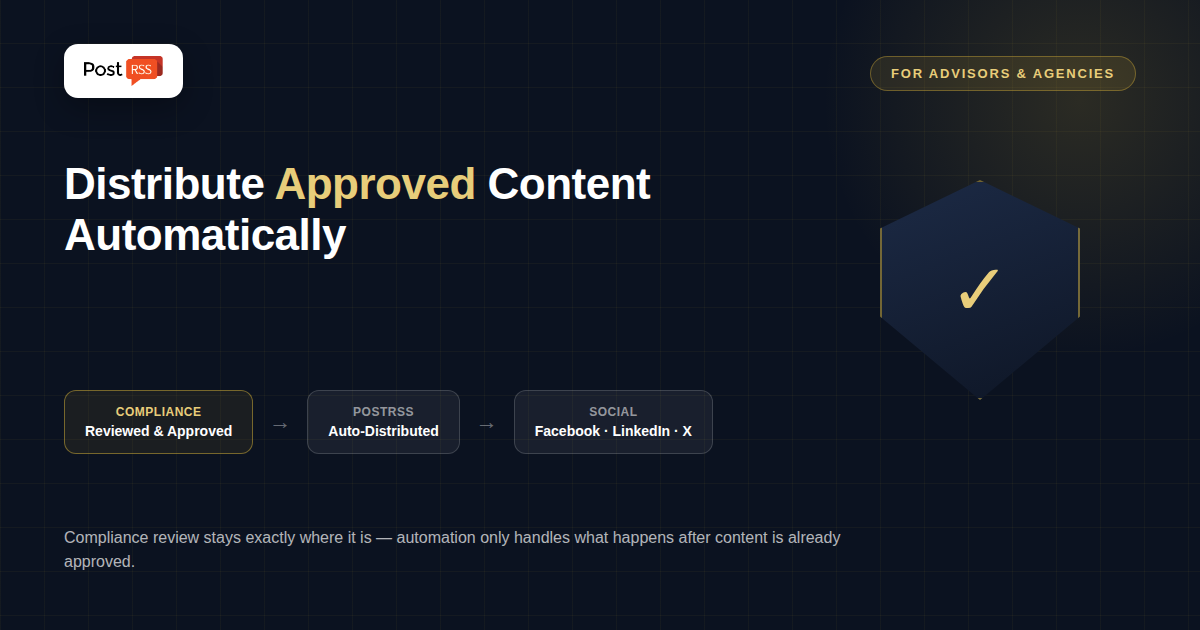
The key insight for regulated industries is that RSS automation doesn’t bypass compliance review — it automates what happens after content is already approved. The workflow that works well: content (a market commentary post, an educational article, a firm announcement) goes through the firm’s existing compliance review and gets published to an approved blog or content platform first. Once that content exists in its approved, published form, an RSS feed of that approved content connects to PostRSS, which then automatically distributes it to Facebook, X, LinkedIn, and Pinterest without anyone needing to manually copy and paste the same approved content to four different platforms. The compliance gate stays exactly where it already is; automation only removes the repetitive distribution work that happens after approval.
RSS automation does not replace a compliance review process, and it should never be configured to publish anything that hasn’t already cleared your firm’s existing approval workflow. It’s not a way to post spontaneous market commentary in real time, and it doesn’t generate content or make judgment calls about what’s appropriate to say publicly — a human, and your compliance process, still decide what gets written and approved. What it removes is the purely mechanical, repetitive step of manually posting already-approved content to every platform your firm maintains, one at a time, which is where most of the wasted time in a compliant social workflow actually sits.
Larger advisory practices and insurance agencies with multiple advisors or branch offices face a scaling version of the same problem: if every advisor manually posts their own content to their own accounts, both the compliance review burden and the inconsistency risk multiply with headcount. A firm-level RSS feed of approved content, connected to each advisor’s or office’s individual social accounts through the same automation, lets the firm maintain one compliance-reviewed content stream while still giving each advisor or location their own social presence — without needing a marketing coordinator to manually cross-post to a dozen individual accounts every week.
LinkedIn typically carries the most weight for financial advisors and B2B-leaning insurance agents, since it’s where prospective clients and referral partners are most likely to engage with professional, educational content. Facebook remains important for advisors and agents serving a local or retail client base, particularly for insurance agencies with a strong community presence. X suits firms that want to share timely market commentary once it’s approved, and Pinterest is a lower-priority but occasionally useful channel for firms publishing evergreen educational content like retirement-planning checklists or infographics that benefit from Pinterest’s search-driven, long-lifespan traffic.
One question compliance officers reasonably ask before approving any automation tool is what happens to the audit trail. Because PostRSS distributes content that already exists in an approved, published form, the recordkeeping story stays simple: your firm’s content management system or archiving tool already captures the approved post at the moment it’s published to your site, and that’s the same content that gets distributed — nothing new is generated or altered in transit. Some firms additionally archive the social posts themselves through a dedicated social media archiving tool required for regulatory retention; that requirement doesn’t change with automation, since the posted content is identical to what was already approved and archived at the source.
A common compliance tension is balancing a firm’s need for consistent, reviewed messaging against individual advisors’ desire to build their own personal brand and referral network. RSS automation handles this by letting the structure mirror however your firm already separates approval authority: if compliance reviews content centrally and every advisor shares the same approved stream, one feed connected to every account keeps everything uniform. If your firm allows advisors more latitude to publish their own approved content (common at larger RIAs and independent insurance agencies), each advisor can maintain a separate approved content source and a separate automation connection, so personal brand-building doesn’t require bypassing the firm’s review process to stay consistent.
A four-advisor RIA publishes one compliance-approved market commentary post per week and two educational articles per month to its firm blog. Once published, that content automatically reaches the firm’s LinkedIn page, each advisor’s professional LinkedIn presence (if configured), and the firm’s Facebook page within minutes — with zero additional manual work beyond the writing and approval that was already required. Before automation, the same content required a staff member to manually post to each channel individually, often days after approval, by which point momentum on timely commentary had already faded. If LinkedIn is the destination you care about, our RSS to LinkedIn page covers that setup on its own.
Before connecting any distribution tool to firm accounts, compliance and IT typically want answers to a short list of practical questions: Does the tool store client data or only content already intended for public distribution? Can access be limited to specific accounts and revoked immediately if an advisor leaves the firm? Does the tool alter content in transit, or publish it exactly as approved? For a distribution-only tool like PostRSS, the answers are generally straightforward — it reads a public RSS feed of already-published content and posts it to connected accounts, without touching client data or requiring access to anything beyond the social accounts and the feed itself. That narrow scope is usually easier to evaluate than a full social media management suite with broader data access and engagement features.
Firms already publishing approved content to a WordPress-based site or content hub can typically connect an RSS feed to PostRSS in under fifteen minutes, using a free plan to test the workflow on a single feed before scaling to cover multiple advisors or offices. See our setup guide for the connection steps and our multi-account management guide for firms coordinating several advisor or office accounts under one workflow.
No — PostRSS distributes content that’s already published to your approved source. Compliance review has to happen before content reaches that source; automation only handles what happens after approval.
Since PostRSS publishes based on what’s already live in your approved feed, the real control point is what you publish to that feed in the first place — keeping your approval process upstream of the feed avoids needing to intercept posts after the fact.
The underlying pattern — automate distribution of already-approved content, not the approval itself — fits any regulated content workflow, though every firm should confirm the specifics with their own compliance and supervisory procedures.
Yes — a common setup connects one firm-wide feed for broad announcements alongside individual advisor feeds (if your firm allows advisor-level content) so each stream can be distributed to the right accounts independently.
Since automation distributes content exactly as it’s published to your approved source, the disclosure should be part of that approved content itself — written into the post template your compliance process already reviews — rather than something added separately at the distribution stage.
Yes — the same approve-then-automate pattern applies regardless of which regulator or supervisory framework governs the firm; the specific review requirements differ, but the workflow of automating distribution after approval is identical.
The advisors and agencies who succeed at social media long-term aren’t the ones who post the most — they’re the ones who post consistently within the constraints their industry actually requires. RSS automation doesn’t ask you to loosen your compliance process; it removes the repetitive, error-prone manual work that happens after content is already approved, so the same review workflow you already trust produces a consistent public presence instead of sporadic bursts followed by long silences.
What changed in the networks, what broke, and how to fix it before it costs you reach.
Built by Internet Solutions, the team behind PostRSS. Each product saves you time in its own way.
 English
 Lietuviškai
 Deutsch
 Français
 Русский
 Español
 Polski
 Italiano
 Українська
 Čeština
 Português
 日本語
日本語 Latviešu valoda
 Eesti
Eesti Magyar
 Bahasa Indonesia
 Türkçe
 हिन्दी
 Ελληνικά
 العربية
 ไทย
ไทย Tiếng Việt
 Română
 Bahasa Melayu
 বাংলা
বাংলা