RSS is one of the few web technologies from the late 1990s still doing real, everyday work today — not as a legacy format kept alive out of habit, but as the actual mechanism behind podcast distribution, countless feed readers, and increasingly, automated content syndication tools like PostRSS. Understanding where it came from explains a lot about why it still works the way it does.
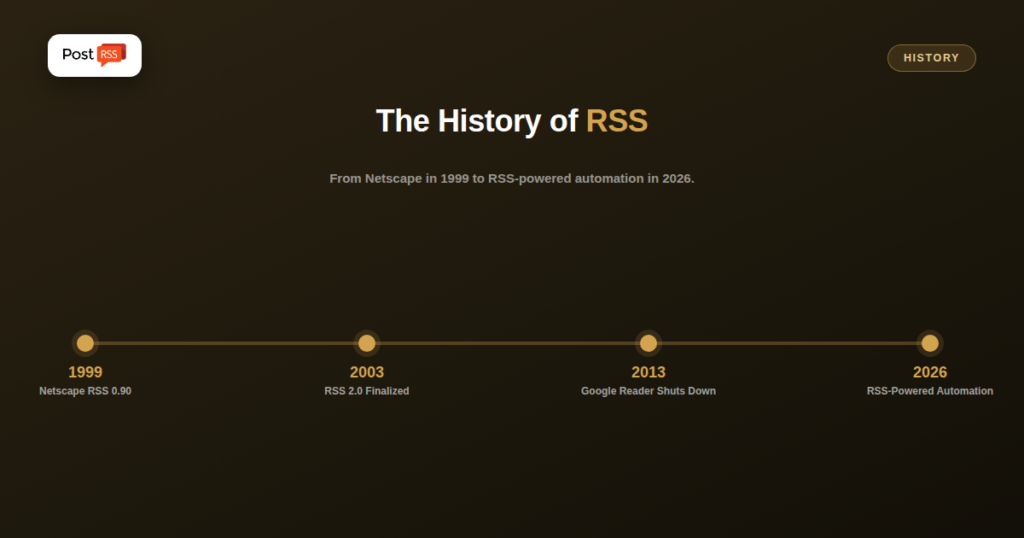
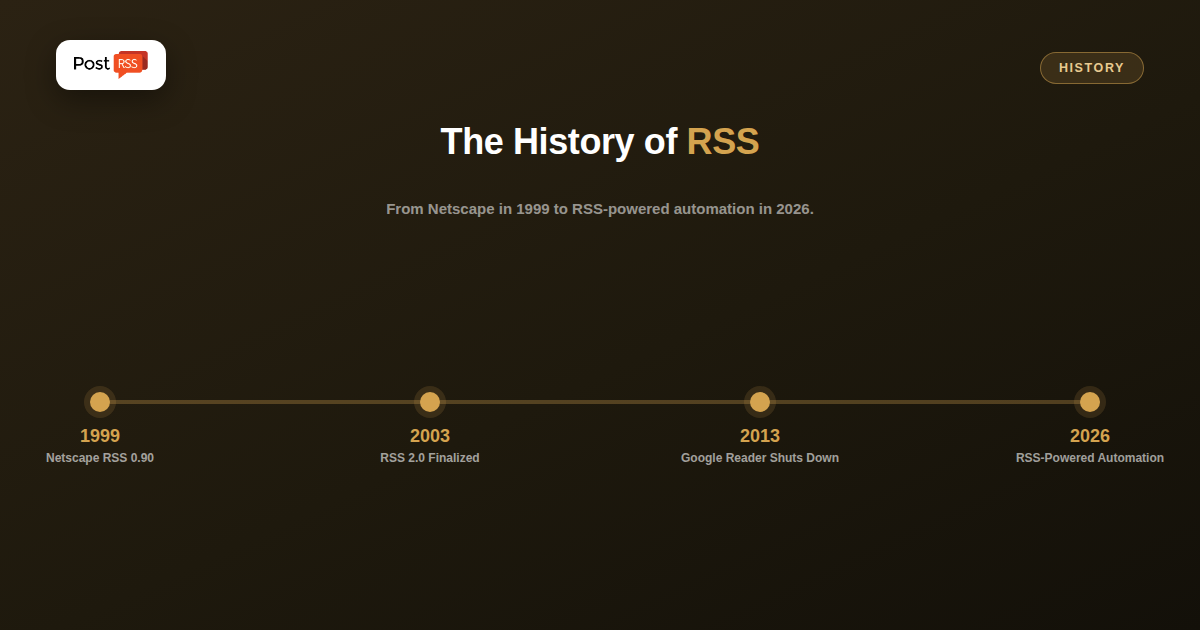
RSS’s earliest version, RSS 0.90, was created by Netscape in 1999 to power personalized content channels on the My Netscape portal. It was a genuinely early example of a standardized way for a machine to read a site’s latest updates, years before “web feed” was a common concept for most internet users.
What followed was a period of competing, incompatible versions and a genuine format schism. Different groups developed RSS 0.91, RSS 1.0 (built on RDF, a different underlying data model), and later RSS 2.0, each with different capabilities and philosophies. This fragmentation is part of why Atom, an entirely separate but conceptually similar feed format, was developed around 2003 — partly as a cleaner, more consistently specified alternative to RSS’s fractured version history.
RSS 2.0, finalized in 2003, became the version that achieved lasting, widespread adoption and has remained essentially unchanged since — a stability that’s arguably RSS’s greatest practical strength. Its simplicity (a title, link, and description per item, with a handful of optional extensions) meant there was very little to break or need updating over the following two decades, even as the web around it changed dramatically.
This period was RSS’s most visible mainstream moment, with dedicated feed reader products (both desktop and web-based) becoming a genuinely popular way for internet users to follow multiple sites without visiting each one manually. This was the RSS use case most people who remember the format associate with it — a personal reading tool, not yet the automation backbone it would later become.
Google’s discontinuation of Google Reader in 2013 is widely remembered as the moment RSS’s mainstream visibility declined sharply. Reader had been one of the most widely used feed reader products, and its shutdown pushed many casual users toward social media as their primary source of updates instead of an RSS reader. This is often mischaracterized as “RSS dying,” when what actually happened was narrower: one major consumer product shutting down, not the underlying format losing technical relevance.
While consumer feed-reader visibility declined, RSS quietly became the actual technical backbone of podcasting — every major podcast platform, including Apple Podcasts, distributes episodes via RSS feeds behind the scenes, a use case that scaled enormously through the 2010s podcasting boom, entirely through the same RSS 2.0 format finalized back in 2003.
The more recent chapter of RSS’s story is its role as the trigger mechanism for automation — tools like PostRSS, Zapier, Make, and countless others watch RSS feeds not for human reading, but to programmatically trigger actions (most commonly, posting new content to social media) the moment something new is published. This is arguably RSS’s best-fit use case: a machine reading a machine-readable format, with no human ever needing to open a feed reader at all.
RSS 2.0’s deliberate simplicity is exactly why it hasn’t needed the kind of overhaul that more complex web technologies periodically require. There’s very little surface area for it to break: a title, a link, a description, a publish date, per item. Newer formats like JSON Feed exist and serve real, if narrower, use cases, but none have displaced RSS’s enormous installed base of readers, podcast platforms, and automation tools built around it over more than two decades.
Technically, no — RSS 2.0 remains the active, unchanged specification behind podcast distribution and a large share of content automation, actively used by essentially every major CMS platform today. Its declining mainstream consumer visibility since Google Reader’s shutdown is a separate question from its ongoing technical relevance.
RSS 2.0 achieved critical mass in adoption before either alternative could displace it, and its simplicity relative to RSS 1.0’s more complex RDF-based model gave it a practical advantage for widespread implementation across CMS platforms and readers.
Nearly every major CMS (WordPress, Shopify, Ghost, Squarespace, Blogger) generates one automatically without configuration, though older custom-built sites or unusual platforms may not — a dedicated feed-generator tool can create one from any webpage in those cases.
That the underlying format is genuinely stable and unlikely to change or disappear — unlike social platform APIs, which change access rules and requirements regularly, an RSS-based automation setup is built on a foundation that has remained functionally identical since 2003.
RSS’s quarter-century history is really the story of one simple, stable format finding new uses as the web around it changed — from Netscape’s 1999 content channels, through the mid-2000s feed-reader boom, through podcasting’s rise, to today’s automation tools. The format itself never needed to change to support any of these very different use cases, which is exactly why it remains the foundation PostRSS and similar tools are built on.