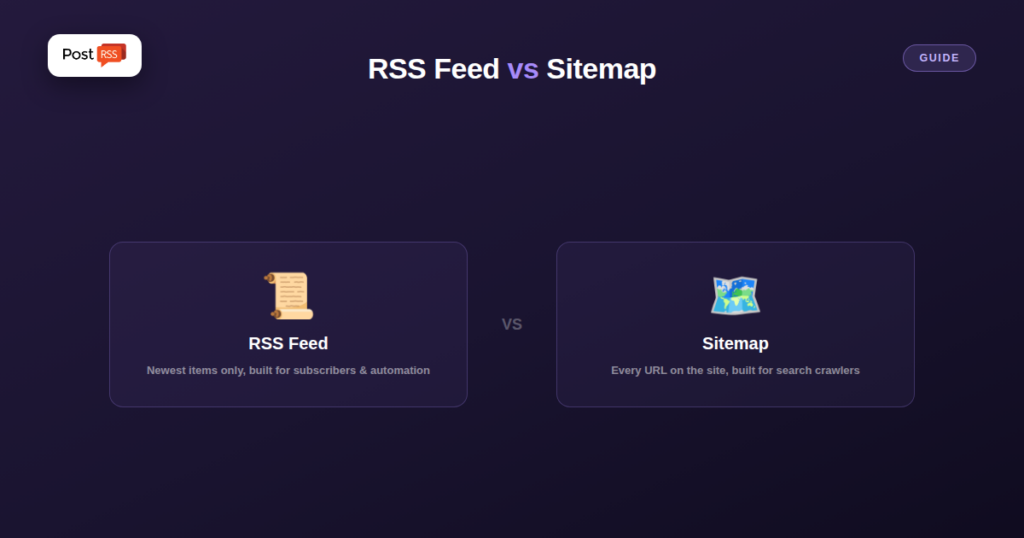
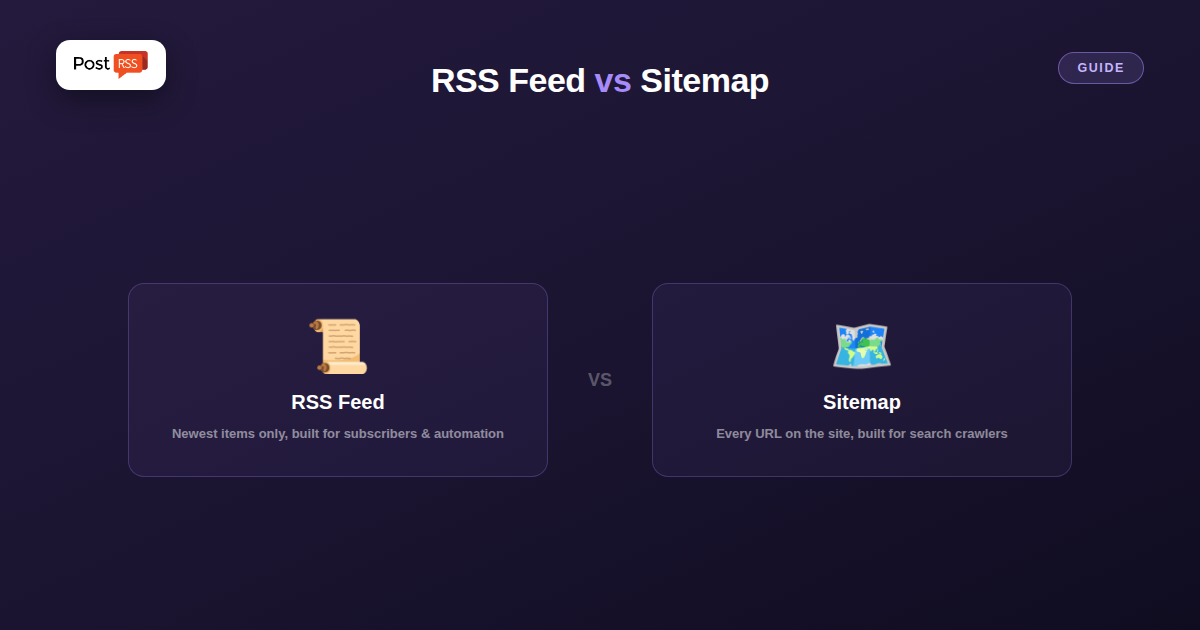
An RSS feed and an XML sitemap are both XML files that list URLs from your site, which is exactly why they get confused. Past that surface similarity, they’re built for different consumers, updated on different schedules, and solve different problems — and most sites that care about both search visibility and content distribution genuinely need to run both, not pick one.
An XML sitemap exists for search engine crawlers. It’s a comprehensive, relatively static list of every URL you want indexed — every page, every post, every product — along with metadata like last-modified date and priority. Its job is discovery and crawl efficiency: helping Googlebot and other crawlers find and re-check your full site’s URL structure, especially pages that aren’t easy to reach through internal links alone. It’s meant to be complete, not recent.
An RSS feed exists for subscription and automation. It’s a short, frequently-updated list of your most recent items — typically the last 10 to 20 posts — built for tools that want to know the instant something new is published. Podcast apps, newsletter tools, feed readers, and automation platforms like PostRSS all poll a feed specifically because it’s small and recency-focused, not because they want your entire site’s URL list.
A sitemap typically includes every indexable URL on the site and gets regenerated on a schedule (often daily) or on publish; an RSS feed intentionally includes only the newest handful of items and updates the moment something new goes live. A sitemap has no concept of “unsubscribe” or “notify me” — crawlers just periodically re-check it. An RSS feed is built around exactly that: tools poll it specifically to detect new items and act on them (post them, email them, download them). Google reads sitemaps; it generally does not use RSS feeds for indexing at all.
Yes, for almost any content site. A sitemap without a feed means search engines can find your content, but nothing can automatically distribute or subscribe to it — no podcast app, no auto-poster, no email digest. A feed without a sitemap means recent content gets picked up by automation quickly, but older pages and full site structure may be poorly discovered by search crawlers relying on that structured, complete list. They’re complementary layers, not competing options, which is why virtually every major CMS generates both by default without asking you to choose.
Not really — the formats overlap enough to look similar but tools expect different structures (a sitemap’s <urlset> versus a feed’s <channel>/<item>), and using one where the other is expected will typically just fail to parse correctly.
No — search engines treat sitemaps and RSS feeds as distinct, well-understood formats with different purposes; there’s no penalty for a site having both, since that’s the expected, standard setup.
Most modern CMS platforms generate both automatically with zero extra setup, so this rarely comes up in practice — but if you’re building a custom site from scratch, prioritize whichever consumer matters more to you right now: a sitemap for search visibility, a feed if you want any kind of auto-posting or subscription feature.
A sitemap is a complete, static map of your site built for search crawlers; an RSS feed is a small, live stream of your newest content built for subscribers and automation. They look similar as XML files and get confused constantly, but they’re solving different problems for different audiences — which is exactly why most sites ship with both, generated automatically, without anyone having to choose.