Updated: 2026-08-20
This post originally announced a May 2015 increase to Ultimate and Enterprise plan task limits. Those numbers are long out of date — PostRSS’s plan structure has been revised several times since. Below is a breakdown of what the higher-tier plans actually include today, for anyone running high-volume, multi-target RSS automation.
Back in 2015, we announced a bump to our top-tier plans: the Ultimate plan moved from 50,000 to 250,000 tasks/month, and Enterprise jumped from 100,000 to 2,000,000 tasks/month. Those changes reflected the platform scaling to support larger publishers and agencies. Since then, the tiers have been restructured multiple times as PostRSS’s infrastructure and customer base have grown.
Most individual bloggers and small business owners are well served by PostRSS’s entry-level plans. The higher tiers — Ultimate and the Enterprise series — exist for a specific kind of user: agencies managing many client accounts, publishers running multiple sites or feeds, and businesses that need to post at high volume across every supported platform simultaneously.
If you’re evaluating whether you’ve outgrown a mid-tier plan, the two numbers that matter most are your target count (how many distinct destinations — pages, profiles, groups — you’re posting to) and your monthly task volume (how many individual posts get pushed out across all of those targets combined).
The Ultimate plan includes the full platform lineup — all 70 network types, the same as Professional Plus — together with premium features like CSV file import and advanced calendar scheduling, syncing every 5 minutes. It’s designed as the step up for users who need more targets and posts per month, without yet needing Enterprise-level target counts.
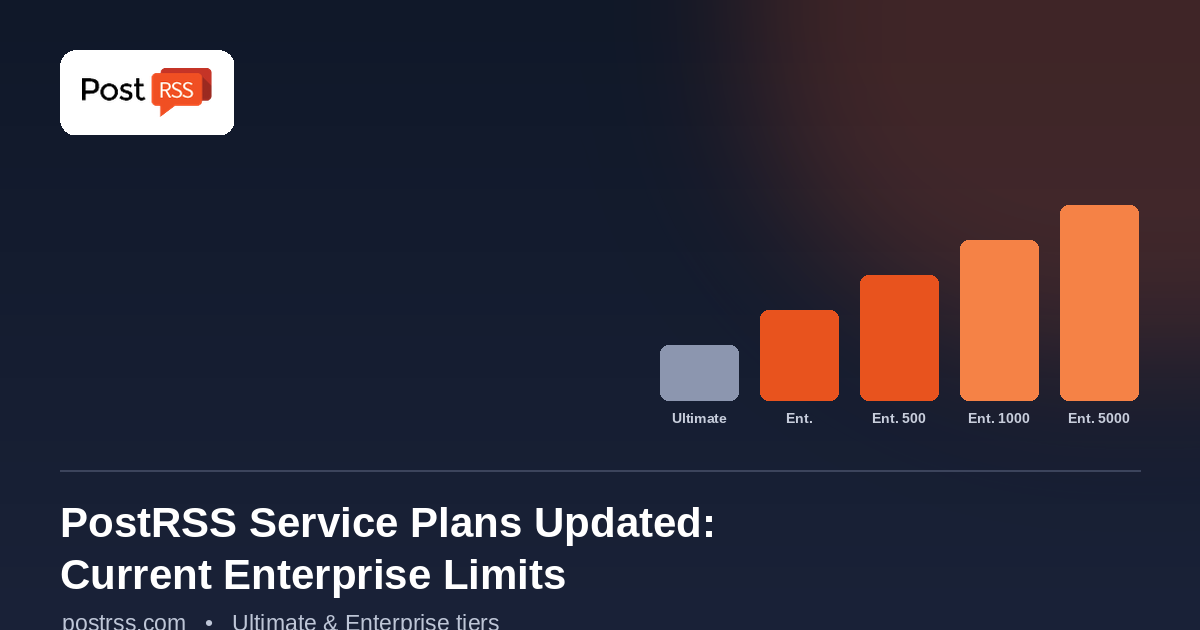
The jump between Enterprise tiers is primarily about target capacity — how many separate accounts, pages, or feeds you can manage simultaneously — rather than sync speed or feature access, which stay consistent (1-minute syncing, full platform support) across the whole Enterprise range. This makes it straightforward to estimate which tier fits: count how many distinct destinations you need to manage today, plus reasonable room to grow, and match that against the target counts above.
A simple way to estimate whether a plan’s monthly task allowance fits your needs: multiply your average number of new posts per month by the number of platforms/targets each post gets pushed to. For example, publishing 50 new articles a month across 20 different target accounts (client pages, for instance) works out to roughly 1,000 tasks/month — comfortably within the base Enterprise tier’s 1,000,000 task ceiling, with plenty of headroom.
Agencies managing dozens of client accounts, each publishing frequently, are usually the ones who actually approach the higher Enterprise 500/1000/5000 tiers — most single-business use cases won’t come close to those ceilings.
If your specific combination of target count and task volume doesn’t cleanly match any listed tier — for example, very high target counts but modest task volume per target, or vice versa — PostRSS offers custom Enterprise plans built around your actual usage pattern. Reaching out directly is the fastest way to get an accurate quote.
Ultimate ($40/month) includes 125,000 posts per month across 50 targets, with feeds checked every 5 minutes. Enterprise ($100/month) raises that to 1,000,000 posts across 100 targets, checks feeds every minute and includes one extra user.
Yes. The pricing page also lists Enterprise 300 ($200/month, 300 targets) and Enterprise 3000 ($1700/month, 3,000 targets), which sit between the tiers described in this post.
Yes. Enterprise plans can invite additional users from the Team menu. The number of extra users grows with the tier, from one on Enterprise to ten on Enterprise 5000.
Yes. An annual subscription saves 20% compared with paying month by month, on the same plan.
Whether you’re running a single high-volume site or managing automation for dozens of clients, PostRSS’s Enterprise tiers are built to scale with you — and it’s worth checking in periodically, since plan structures (like the one described in this post) do get revised as the platform grows.
What changed in the networks, what broke, and how to fix it before it costs you reach.
Built by Internet Solutions, the team behind PostRSS. Each product saves you time in its own way.
 English
 Lietuviškai
 Deutsch
 Français
 Русский
 Español
 Polski
 Italiano
 Українська
 Čeština
 Português
 日本語
日本語 Latviešu valoda
 Eesti
Eesti Magyar
 Bahasa Indonesia
 Türkçe
 हिन्दी
 Ελληνικά
 العربية
 ไทย
ไทย Tiếng Việt
 Română
 Bahasa Melayu
 বাংলা
বাংলা