
Updated: 2026-08-20
The digital marketing ecosystem is fluid. Over the years, massive platforms rise, evolve, and sometimes wrap up operations entirely (such as Google+, which was officially discontinued in 2019). At PostRSS.com, our core mission is to constantly adapt to these shifting trends, ensuring that your business always has access to effective, high-traffic channels for organic reach.
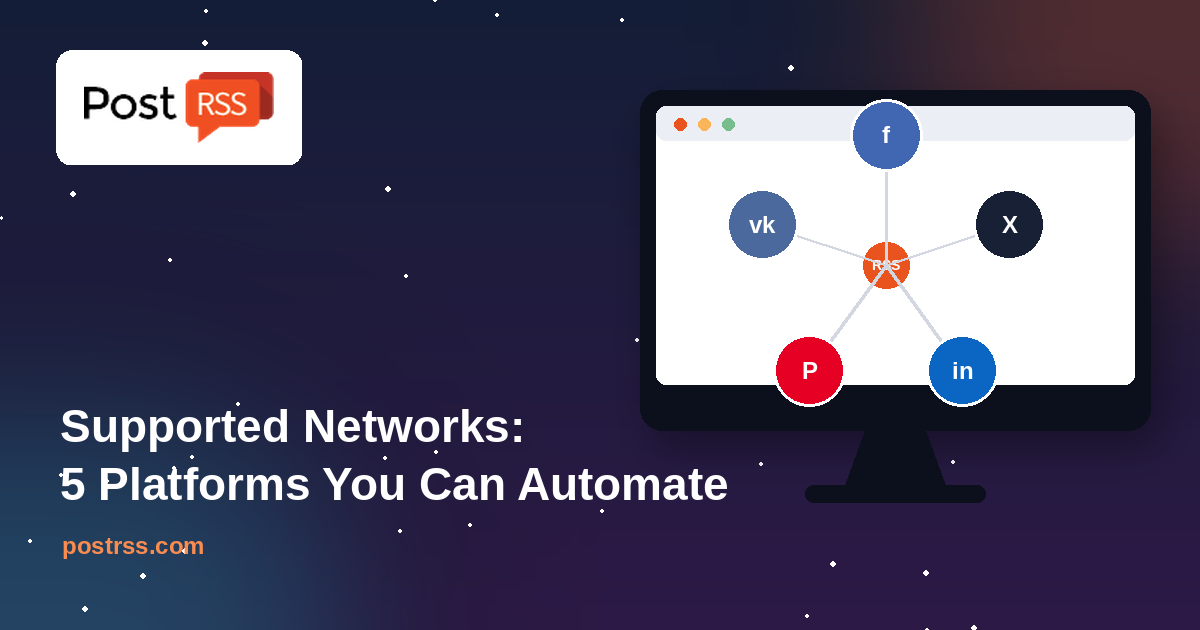
By converting your website's RSS or Atom feed into automated social updates, PostRSS allows you to broadcast your content across a diverse network of channels simultaneously.
Here is an overview of the social platforms currently supported by PostRSS, what makes each one distinct, and how to think about which ones actually deserve a place in your distribution strategy.
Facebook remains one of the largest social networks in the world, with an audience spanning nearly every age group and demographic. With PostRSS, you can automatically distribute your blog posts, landing pages, or product announcements straight to your official brand Pages (and Groups where you have administrator rights). The platform supports rich-media integration, meaning your automated updates display clean, full-width images and descriptions pulled directly from your content.
Best fit for: Nearly any business or creator — Facebook's broad reach makes it close to a default first channel, especially for community-building around a Page or Group.
X is built around rapid, real-time information. To stay relevant on X, frequent posting matters more than on almost any other platform — content has a short half-life, and accounts that go quiet lose momentum fast. PostRSS hooks directly into your feed to post your newest links the moment they go live on your site, keeping your profile active without requiring you to manually check in throughout the day.
Best fit for: News, commentary, product updates, and any content where being early matters — X's audience rewards timeliness over polish.
For B2B companies, SaaS platforms, and career-focused creators, LinkedIn is a distinct kind of audience — professionals actively looking for industry insight, not casual browsing. PostRSS allows you to automatically syndicate your industry insights, company news, and in-depth articles to both personal profiles and company pages. This is one of the more reliable ways to build professional authority over time, since consistent presence matters more than viral spikes on this platform.
Best fit for: B2B brands, thought leadership content, case studies, hiring announcements, and anything positioning your business as a credible authority in its space.
Pinterest operates like a visual search engine, where a single high-quality graphic can drive organic traffic back to your site for months or even years — a fundamentally different content lifespan than the other platforms on this list. PostRSS features native Pinterest integration, automatically extracting your featured images and turning your new blog posts or products into pinnable, clickable content.
Best fit for: Visual-heavy niches — food, fashion, home design, DIY, travel — and e-commerce stores where a strong product photo is the whole pitch.
To help businesses reach audiences in regions where VKontakte remains a dominant platform, PostRSS provides support for VK walls and community pages. You can syndicate your feed content directly to these destinations, extending your reach into markets that other Western-centric platforms may not effectively cover.
Best fit for: Businesses with an existing or target audience in regions where VK has strong traction, or brands specifically expanding into those markets.
Supporting five platforms doesn't mean every business should automate to all five. The more useful question is: where does your specific audience actually spend time, and what content format do you naturally produce?
A common mistake is treating platform count as a proxy for effort or seriousness — connecting all five out of a sense that "more is better." In practice, three well-matched platforms consistently outperform five mismatched ones, both in engagement and in how much attention the channel mix actually needs from you over time.
We constantly monitor social media developer policies and API updates so you don't have to. When networks update their core logic, our engineering team works to keep background systems aligned, aiming to minimize disruptions to your automated publishing pipelines.
This is also why the list of supported platforms itself isn't static — it reflects where audiences and API access currently make automation both possible and worthwhile, which is part of why platforms like Google+ eventually dropped off entirely rather than staying supported indefinitely after they lost relevance.
Setting up your multi-channel syndication hub takes less than five minutes:
👉 Ready to launch your brand across the web? Sign up for PostRSS today and start broadcasting your content to the platforms that matter for free!
