Updated: August 24, 2026
LinkedIn's ranking system has continued to diverge from the other major networks through 2026, leaning further into a model built around dwell time, professional relevance, and creator-style content formats rather than simple follower-graph distribution. For businesses automating RSS-to-LinkedIn posting, understanding what's actually shifted — and what's stayed remarkably consistent — matters more than reacting to every individual ranking rumor, since LinkedIn's core preferences have been unusually stable even as the specific mechanics evolve.
Our RSS to LinkedIn page is the place to start if you are setting this up now.
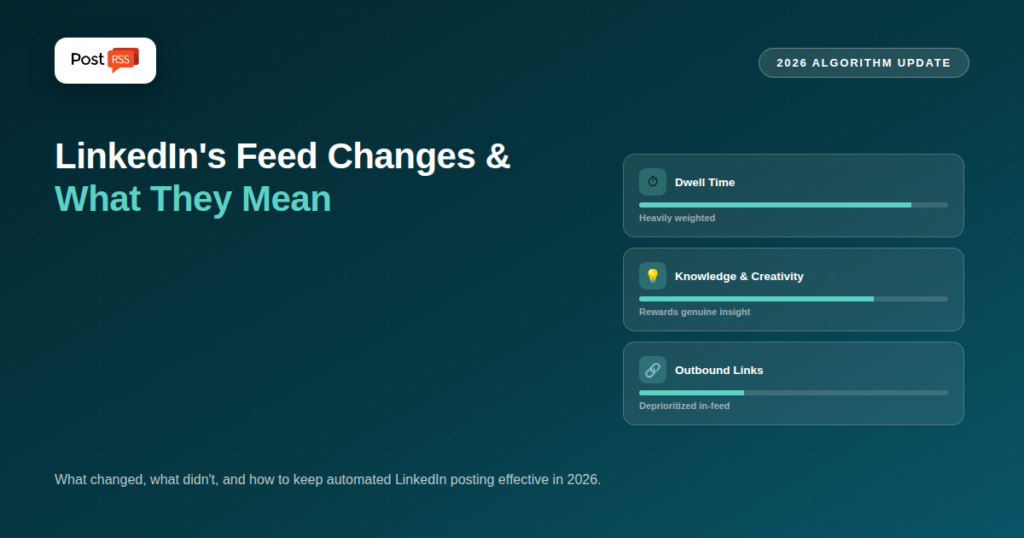
LinkedIn has continued expanding its "knowledge and creativity" ranking signals, a framework it's discussed publicly for several years that weights content based on whether it teaches something, sparks genuine discussion, or reflects real expertise, rather than just how quickly it accumulates likes. Dwell time — how long someone actually spends reading a post before scrolling past — has become an increasingly heavily weighted signal, which structurally favors content that gives readers a reason to pause: a native document carousel, a well-structured text post with genuine substance, or a poll inviting a quick interaction. LinkedIn has also continued deprioritizing posts with external links in the primary post body, a pattern consistent with other major platforms wanting to keep users on-platform rather than sending them elsewhere immediately.
A plain link post — title, description, and a link back to a source article — sits in a similar position on LinkedIn as it does on Facebook: it's a legitimate, useful format, but not the one the algorithm rewards most generously in pure reach terms. This concern is real but shouldn't be overstated for automated distribution specifically: LinkedIn link posts still reach a page's existing followers reliably, and professional audiences searching for company updates, thought leadership, and industry news continue to value link-based content precisely because it points to something substantive rather than being content-for-content's-sake. The practical takeaway mirrors Facebook's situation: automated link posts remain a legitimate, worthwhile piece of a broader LinkedIn content mix rather than something to abandon because of ranking mechanics.
Organic reach on LinkedIn company pages has always been more modest than personal profiles, a gap that's persisted through 2026's changes rather than narrowing. For a company page relying on automated RSS posting with no additional manual engagement layer, realistic reach concentrates among existing followers and their direct network, with broader algorithmic distribution reserved for posts that generate genuine comment activity in their first hour or two. This isn't a reason to avoid LinkedIn automation — consistent presence still compounds, and LinkedIn remains one of the most valuable B2B and professional audiences available — but it does mean treating LinkedIn reach as one signal among several (see our companion piece on measuring social performance beyond simple metrics) rather than the sole measure of whether automated posting is worthwhile.
One of LinkedIn's most consistent characteristics, unchanged through 2026's ranking updates, is that personal profile posts significantly outperform company page posts in organic reach, often by a wide margin. This isn't a bug or a recent shift — LinkedIn's algorithm has favored person-to-person content over brand content for years, on the logic that professional networks are fundamentally about people, not companies. For businesses automating RSS content to LinkedIn, this creates a practical strategic question: automation usually starts with a company page, but the strongest organic reach on LinkedIn specifically often comes from a founder, executive, or employee sharing content from their personal profile — and PostRSS can post to a connected personal profile too, not only to a company page. The realistic response isn't abandoning company-page automation, but treating it as the reliable baseline while encouraging key team members to manually amplify particularly important posts from their own profiles when it matters most.
LinkedIn has continued investing in native content formats — document carousels, polls, and native video — that keep engagement entirely on-platform, and these formats do get measurably stronger algorithmic treatment than link posts. This doesn't make automated link posts pointless; it means they're best understood as one tool in a broader content strategy rather than the entire strategy. A business publishing regular blog content or announcements benefits from RSS automation handling that steady stream reliably, while reserving the effort of building a native document or carousel for content that genuinely warrants the extra production time — a major report, a detailed how-to, or a significant company milestone.
| Platform | 2026 Trend for Automated Link Posts |
|---|---|
| Dwell time and "knowledge and creativity" signals favor substantive posts; link posts remain reliable for existing followers | |
| Recommendation-based feed increasingly favors native formats over outbound links | |
| X | Real-time relevance still rewards timely posting; more recency-driven than LinkedIn's model |
| Search-driven discovery, largely unaffected by the feed-ranking pressures facing LinkedIn and Facebook |
This is a strong practical argument for keeping RSS automation spread across multiple platforms rather than treating LinkedIn as your only distribution channel — a LinkedIn-specific ranking shift affects one leg of your strategy rather than your entire presence when your automation already spans several networks.
In most cases, no — the core value RSS automation delivers (reliable, consistent distribution without manual effort) isn't affected by ranking changes, since automation controls whether content gets posted, not how LinkedIn's algorithm subsequently ranks it. What's worth revisiting periodically is how source content gets written — leaning descriptions toward genuine insight rather than pure summary — while leaving the distribution mechanism itself untouched. Disconnecting and reconnecting automation, or abandoning LinkedIn based on a single reach dip, usually costs more in lost consistency than it gains in marginal algorithm alignment.
While standard company page posts face the reach dynamics described above, LinkedIn Newsletters and active Groups have generally retained stronger, more direct distribution to a genuinely interested audience, since both carry an explicit subscription or membership signal the algorithm can trust more confidently than passive page-follow status. Businesses running RSS automation for standard posts can benefit from manually maintaining a LinkedIn Newsletter for recurring, higher-value content as a complementary channel outside the automated pipeline, since that format reaches subscribers directly regardless of the same-day algorithmic ranking pressures facing ordinary feed posts.
LinkedIn's own Page Analytics remain the most direct way to see how a specific company page is actually performing under current ranking behavior, rather than relying on general industry commentary about "the algorithm." Impressions and engagement trends over a rolling 90-day window matter more than any single post's numbers, especially during a period of ongoing ranking adjustments where week-to-week variation is common and not necessarily meaningful. Follower growth on its own is a particularly weak signal to over-index on, since it moves slowly and is influenced by far more than posting activity; engagement rate and comment quality on individual posts tend to be more actionable indicators of whether current content is resonating under LinkedIn's present ranking model. If reach on automated link posts has genuinely declined for your page specifically, that's useful signal to test a native-format post occasionally; if it's held roughly steady, general industry narratives about declining link-post reach may matter less for your specific audience than broader commentary suggests.
Not every LinkedIn audience responds to the same content mix identically, and this matters more on LinkedIn than on more homogeneous consumer platforms because its user base is explicitly professional and industry-segmented. A B2B software company's audience often engages heavily with data-driven insight posts and industry commentary, while a professional services firm's audience may respond more strongly to case studies and thought-leadership pieces tied to specific client outcomes. A recruiting or staffing-focused page tends to see stronger engagement on culture and hiring content than on generic industry news. Because RSS automation distributes whatever's published on your own site without discriminating by content type, understanding which categories of your own content actually resonate with your specific LinkedIn audience over a full quarter is more useful than applying generic platform-wide advice uniformly.
Despite the ranking mechanics evolving, several fundamentals remain stable on LinkedIn specifically: substantive, relevant content still outperforms generic promotional posts, consistent posting still beats sporadic bursts, and genuine comment engagement in a post's first hour still matters more than any other single factor. RSS automation supports the consistency piece directly — it's the content-quality and engagement-generation work layered on top that requires ongoing human attention, not the underlying distribution mechanism.
If you're already running LinkedIn automation through PostRSS, no reconfiguration is needed in response to algorithm changes — the adjustments worth making live in how post descriptions are written, not in the automation itself. See our setup guide if you're adding LinkedIn to an existing multi-platform automation setup for the first time.
Not necessarily — link posts still reach your existing followers reliably and cost nothing extra to maintain; the better move is usually supplementing automation with occasional native-format posts for your highest-value content, rather than dropping link automation altogether.
No — the algorithm affects how LinkedIn ranks and distributes content after it's posted, not whether automated posting itself works; PostRSS continues publishing reliably to LinkedIn Company Pages regardless of ranking changes on LinkedIn's side.
You do not have to choose: from the Professional plan, PostRSS posts to LinkedIn Company Pages, personal profiles and Groups. Automating a founder or team member profile alongside the company page, or having them share especially important posts by hand, are both reasonable ways to get the stronger personal-profile reach.
A quarterly review of what's actually performing, rather than reacting to every individual algorithm rumor, tends to produce more stable results than frequent strategy changes chasing short-term ranking shifts.
Pausing tends to cost more than it saves — a dormant company page loses the consistency and engagement history that LinkedIn's ranking generally rewards, so maintaining steady automated posting through periods of change is usually the better default than stopping and restarting later.
Yes, within reason — a steady cadence of a few posts per week tends to perform better than either sporadic single posts or an overwhelming daily volume that risks fatiguing a smaller, more concentrated professional audience compared to consumer platforms.
LinkedIn's 2026 changes continue a long-running trend toward rewarding substance and genuine engagement rather than introducing a fundamentally new dynamic, and the practical response for automated posting hasn't changed much either: write descriptions that demonstrate real insight, diversify across platforms, and keep showing up consistently. RSS automation remains well suited to exactly that strategy, regardless of which specific ranking factors LinkedIn adjusts next.
What changed in the networks, what broke, and how to fix it before it costs you reach.
Built by Internet Solutions, the team behind PostRSS. Each product saves you time in its own way.
 English
 Lietuviškai
 Deutsch
 Français
 Русский
 Español
 Polski
 Italiano
 Українська
 Čeština
 Português
 日本語
日本語 Latviešu valoda
 Eesti
Eesti Magyar
 Bahasa Indonesia
 Türkçe
 हिन्दी
 Ελληνικά
 العربية
 ไทย
ไทย Tiếng Việt
 Română
 Bahasa Melayu
 বাংলা
বাংলা