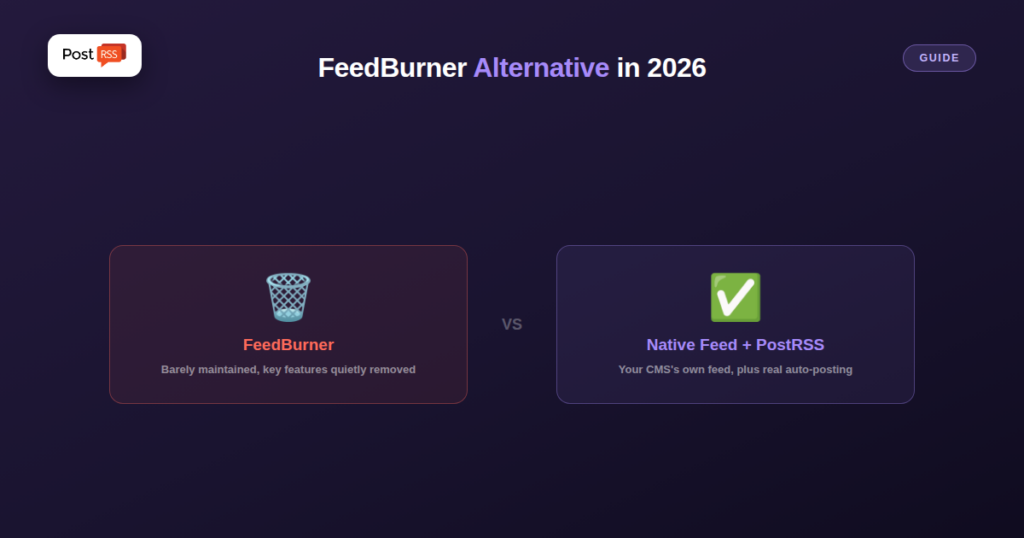
FeedBurner still runs, technically, but Google stopped meaningfully developing it years ago and quietly removed features (including email subscriptions) along the way. If you’re still using it, or found an old tutorial recommending it, here’s what actually makes sense to use instead in 2026.
FeedBurner was, for years, the default answer to “how do I manage my RSS feed,” which means a huge amount of old blog posts, forum answers, and tutorials still point to it. Many sites that set it up a decade ago still have it quietly running in the background, redirecting their real feed through FeedBurner’s URL — often without anyone actively maintaining or checking it.
Beyond just re-hosting your feed URL, FeedBurner offered subscriber counts, basic analytics, and (in its most-used era) email digest subscriptions. The email subscription feature was discontinued years ago, and the analytics have grown increasingly unreliable, leaving most of what made it popular no longer functional — while the basic feed-redirect part still technically works.
If you just need a working RSS feed, you almost certainly already have one: every modern CMS (WordPress, Ghost, Squarespace, Shopify) generates a valid feed automatically at a predictable URL, with no third-party service needed at all. If you specifically want email newsletter delivery from your feed, a dedicated RSS-to-email tool built for that purpose (rather than a legacy feed-hosting service) handles it properly. If you want your new posts automatically distributed to social media, that’s a job for a dedicated RSS auto-posting tool like PostRSS — a category that didn’t really exist when FeedBurner launched.
If FeedBurner is still redirecting your feed and nothing is broken, there’s no urgency to touch it — but if you’re setting up something new, there’s no reason to add it into a fresh workflow either. Pointing automation and subscription tools straight at your CMS’s native feed URL is simpler, removes a dependency on a barely-maintained legacy service, and avoids the redirect entirely.
There’s no announced shutdown date, but Google has already removed major features over the years without much warning, which is itself a reason not to build anything new around it.
If people subscribed to your FeedBurner URL specifically, redirecting or removing it can disrupt their existing subscription; check your traffic and subscriber sources before changing anything on a feed people are actively depending on.
Your own CMS’s native feed, almost always available by default at a URL like /feed/ — no third-party account or setup required.
FeedBurner isn’t a modern recommendation for anything in 2026 — its most useful features are gone, and every job it used to handle now has a purpose-built, actively maintained alternative: your CMS’s native feed for basic hosting, a dedicated email tool for newsletters, and a dedicated auto-posting tool for social distribution.