Updated: August 24, 2026
Facebook's 2026 algorithm continues rewarding native video and Reels more generously than link posts, which naturally raises a question for anyone running RSS automation: can PostRSS auto-post video content, and if so, does it actually reach Facebook as a native video the algorithm favors? The honest answer involves a technical distinction that most marketing content glosses over. This guide covers exactly what's possible, what isn't, and how to build a realistic video strategy around RSS automation's actual capabilities.
RSS feeds are built to carry metadata and links, not actual video files. A podcast or video-focused RSS feed typically includes an "enclosure" — a link pointing to where the actual video or audio file lives — alongside a title, description, and image, rather than embedding the video content itself inside the feed. Facebook's Video API, by contrast, requires an actual video file to be uploaded directly to Facebook's servers to become a native video or Reel; it doesn't accept a link to a video hosted elsewhere and automatically convert that into a native upload. This is the crux of the limitation: RSS-to-social automation tools work with links, and native Facebook video requires an upload, not a link.
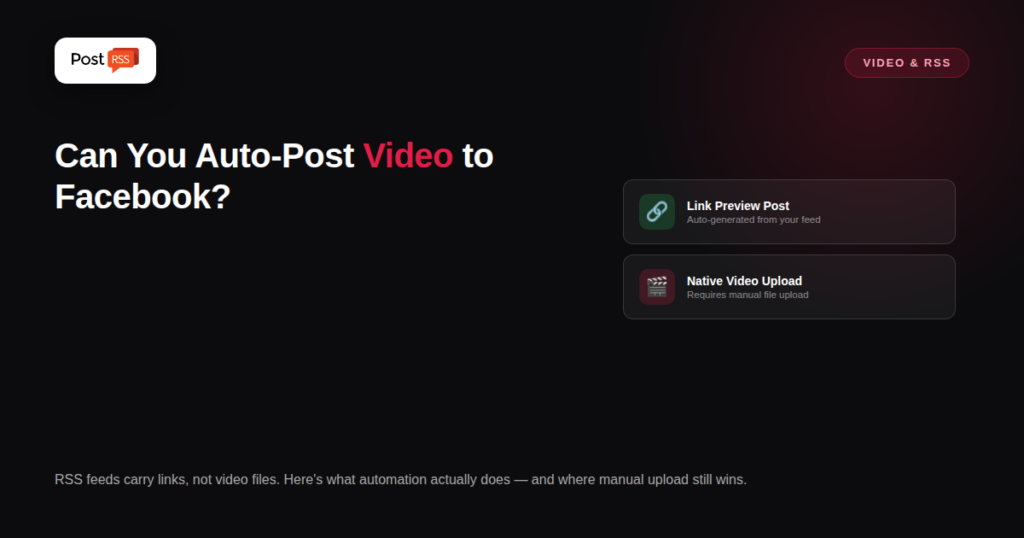
When your RSS feed item links to a video — say, a YouTube video, a podcast episode, or a video hosted on your own site — PostRSS posts that item to Facebook the same way it handles any other link: as a link with a preview card, typically showing the video's thumbnail image, title, and description, with a click-through to wherever the video actually lives. This is a real, functional post that reaches your audience and drives clicks to your video content. It is not, however, a native uploaded video or Reel, and Facebook's algorithm treats these two formats differently in terms of reach and engagement priority.
Facebook's 2026 ranking continues favoring content that keeps users on-platform, and a native video or Reel satisfies that preference directly, while a link post pointing to an external video (even one with a compelling thumbnail) is still fundamentally an outbound link in the algorithm's eyes. This doesn't make automated link-to-video posts worthless — they still reach your existing audience and can drive meaningful click-through — but it does mean expecting automation to deliver native-video-level organic reach is setting up for disappointment based on a technical misunderstanding rather than an actual limitation of PostRSS specifically. This is true of RSS-based automation broadly, not a PostRSS-specific gap.
For an RSS item to become a native Facebook video automatically, the feed itself would need to reference an actual downloadable video file (not just a link to a hosting page), and the automation tool would need to download that file and re-upload it to Facebook's Video API as a distinct step beyond standard link-based posting. This is a meaningfully more complex technical process than reading a title and description from a feed item, involving file transfer, format compatibility checks, and upload-specific API permissions. It's a fundamentally different capability than RSS-to-social distribution as most tools, including PostRSS, are built to provide.
Podcast RSS feeds and YouTube channel feeds both work well with PostRSS in the link-preview sense described above — a new episode or video triggers an automatic post announcing it with a thumbnail, title, and link, reaching your Facebook audience the moment it's published. This is genuinely valuable for consistency and reach among your existing followers, even though it doesn't produce a native-video post. See our guides on auto-posting podcast RSS feeds and turning YouTube uploads into automatic social posts for platform-specific detail on this exact workflow.
| Platform | What Happens With a Video Link in Your Feed |
|---|---|
| Link preview card with thumbnail, title, description; not a native video | |
| X | Link preview card; X similarly doesn't auto-convert an external link into native video |
| Link preview card; same limitation applies | |
| Pin with thumbnail image and link; Pinterest is inherently link-and-image-based regardless |
This isn't a Facebook-specific gap — it reflects how RSS-based automation fundamentally works across every platform PostRSS supports, since the mechanism (reading feed metadata and posting a link) is the same regardless of destination.
Not necessarily. If video is a significant part of your content strategy, the practical response is accepting that automation handles the consistent, high-volume announcement layer while native-video reach benefits require occasional manual effort for your highest-priority content — not abandoning automation for video content entirely. Many businesses successfully run both in parallel: automated link-preview announcements for every video as a reliable baseline, with manual native uploads reserved for content that specifically warrants the extra reach investment.
If you're setting up a feed specifically to support this hybrid strategy, make sure your feed item's image field points to a genuinely compelling video thumbnail (not a generic placeholder) and that the description gives enough context to justify a click, since these are the elements that actually determine how well an automated link-preview post performs. This is worth deliberate attention precisely because the post won't get native-video algorithmic treatment — a strong thumbnail and description are doing more of the performance work than they would for a native upload.
A podcast network publishing three episodes a week connects its podcast RSS feed to PostRSS, which automatically posts a link-preview announcement for each new episode to Facebook, X, and LinkedIn the moment it goes live — three automated posts a week with zero manual cross-posting effort. Separately, the network's social media manager manually uploads one flagship episode per month as a native Facebook video with custom captions and a trailer edit, reserved for the episode expected to have the broadest appeal. This hybrid approach gets the consistency benefit of automation for routine content and the reach benefit of native upload for the content that most justifies the extra work, rather than treating the two as mutually exclusive strategies.
It's worth being clear that this isn't a gap specific to PostRSS's engineering choices — it reflects a fundamental architectural reality of how RSS as a format and Facebook's Video API as a system are built to work. RSS was designed decades ago as a lightweight metadata-and-link syndication format, long before native video upload APIs existed in their current form, and the two were never designed to interoperate directly. Any RSS-based automation tool claiming to natively upload video without a distinct, separate upload mechanism is either doing something considerably more complex than standard feed-reading, or overstating what it actually does.
If you're running a video or podcast feed through PostRSS already, no configuration change is needed to understand this distinction — it's simply useful context for setting realistic reach expectations. See our setup guide if you're connecting a video-related feed for the first time.
No — PostRSS distributes feed items as links with preview cards, the same mechanism it uses for any content type; it doesn't download and re-upload video files as native Facebook video or Reels.
Not at all — automated link-preview posts still reach your audience and drive traffic reliably; they just don't get the algorithmic reach boost native video and Reels receive specifically.
Some specialized tools built specifically around native video publishing exist, but they generally aren't built around the general-purpose RSS-to-multi-platform model; that's a fundamentally different, narrower product category than what PostRSS and similar RSS automation tools provide.
No — a link-preview announcement is still valuable for driving awareness and clicks; the realistic expectation is just that it performs differently than a native upload, not that it's not worth doing.
RSS automation is fundamentally a link-and-metadata distribution system, and that's true regardless of whether the content behind the link is an article or a video. Understanding this distinction clearly — rather than assuming automation should behave like a native video upload tool — lets you build a realistic strategy that uses automation for consistent, reliable announcement coverage while reserving manual native uploads for the video content where maximum reach genuinely justifies the extra effort.