Most guides about RSS and YouTube focus on Shorts, because that’s the format most auto-posting tools support today. But a lot of channels don’t publish Shorts at all — they publish standard long-form videos, and the question that actually matters to them is whether an RSS feed can trigger a regular YouTube upload automatically. This guide separates what’s technically possible from what’s actually supported by mainstream auto-posting tools in 2026, and why the two aren’t the same thing.
There are two completely different things people mean when they ask about “auto-posting video to YouTube from RSS”:
The second case is well supported: YouTube channels publish their own RSS feed for every upload, and that feed can drive auto-posting to other networks the moment a video goes live. The first case — genuinely uploading raw video to YouTube via automation — is a different, much more restricted problem, and it’s the one this article focuses on.
Yes, technically. The YouTube Data API v3 includes a videos.insert endpoint that allows an authenticated application to upload a video file along with title, description, tags, and privacy status. In principle, a tool could watch an RSS feed for new video enclosures and push each one to videos.insert automatically.
In practice, very few auto-posting tools — including most RSS-to-social schedulers — implement this, for three reasons:
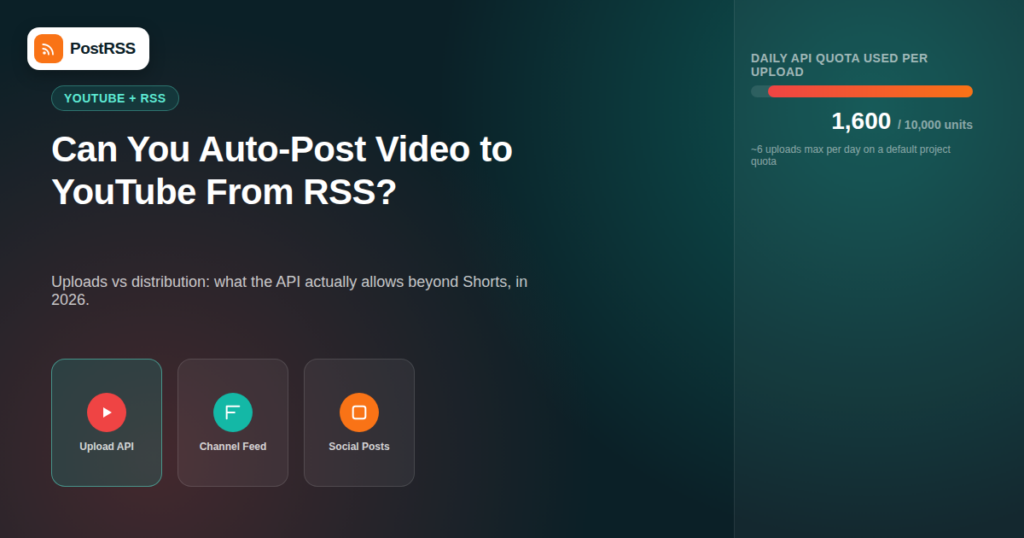
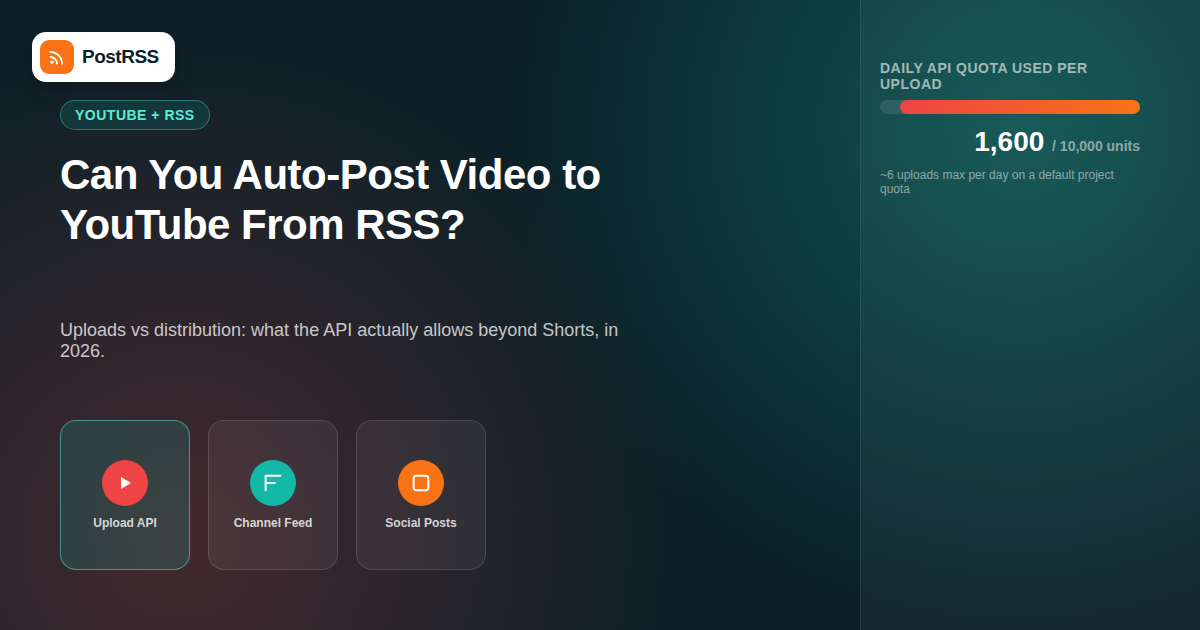
YouTube’s API quota system charges a flat 1,600 units per upload call out of a default daily project quota of 10,000 units. That means a standard, unapproved API project can upload roughly six videos a day before hitting the ceiling — and every other API call your integration makes (channel lookups, playlist updates, status checks) eats into that same budget. High-volume RSS feeds publishing dozens of items a day simply can’t be matched one-to-one with automated uploads under a default quota.
An RSS <enclosure> tag can technically point to a video file, but most CMS platforms don’t publish full-resolution source video through RSS — they publish thumbnails and, at most, a link to a hosted player (often YouTube or Vimeo itself). Without a direct, downloadable video file URL in the feed, there’s nothing for the API to upload in the first place.
YouTube increasingly expects channel owners to set metadata — thumbnails, end screens, cards, monetization settings, made-for-kids status — that a fully blind automation pipeline can’t reliably fill in. Many creators intentionally keep the final publish step manual specifically to control these details.
Where RSS and YouTube automation genuinely shines is the reverse direction — taking your channel’s own upload feed and distributing it everywhere else. Every YouTube channel has a public RSS feed at a predictable URL pattern, and that feed updates the moment a new video (including a Short) goes live. Connected to an auto-posting tool, that single feed can:
This is the workflow the vast majority of channels actually want, and it requires zero YouTube API quota on the posting side, since you’re reading YouTube’s own feed rather than writing to YouTube’s API.
| Approach | Direction | API Quota Impact | Reliability | Typical Use Case |
|---|---|---|---|---|
| RSS → YouTube upload | Into YouTube | High (1,600 units/upload) | Limited by quota & feed video availability | Bulk repurposing at small scale |
| YouTube feed → Social auto-post | Out of YouTube | None (read-only RSS) | High, consistent | Announcing every new upload everywhere |
| YouTube feed → Shorts-only clip tools | Out of YouTube (repurposing) | N/A (separate tool) | Tool-dependent | Turning long videos into clips |
Every public YouTube channel exposes an RSS feed at a predictable URL built from its channel ID: https://www.youtube.com/feeds/videos.xml?channel_id=YOUR_CHANNEL_ID. If you only know your channel’s custom handle (like @yourchannel), you can find the underlying channel ID by viewing the page source of your channel page and searching for "channelId", or by using any free channel-ID lookup tool. Once you have the feed URL, it works exactly like a blog’s RSS feed: it lists the most recent uploads with title, link, thumbnail, and publish date, and updates automatically as new videos go live.
This is the feed you plug into an auto-posting tool — not a feed you need to build or host yourself, and not something that requires any Google Cloud project, API key, or OAuth approval, since it’s a public, read-only feed the same as any WordPress RSS feed.
| Symptom | Likely Cause | Fix |
|---|---|---|
| Feed shows old videos only | Wrong channel ID or cached feed | Re-verify the channel ID; force a feed re-fetch in your tool |
| Shorts and long-form videos both post identically | YouTube’s feed doesn’t distinguish Shorts by default | Use title/duration-based filtering rules if you want different captions per format |
| Thumbnail missing from auto-post | Some tools don’t parse YouTube’s media:thumbnail tag automatically | Check your tool’s field mapping for video feeds specifically |
| Delayed posting after upload | Feed polling interval | Most tools check every 10-30 minutes by default; adjust if your plan allows faster polling |
For channels that truly need to push a high volume of pre-rendered video files to YouTube automatically — for example, a media company syndicating dozens of short clips a day — the realistic path is:
For nearly everyone else, the better return on effort is automating distribution from your channel’s own feed rather than automating the upload step itself.
These are handled differently by the API and by most tools. Shorts uploads go through the same videos.insert endpoint as regular videos (just flagged by aspect ratio and duration), so the quota and file-availability constraints above apply equally. YouTube Community Posts (text, image, and poll updates) use a separate, much more limited surface that isn’t broadly opened to third-party posting tools at all — treat Community Posts as effectively manual-only in the same way Instagram Broadcast Channels are, covered in our guide on YouTube auto-posting from RSS.
Consider a mid-size media channel publishing 15 new videos a week, produced in a CMS and exported as source files. If that team tried to automate raw uploads directly via the API, 15 uploads would consume 24,000 quota units against a 10,000-unit daily default — already over budget before a single metadata lookup or thumbnail update runs. Even after a quota increase, the team would still need a pipeline that reliably fetches full-resolution source files, fills in category and privacy fields, and flags anything needing manual thumbnail work.
Compare that to the feed-out model: the same 15 videos, once uploaded through YouTube Studio as usual, generate 15 feed entries that an auto-posting tool reads for free and distributes across four or five other networks — roughly 60-75 additional social posts a week with zero YouTube API quota spent. For almost every team, that second number is where the real automation value sits, which is why so few auto-posting tools invest in building out raw upload support.
Most RSS-to-social auto-posting tools, including PostRSS, focus on distribution — taking your existing YouTube uploads (via your channel’s own feed) and posting them to other networks — rather than pushing new raw video files into YouTube, because of the API quota and metadata constraints described above.
Google treats video uploads as the most resource-intensive API action on the platform, since it involves transcoding, storage, and content review, and prices the quota accordingly relative to lightweight read calls.
Yes. Google offers an audit and quota extension request process for projects with a legitimate, sustained need for higher limits, though approval isn’t guaranteed and requires documenting your use case.
For a genuine upload, yes — the automation needs a retrievable video file, not just a thumbnail or a link to a page where the video is embedded.
Point an auto-posting tool at your channel’s own RSS feed and use it to announce every new upload across Facebook, X, LinkedIn, and Pinterest automatically — no YouTube-side API access required.
No. Sharing your own video link on other platforms doesn’t affect YouTube’s recommendation algorithm; what matters for YouTube’s algorithm is on-platform engagement (watch time, retention) after someone clicks through.
Distribution out of YouTube is well supported today; posting into Community tabs isn’t broadly available through third-party tools, so most workflows combine automated distribution with a manual Community Post cadence.
No — reading a public RSS feed is a passive, read-only action that YouTube itself provides for exactly this kind of use, so it carries no more risk to your channel than someone subscribing to it in a feed reader. The account-safety concerns that apply to browser-automation workarounds on platforms like Instagram simply don’t apply here, since nothing is logging into your YouTube account or simulating a session.
Auto-posting raw video into YouTube from an RSS feed is technically possible through the Data API but is bottlenecked by quota costs, the practical unavailability of source video files in most feeds, and metadata requirements that resist full automation. The workflow that actually delivers consistent value for almost every channel runs the other direction: treat your YouTube channel’s own feed as the automation trigger, and let it drive announcements across every other platform the moment a new video goes live. Save the upload step itself for a deliberate, reviewed process rather than a blind automation pipeline.