Updated: 2026-09-27
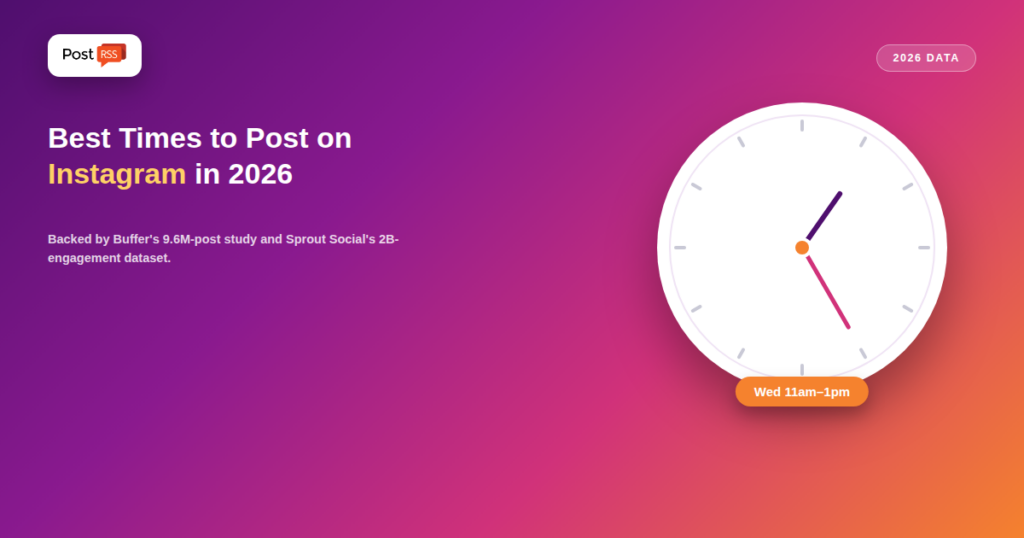
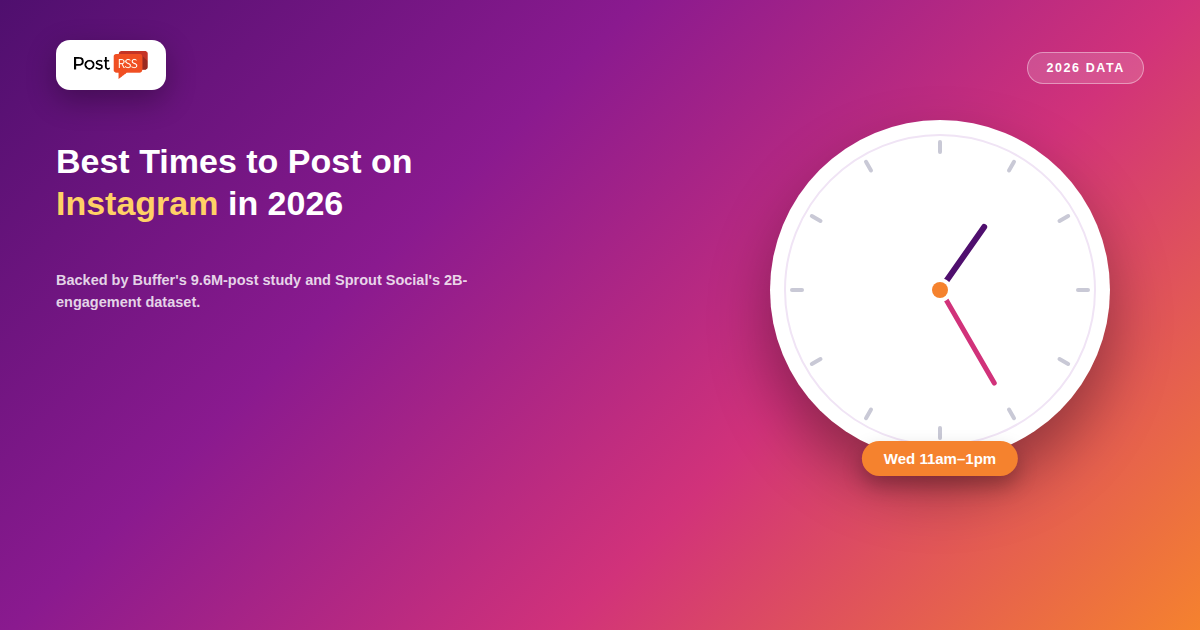
Short answer: Wednesday between 11am and 1pm is the strongest general window in both of 2026's large datasets — Buffer's 9.6M-post analysis and Sprout Social's 2B-engagement study — with Tuesday and Thursday close behind. Treat that as a starting hypothesis, not a rule: your own account's Instagram Insights beat any aggregate once you have a few months of history. Timing is also the smallest of the three levers, behind content quality and a consistent cadence.
Two large independent datasets published in the last year — Buffer’s State of Social Engagement 2026 report and Sprout Social’s platform-wide engagement analysis — both converge on a similar answer to one of the most-searched questions in social media: when should you actually post on Instagram to get seen? This guide breaks down what the current data actually says, day by day, why the “best time” question is more nuanced than a single headline number, and how to turn that data into a posting schedule you can actually run without babysitting your phone at 9am every morning.
Instagram’s algorithm has shifted many times over the years, and at various points the industry has argued that posting time matters less than it used to because the algorithm increasingly serves content based on relevance and predicted interest rather than strict recency. That’s partially true — a genuinely strong post can still perform well hours after publishing. But recency remains a real signal alongside relevance: a post has its best shot at reaching your existing followers’ feeds in the window shortly after it goes live, before it’s competing with everything else published since. Posting when your specific audience is actually active online gives a post its best chance at early engagement, and early engagement is still one of the strongest predictors of how far the algorithm pushes a post afterward. Timing isn’t the only lever, but it’s a low-effort one, and the data below gives you a genuinely evidence-based starting point rather than a guess.
Two sources anchor this guide, both recent and both large enough to be meaningfully more reliable than the anecdotal “best time to post” charts that circulate without any stated methodology:
Both datasets independently point to similar general windows, which is itself meaningful — when two differently-constructed studies with different time ranges land on overlapping conclusions, that’s a much stronger signal than either one alone.
Here’s the day-by-day breakdown based on the combined signal from both datasets. Treat these as strong starting points, not absolute law — the section after this one covers how to verify and adjust for your specific audience.
| Day | Strongest Window | Notes |
|---|---|---|
| Monday | 10am–12pm | Lower overall engagement day; audiences are catching up after the weekend |
| Tuesday | 9am–11am, 1pm–2pm | Consistently one of the stronger weekdays across both datasets |
| Wednesday | 11am–1pm | The single strongest overall day in both reports, sometimes called the mid-week peak |
| Thursday | 9am–11am, 2pm–3pm | Strong throughout the workday, similar shape to Tuesday |
| Friday | 10am–11am | Engagement tapers off in the afternoon as attention shifts to the weekend |
| Saturday | 11am–1pm | Lower overall volume but engaged, leisure-browsing audience |
| Sunday | 12pm–2pm, 7pm–9pm | Two distinct windows: midday leisure scrolling and evening wind-down browsing |
If you only take one row from this table: Wednesday late-morning is the closest thing to a universal sweet spot across both datasets, and it’s a reasonable default if you’re only able to post once and want the best general odds.
The table above gives each day’s strongest window. This one expands the same data into a full grid so you can see the shape of a whole week at a glance — useful when you are filling a posting schedule rather than picking a single slot.
Times are in your audience’s local timezone, not yours. If those differ, translate before scheduling; the section on timezones further down explains how.
| Hour | Mon | Tue | Wed | Thu | Fri | Sat | Sun |
|---|---|---|---|---|---|---|---|
| 6am | Low | Low | Low | Low | Low | Low | Low |
| 7am | Low | Low | Low | Low | Low | Low | Low |
| 8am | Med | Med | Med | Med | Med | Low | Low |
| 9am | Med | High | Med | High | Med | Low | Low |
| 10am | High | High | Med | High | High | Med | Low |
| 11am | High | High | High | High | High | High | Med |
| 12pm | High | Med | High | Med | Med | High | High |
| 1pm | Med | High | High | Med | Med | High | High |
| 2pm | Med | High | Med | High | Low | Med | High |
| 3pm | Low | Med | Med | High | Low | Med | Med |
| 4pm | Low | Low | Low | Med | Low | Low | Low |
| 5pm | Low | Low | Low | Low | Low | Low | Low |
| 6pm | Low | Low | Low | Low | Low | Low | Med |
| 7pm | Med | Med | Med | Med | Med | Med | High |
| 8pm | Med | Med | Med | Med | Med | Med | High |
| 9pm | Low | Low | Low | Low | Low | Low | High |
| 10pm | Low | Low | Low | Low | Low | Low | Med |
How to read it. High marks the hours that appear as peak windows in both datasets. Med marks hours that perform acceptably and are worth using when you post more than once a day. Low marks hours where reach is consistently weaker — not useless, but the last slots you should fill.
Three patterns are worth noticing because they hold across almost every account type:
If you are scheduling automatically rather than posting by hand, this grid translates directly into a posting calendar — pick the High cells first, fill with Med cells if you publish more often than the High slots allow, and leave the Low hours for content that is not time-sensitive.
Aggregate data describes averages across hundreds of thousands of accounts spanning every industry, audience type, and geography — it does not describe your specific followers. A B2B account whose audience checks Instagram during work breaks behaves differently than a lifestyle brand whose audience scrolls in the evening after work, which behaves differently again from an account with a mostly international, multi-timezone following. Industry-level patterns worth knowing: B2B and professional-services accounts tend to skew toward weekday, business-hours engagement; consumer lifestyle, food, and entertainment accounts tend to see stronger evenings and weekends; accounts with a young, student-heavy audience often see a distinct late-evening spike that doesn’t show up in general aggregate data at all. None of this means the table above is wrong — it means it’s a starting point to test against your own account’s actual behavior, not a number to follow blindly forever.
Instagram‘s own Insights panel (available on professional and creator accounts) shows when your specific followers are most active, broken down by day and hour, based on your actual audience rather than the platform-wide average. The practical process: check that chart, cross-reference it against the aggregate table above, and treat the overlap between the two as your highest-confidence posting window. If your own Insights data meaningfully disagrees with the general aggregate — for example if your audience skews heavily toward one timezone or a distinct activity pattern the general data wouldn’t capture — trust your own account’s data over the generic benchmark every time. The aggregate numbers are a starting point for accounts with limited history; a few months of your own account’s real data always outranks someone else’s average.
All of the times above assume a single-timezone audience, which is a reasonable assumption for many accounts but not all of them. If your following is meaningfully international, a single “best time” doesn’t exist in the way the table implies — you’re choosing between a few different tradeoffs: post for your largest single timezone segment and accept lower reach in others, alternate posting times across different days to give each major timezone segment a turn, or if you’re using an automated posting tool, schedule multiple pieces of content spread across the day so different regions each get something in their own active window. There’s no universally correct answer here; it depends on how concentrated versus spread out your actual follower base is, which — again — your own Instagram Insights data will show you directly.
Yes, to a meaningful degree. Feed posts and carousels tend to follow the general patterns in the table above fairly closely, since they’re competing directly in the main feed alongside everything else posted around the same time. Reels behave somewhat differently — because Instagram surfaces Reels through its own discovery-driven distribution rather than purely chronological feed placement, a well-performing Reel can continue gaining views for days after it’s posted, making the exact posting hour less make-or-break than it is for a feed post. Stories are the most time-sensitive of all three, since they disappear after 24 hours and are viewed almost entirely by people already actively browsing at that moment — for Stories, matching your audience’s actual real-time active hours matters more than for any other format.
It’s worth being honest about where posting time sits in the overall priority list, because it’s easy to over-index on a single variable. Content quality and relevance to your specific audience remain the dominant factor in how any individual post performs — a mediocre post at the “perfect” time will still underperform a strong post at a mediocre time. Consistency (posting on a predictable, sustained cadence rather than in unpredictable bursts) is the second-biggest lever, since accounts that go quiet for weeks tend to lose algorithmic momentum regardless of when they eventually post again. Exact posting time is a real but smaller factor on top of those two — worth optimizing once the content and consistency fundamentals are in place, not a substitute for either.
The gap between knowing the best times and actually posting at them consistently, day after day, is where most accounts fall short — manually opening the app at 11am every Wednesday isn’t a realistic long-term habit for most people managing an account alongside everything else they do. This is where scheduling automation earns its place: setting a recurring posting window once, rather than remembering to manually post at the right moment every single day. Two things are worth being direct about here. Instagram’s own API restricts what any third-party tool can publish without manual confirmation, which is why hands-off Instagram scheduling never behaves quite like posting yourself. And PostRSS’s Instagram support is still being tested — it sits on the Professional Plus plan but isn’t live yet — so PostRSS is not the tool to build an Instagram schedule on today. Where it does fit is the rest of your distribution: if the same content goes out on a blog or site, PostRSS posts each new feed item to 66 networks automatically, on the schedule you set. For any tool you do use for Instagram, setting your feed’s checking and posting schedule to align with your identified best-time windows is exactly the kind of “set it up once, benefit from it every week” automation that closes the gap between having good timing data and actually acting on it consistently.
A few patterns show up repeatedly in accounts that struggle with timing strategy despite having good data available: chasing a “best time” number without ever checking it against their own account’s Insights data, changing posting time constantly based on how the last single post performed (one post’s outcome is noise, not signal — patterns take weeks to establish reliably), posting at a technically-optimal hour but with such long gaps between posts that consistency suffers, and treating every content type identically when Reels, Stories, and feed posts genuinely behave differently, as covered above. The fix for all of these is roughly the same: pick a reasonable starting schedule from good data, hold it consistently for several weeks, then adjust based on your own account’s actual results rather than any single post’s performance.
Where PostRSS's own Instagram support currently stands is covered on our auto-post RSS to Instagram page; the networks that are live today, and the plan each one sits on, are on the pricing page.
Based on both Buffer’s and Sprout Social’s 2026 data, Wednesday between 11am and 1pm is the closest thing to a universal peak window, though your own account’s Insights data should always take priority over any general benchmark once you have a few months of history to check.
Yes, though it’s one factor among several rather than the dominant one — early engagement after posting remains a real signal the algorithm weighs, so posting when your specific audience is actually active still meaningfully affects a post’s early performance, even as relevance-based ranking has grown more important overall.
Not necessarily — Stories are the most time-sensitive since they’re viewed live by people already browsing, feed posts roughly follow general best-time patterns, and Reels are the least time-sensitive of the three because Instagram’s discovery-based distribution can keep surfacing a strong Reel for days after posting.
Check the Insights panel on your professional or creator account, which shows exactly when your own followers are most active by day and hour — cross-reference that against general benchmark data, and trust your own account’s numbers whenever the two disagree.
There’s no single perfect time in that case — options include prioritizing your largest timezone segment, rotating posting times across different days, or using scheduling automation to spread multiple pieces of content across the day so different regions each get coverage in their own active window.
Tools that already support Instagram can, for many content types and account setups, though Instagram’s API imposes real restrictions on fully automated posting for certain configurations — worth checking a tool’s own Instagram documentation before assuming hands-off scheduling covers every content type. PostRSS is not one of them yet: its Instagram support is still being tested (on the Professional Plus plan) and isn’t live yet.
No — content quality and consistency of posting cadence both outweigh exact timing in how an account performs overall; timing is a smaller, worthwhile optimization on top of getting those two fundamentals right, not a substitute for either.
The 2026 data from Buffer and Sprout Social gives a genuinely evidence-based starting point — Wednesday late-morning as the strongest general window, with Tuesday and Thursday close behind — but the real value comes from treating that as a starting hypothesis to test against your own account’s Insights data rather than a rule to follow blindly forever. Pair good timing with consistent posting cadence and content quality, automate the parts that are tedious to do manually every day, and let your own account’s real engagement data have the final say once you’ve got enough of it to trust.
What changed in the networks, what broke, and how to fix it before it costs you reach.
Built by Internet Solutions, the team behind PostRSS. Each product saves you time in its own way.
 English
 Lietuviškai
 Deutsch
 Français
 Русский
 Español
 Polski
 Italiano
 Українська
 Čeština
 Português
 日本語
日本語 Latviešu valoda
 Eesti
Eesti Magyar
 Bahasa Indonesia
 Türkçe
 हिन्दी
 Ελληνικά
 العربية
 ไทย
ไทย Tiếng Việt
 Română
 Bahasa Melayu
 বাংলা
বাংলা