Plenty of businesses have built up a large list of people who’ve messaged their Facebook Page over the years, and it’s tempting to treat that list like an email list — auto-send everyone a Messenger update every time you publish something new. Meta’s messaging policies have never really allowed that in the generic, broadcast-to-everyone sense, and a set of platform changes landing in early 2026 narrows the legitimate paths even further. Here’s what’s actually possible today, and why “auto-post my RSS feed straight into everyone’s Messenger inbox” isn’t one of them.
Meta’s core rule for Messenger has long been the 24-hour standard messaging window: once a person messages your Page, you can freely reply for 24 hours after their last message. Outside that window, unsolicited messages are restricted to a small set of approved, non-promotional purposes — not a general-purpose broadcast channel for “here’s our new blog post.” A generic RSS-triggered message sent to every past contact, regardless of when they last messaged you, is exactly the kind of unsolicited, promotional broadcast this rule exists to prevent.
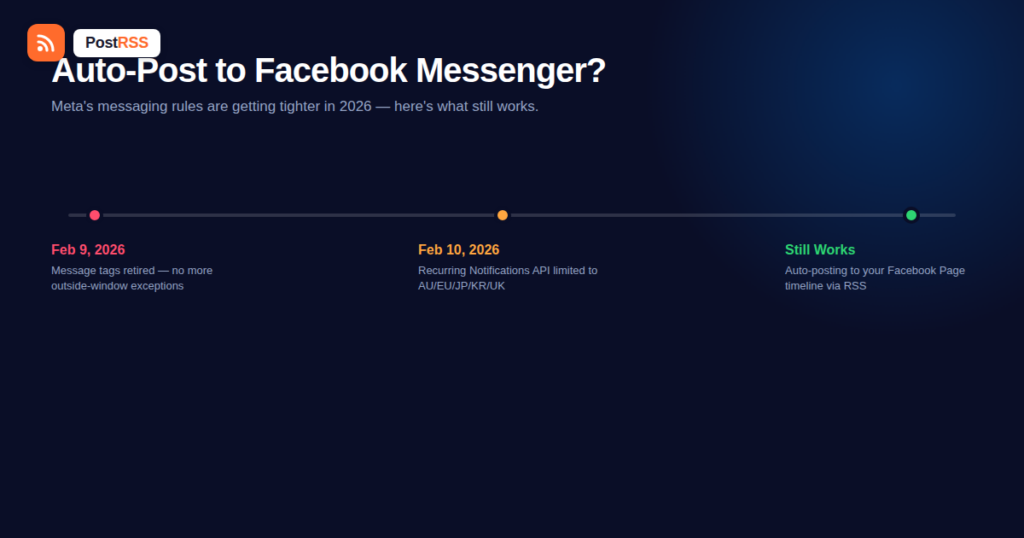
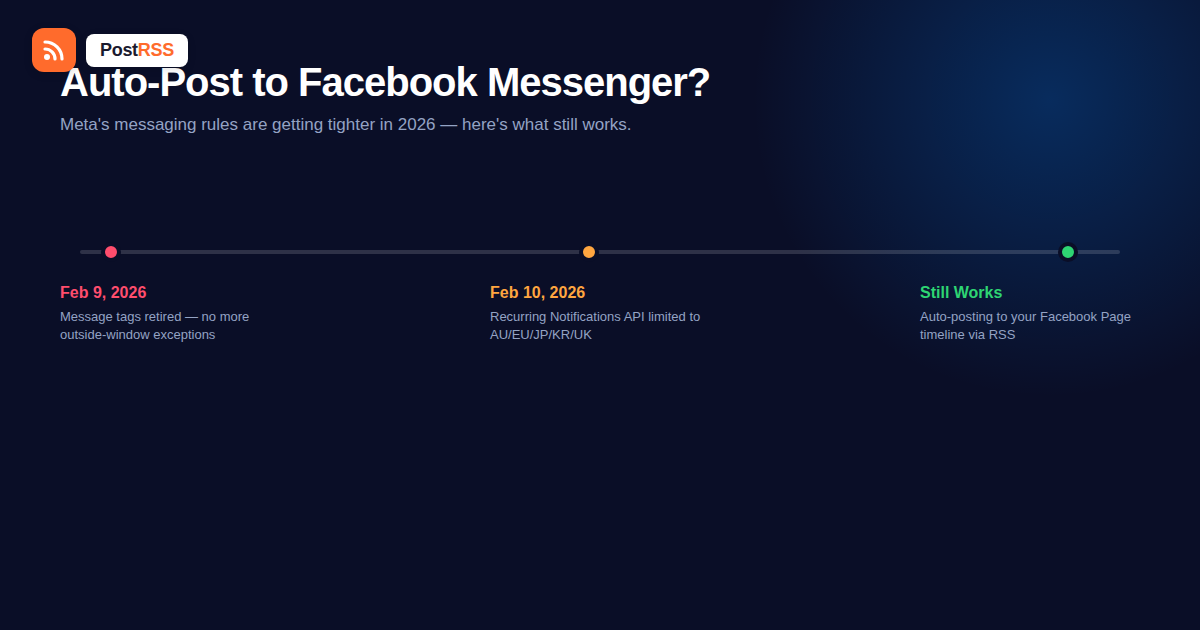
For a while, a set of “message tags” let businesses send certain non-promotional updates outside the 24-hour window for specific, narrow purposes — things like confirmed event reminders. Meta announced these tags are being deprecated on February 9, 2026, closing off even that narrower exception. Any integration that was relying on a message tag to justify an outside-window send needs a different approach going forward, since the tag-based workaround is going away entirely rather than being replaced with an equivalent.
Separately, Meta’s Recurring Notifications API — which let a user explicitly opt in to ongoing updates from a Page through a specific opt-in prompt — is having its access cut on February 10, 2026, except in Australia, the EU, Japan, South Korea, and the UK. For businesses outside those regions, this removes what had been one of the more legitimate, explicitly-consented paths to sending users regular Messenger updates about new content, since it required an affirmative opt-in rather than assuming consent from a past conversation.
| Message type | How it works | Fits “auto-post new content”? |
|---|---|---|
| Standard reply (within 24-hour window) | Free-form reply to a user who messaged you recently | No — only works for users who’ve messaged you in the last 24 hours, not a broadcast list |
| Message tags | Narrow, non-promotional exceptions to the 24-hour window | Being deprecated February 9, 2026 — not a path going forward |
| Recurring Notifications API | User explicitly opts in to ongoing updates via a prompt | Being restricted to AU/EU/JP/KR/UK from February 10, 2026 |
| Sponsored Messages | Paid ad-style message to people who’ve previously messaged your Page | Partially — works as a paid, deliberate send, not a free automatic broadcast |
| One-Time Notification | A single follow-up message after a user opts in via a specific button, used once | No — single-use by design, not a recurring feed-triggered channel |
It’s worth being precise about why Messenger is uniquely restricted compared to a couple of superficially similar automated-update channels businesses sometimes compare it to:
Put together, these rules rule out the exact use case an RSS-triggered “message everyone who’s ever contacted us” automation would need: an unrestricted, repeatable, unsolicited send to a broad list, outside the 24-hour window, without a specific per-user opt-in mechanism behind it. Meta has consistently tightened rather than loosened this over time — the February 2026 changes are a continuation of a years-long trend of narrowing what unsolicited business messaging on Messenger is allowed to look like, not a one-off policy shift.
This isn’t a sudden reversal — it’s the continuation of a direction Meta has been moving in for years. Messenger’s original subscription messaging model, which let approved businesses send ongoing content updates to subscribers, was phased out some time ago in favor of the narrower, purpose-specific message tags that are now themselves being retired. Each step in that progression has moved in the same direction: fewer ways to send unsolicited messages to a broad list, more requirements around recency of contact or explicit per-user consent. Reading the February 2026 changes as one more step in that pattern, rather than an isolated policy update, makes it easier to predict where things are headed rather than treating each change as a surprise to work around.
It’s worth contrasting this with a superficially similar idea that doesn’t carry the same restrictions: turning a blog’s RSS feed into an automatic email newsletter digest. Email doesn’t have an equivalent of the 24-hour messaging window — a subscriber who opted into your mailing list can receive a regular digest indefinitely, governed by anti-spam law (like CAN-SPAM or GDPR consent rules) rather than a platform-specific messaging-window policy. If the actual goal behind “auto-post to Messenger” was really “keep my audience updated automatically without them needing to check social media,” an RSS-to-email digest reaches that same underlying goal without running into any of Messenger’s restrictions, since email’s rules are built around list consent rather than recency of a private conversation.
If a Messenger broadcast setup that used to work has recently started failing or getting flagged, the most common causes are:
The good news is that the actual high-value automation here — getting new content in front of your Facebook audience automatically — doesn’t need Messenger at all. Auto-posting a new article directly to your Facebook Page’s timeline, the way standard RSS auto-posting already works, reaches your followers’ feeds without touching any of the Messenger restrictions above, since a Page post isn’t a private message and isn’t governed by the 24-hour window rule. For the Messenger side specifically, the compliant, sustainable pattern is:
No — this is exactly the kind of unsolicited, promotional broadcast Meta’s 24-hour window and message-tag policies are designed to prevent, and the February 2026 changes close off even the narrower exceptions that used to exist.
Message tags are being fully deprecated on February 9, 2026, so any integration relying on them needs a different, compliant approach before that date.
No, it remains available in Australia, the EU, Japan, South Korea, and the UK from February 10, 2026 onward — access is being restricted by region, not eliminated everywhere.
Yes, Sponsored Messages let you send a paid, ad-style message to people who’ve previously messaged your Page, though this is a deliberate, paid send rather than a free automatic broadcast.
No — Page timeline posts aren’t private messages and aren’t governed by the 24-hour messaging window, so standard RSS-to-Facebook-Page automation is unaffected by any of this.
Where the Recurring Notifications API remains available, yes, through its explicit opt-in prompt; outside those regions after February 2026, that specific mechanism won’t be an option.
Unsolicited business messaging has a long history of being used for spam, which is the underlying reason Meta has steadily narrowed non-promotional exceptions over time rather than expanding what businesses can send without explicit, recent user consent.
Often yes — if the underlying goal was keeping an audience automatically updated without them checking social media, an RSS-driven email digest reaches that goal under email’s consent-based rules rather than Messenger’s recency-based messaging window.
Instagram DMs operate under a broadly similar set of Meta messaging policies, so a generic automated broadcast to Instagram followers’ inboxes runs into comparable restrictions, though the specific tags and APIs involved aren’t identical to Messenger’s.
It’s possible in principle, but the multi-year trend has consistently moved toward tighter restrictions rather than looser ones, so planning around a future reversal isn’t a reliable strategy for a content distribution pipeline you need working today.
Auto-posting your RSS feed as a Messenger broadcast to everyone who’s ever contacted your Page isn’t viable today, and Meta’s February 2026 changes — retiring message tags and narrowing the Recurring Notifications API to a handful of regions — make the legitimate paths even narrower than before. The workable automation is elsewhere: post new content to your Facebook Page’s timeline automatically through standard RSS auto-posting, and treat Messenger as a one-to-one, consent-driven channel rather than a broadcast list. Set up PostRSS for the Page-timeline side, keep Messenger for genuine, opted-in conversations, and consider an RSS-to-email digest for anyone who specifically wants updates delivered straight to them without checking a feed.