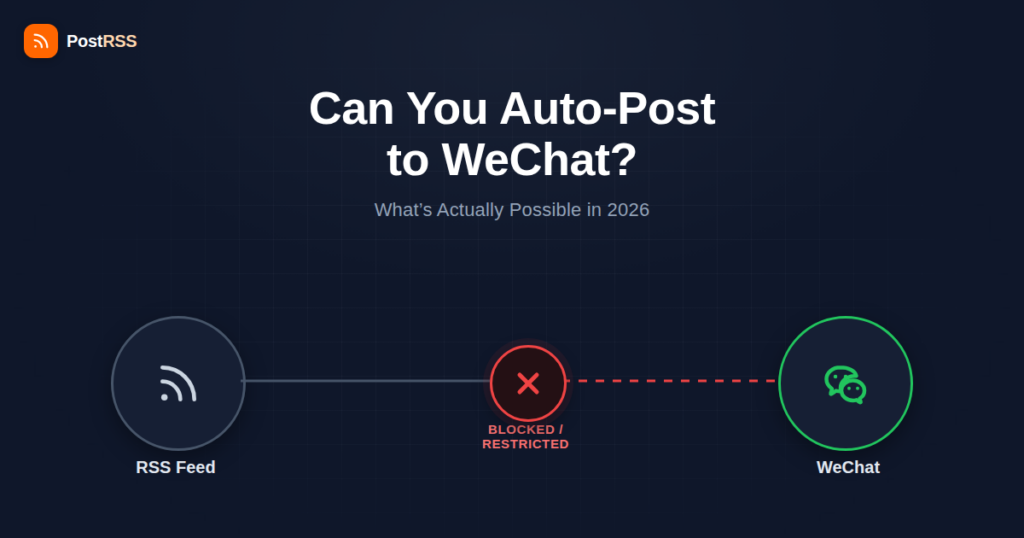
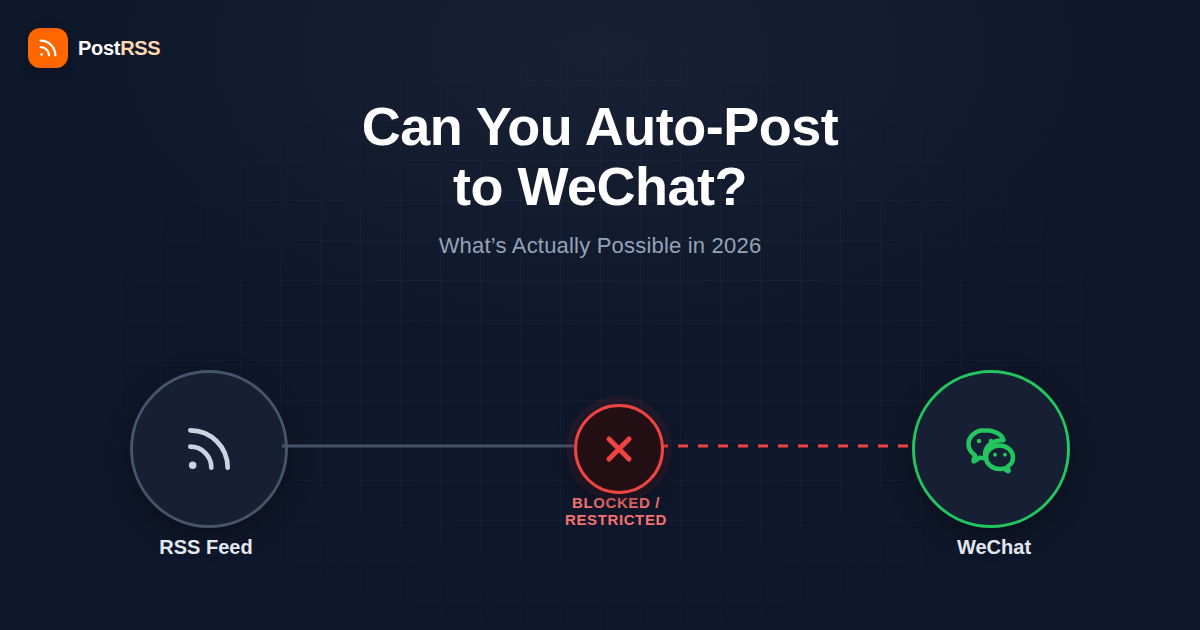
If you run a blog, newsroom, or e-commerce site outside China and you’re looking at your RSS feed wondering whether it can push straight into WeChat, the short answer is: almost certainly not, at least not the way you’re used to with other networks. WeChat is not built like Facebook, X, or LinkedIn, and the gap isn’t a missing feature you can work around with a clever integration — it’s a deliberate, government-shaped wall around who gets to publish programmatically at all. This article walks through exactly what WeChat Official Accounts are, why the platform’s API model excludes most Western publishers by design, what the handful of real workarounds look like (and what they cost), and what a more realistic content strategy looks like if reaching Chinese audiences matters to you.
WeChat (Weixin in mainland China) isn’t really “one platform” in the way Instagram or Threads is. It’s closer to an operating system that happens to run inside a messaging app, with over a billion monthly active users doing everything from chatting and paying bills to reading news and booking doctor’s appointments. Publishing to a WeChat audience means publishing through a WeChat Official Account (公众号), and there are two flavors that matter here:
Both account types sit inside WeChat’s official backend, and both require an application process that was built primarily for mainland Chinese entities. That single fact is the root of almost every limitation described in this article.
Every other platform in the “auto-post from RSS” world — Facebook, X, LinkedIn, Pinterest, Mastodon, Bluesky — publishes a public API that a third-party tool can register with, get a developer key for, and post through on a schedule. Tools built around RSS automation exist precisely because those APIs are open enough for a general-purpose scheduler to connect to them without the platform needing to know or approve of your specific business.
WeChat’s API model works differently on three counts that compound against outside publishers:
To get an Official Account verified — which is what unlocks the publishing API, custom menus, and most integrations — Tencent requires a Chinese business license (营业执照) or equivalent mainland registration. An unverified, foreign-registered account can still exist, but it’s capped at extremely limited functionality: no API access for automated publishing, no advanced menu customization, and often no ability to publish original articles at all without manual review each time.
Related but distinct: many of the deeper integrations (linking a website, using certain webview features inside articles, some payment and mini-program functions) expect an ICP filing (Internet Content Provider registration with China’s Ministry of Industry and Information Technology). This is a mainland-specific compliance requirement that has no real equivalent for a US, UK, EU, or Australian site owner, and getting one generally requires either a Chinese business presence or a local partner who holds one on your behalf.
Even accounts that clear the above hurdles operate inside a content moderation system that reviews published material against domestic regulations. This isn’t unique to automated posting — it applies to every publisher on the platform — but it means WeChat is not treating third-party API access as a neutral pipe the way Buffer-style tools can treat X or LinkedIn. Every automated integration is, in effect, a business relationship WeChat/Tencent has to be comfortable with.
Put together, this is why you won’t find WeChat listed as a supported destination in general-purpose social media automation tools built for a global audience, including PostRSS. It’s not an oversight or a lower engineering priority — the access simply isn’t available to the vast majority of accounts that would want it, and building a feature nobody outside mainland China could actually use isn’t a responsible use of engineering time.
None of this means zero Western brands ever get content onto WeChat. It means the paths that exist are narrower, more manual, and generally require either a China-based partner or accepting a lot of manual labor. Here’s what’s actually out there:
This is the baseline everyone falls back to. WeChat’s web-based Official Account editor lets you compose and publish articles by hand, including images, formatting, and links. It works for any verified account, foreign or domestic, and it’s genuinely the most common path for small and mid-size Western brands that maintain a WeChat presence: someone on the team (often a bilingual staffer or an agency) copies the article over, adjusts formatting for WeChat’s editor quirks, and hits publish. There’s no automation here — RSS or otherwise — it’s a person doing the same job a scheduler would do on other platforms, just by hand.
A small set of enterprise content platforms (some social media management suites with a China division, and a handful of China-focused MarTech vendors) have built formal partnerships or licensing arrangements that let them publish to WeChat Official Accounts on behalf of client businesses. These aren’t consumer RSS-to-social tools — they’re typically enterprise contracts, often bundled with a broader “China digital marketing” service, and they exist because the vendor has done the compliance work (business registration, ICP filing, ongoing relationship management with Tencent) that an individual site owner hasn’t. If you’re a larger brand seriously investing in the Chinese market, this is usually the path that gets evaluated, and it comes with enterprise pricing to match.
Some China-marketing agencies have built internal tooling — not public products — that watches a client’s RSS feed and semi-automates the process of getting new posts into WeChat’s editor: pulling in the content, applying WeChat-appropriate formatting, and queuing it for a human reviewer to approve and publish. This is best described as “RSS-assisted” rather than “RSS auto-posted” — a person is still in the loop for every single post, both because WeChat’s workflow expects it and because content aimed at a Chinese audience typically needs localization (translation, cultural adaptation, sometimes different images) that a straight feed-to-post pipeline can’t provide anyway. These setups are typically custom-built and offered as part of an agency retainer, not something you can sign up for as a standalone SaaS product.
To be direct about it: there is no consumer-facing, self-serve tool that lets a foreign site owner connect an RSS feed to a WeChat Official Account and have posts appear automatically, the way you’d connect a feed to a Mastodon or Bluesky account in a few clicks. If you see a tool marketed that way, look closely at what account type it actually supports and whether it requires you to already hold a verified, China-registered account — because that verification step is the part doing all the work, and it’s the part most Western site owners can’t get through without local business infrastructure.
Here’s how WeChat stacks up against platforms where RSS auto-posting genuinely is straightforward, in terms of API openness and what a Western site owner can realistically expect:
| Platform | API Openness for Foreign Accounts | RSS Auto-Posting Feasibility | Verification/Registration Burden | Chinese Audience Reach |
|---|---|---|---|---|
| WeChat Official Accounts | Closed to most; requires China business license/ICP for full API | Not realistic without a China-based partner or agency | Very high — mainland business registration typically required | Very high (dominant platform in mainland China) |
| X (Twitter) | Open, developer API available globally | Fully supported by most RSS automation tools | Low — standard app/developer account | Low (blocked in mainland China) |
| Open, Graph API available globally | Fully supported | Low — standard Page/app setup | Low (blocked in mainland China) | |
| Open, API access with standard approval | Fully supported | Low | Low (blocked in mainland China) | |
| Mastodon | Fully open, protocol-level API | Fully supported | None — self-hosted or public instance | Very low (minimal mainland presence) |
| Bluesky | Open, public API (AT Protocol) | Fully supported | None | Very low |
| Xiaohongshu (RedNote) | Closed/limited for foreign brands, similar dynamic to WeChat | Not realistic without local partnership | High | High (China-focused, especially younger/urban users) |
| Restricted; foreign account verification is harder than domestic | Limited, generally manual | Moderate-high | Moderate-high |
The pattern is clear: the platforms with open APIs and easy RSS auto-posting are exactly the ones blocked or restricted inside mainland China, and the platforms with real mainland reach are exactly the ones with closed, registration-gated APIs. There’s no shortcut around that trade-off — it reflects China’s internet regulatory structure, not a product gap any single tool vendor can engineer past.
If your actual goal is “reach people in China,” rather than “check a WeChat box,” a few paths are worth weighing before you invest in a manual or agency-driven WeChat pipeline:
WeChat publishing at any real scale requires ongoing localization: translated copy, culturally adapted framing, images that render correctly in WeChat’s editor, and — for anything beyond a hobby account — a verified business presence. If Chinese readers are a small fraction of your addressable audience, the honest calculation often favors putting that effort into channels where you already have traction and where automation genuinely works, rather than building a parallel manual workflow for one platform.
A common and pragmatic split: keep your day-to-day content distribution to X, Facebook, LinkedIn, Pinterest, Mastodon, Bluesky, Threads, and similar platforms fully automated from your RSS feed, and treat WeChat as a separate, deliberately manual or agency-managed channel that only gets your best, most localized content — not every post your feed produces. This keeps automation doing what it’s good at (volume, consistency, speed) while reserving human effort for the one platform that actually requires it.
If Chinese audience reach is the actual goal rather than WeChat specifically, it’s worth knowing that Xiaohongshu and Weibo carry similar restrictions for foreign accounts, but for different audience segments (Xiaohongshu skews toward lifestyle, beauty, and younger urban users; Weibo is closer to a public microblogging/news feed). None of these offer a self-serve RSS auto-posting path either, for the same underlying regulatory reasons — so a China strategy usually means picking one or two platforms and investing in local production, not spreading thin across all of them.
Some Western publishers skip platform-native WeChat publishing altogether and instead maintain a WeChat mini-program or H5 landing page that mirrors their site’s latest content, updated periodically by a local partner, with WeChat used mainly to drive traffic to that page rather than to host full articles. This sidesteps some of the article-publishing API restrictions, though it still requires a verified account and local involvement to set up properly — it’s a lighter lift than full content publishing, not a free one.
If you’re already using an automation tool to keep your global social presence current, the practical takeaway is to treat WeChat as explicitly out of scope for that pipeline rather than something to keep checking back on. Feed-to-social tools including PostRSS are built around platforms with public, stable APIs — that’s what makes reliable, unattended scheduling possible in the first place, and it’s also exactly the ingredient WeChat withholds from foreign publishers by design. Trying to force an RSS-to-WeChat connection through unofficial scraping or browser-automation tricks isn’t just against WeChat’s terms of service — accounts built that way tend to get flagged and restricted quickly, which defeats the purpose of investing in the channel at all.
A more durable strategy is to let your automated distribution handle the platforms where it can run cleanly — Facebook, X, LinkedIn, Pinterest, VKontakte, Threads, Mastodon, Bluesky, and other feed-friendly networks — while budgeting separate, intentional time or agency spend for WeChat if and when the Chinese market becomes a genuine priority rather than a nice-to-have. Trying to automate everything uniformly, including platforms that structurally don’t allow it, usually produces worse results than accepting the split and optimizing each side properly.
No general-purpose automation platform offers a native WeChat Official Account publishing connector for foreign, unverified accounts, because WeChat doesn’t expose that API access to accounts without mainland business verification. Some workflow tools can push content into WeChat’s customer service messaging API for accounts that already have that access, but that’s a different (and much narrower) capability than publishing articles, and it still requires a verified service account first.
Generally, no, for the publishing features most people mean when they say “auto-post.” Some limited functionality is available to unverified personal or overseas accounts, but full article publishing via API and most integration-level access require verification, which in practice means a mainland Chinese business license or equivalent registration, sometimes achievable through a local partner entity that applies on your behalf.
No. WeChat’s editor doesn’t have a built-in RSS import feature. Any content brought in from an RSS feed is copied and reformatted by hand (or by a custom internal tool built by an agency) — there’s no native “paste your feed URL here” option in the platform itself.
Instagram, Threads, and similar platforms restrict certain features (like fully automated posting for personal accounts) but still operate under a global, generally applicable developer program that any business worldwide can apply to. WeChat’s restriction is different in kind: it’s tied to China’s regulatory framework for internet publishing, which draws a hard line based on business registration location, not just account type or use case.
That depends entirely on how much of your audience is in mainland China. If it’s meaningful, a manually managed or agency-supported WeChat account can still be worthwhile — WeChat’s reach and engagement there are hard to replace with anything else. If Chinese readers are a small slice of your traffic, the manual overhead often isn’t justified compared to doubling down on platforms your existing workflow already covers well.
Yes. Xiaohongshu (RedNote) and Weibo both apply similar verification requirements for foreign accounts and don’t offer open, self-serve APIs for RSS-style automated posting. If Chinese audience reach is your goal rather than WeChat specifically, expect the same fundamental trade-off on those platforms too.
Support for any platform depends on that platform actually exposing a public API a third-party tool can integrate with for accounts outside its home region. WeChat hasn’t done that for foreign publishers, and there’s no indication that’s changing — so it isn’t something a scheduling tool can build around regardless of demand. If that changes, it would be a meaningful update worth revisiting, but as of now the restriction sits with WeChat’s platform policy, not with any individual product’s roadmap.
WeChat auto-posting from an RSS feed isn’t a feature that’s merely missing from most tools — it’s largely unavailable to Western site owners because WeChat’s API access is gated behind mainland Chinese business verification and ICP filing requirements that most foreign publishers simply can’t meet. The realistic paths that exist — manual publishing through WeChat’s own editor, enterprise CMS platforms with formal China partnerships, or agency-run RSS-assisted workflows — all involve either significant manual labor or a local business relationship, and none of them are a plug-and-play automation you can set up in an afternoon.
If Chinese audience reach genuinely matters to your business, the honest move is to budget for that as its own initiative — likely involving a local partner or agency — rather than expecting it to slot into the same automated pipeline as your other social channels. And if it’s a nice-to-have rather than a strategic priority, your time is almost certainly better spent making sure your RSS feed is reliably and automatically reaching the platforms that do offer open access: X, Facebook, LinkedIn, Pinterest, Threads, Mastodon, Bluesky, and the rest of the global network your content can actually automate its way into today via PostRSS.