Link shorteners look like an obvious win for automated social posting: shorter links, cleaner captions, click tracking you don’t have to configure. They also carry real costs that only become visible at scale — reduced trust, platform-level suppression on some networks, and a single point of failure that can silently break every link you’ve ever published. This guide covers what shorteners genuinely do for automated content distribution, where they help, where they quietly hurt, and what most publishers should actually do instead.
A shortener replaces your URL with a short one on a different domain, and when someone clicks it, that service issues an HTTP redirect to your real destination. Two consequences follow from that simple mechanism, and both matter more than they first appear.
First, every click now passes through a third party’s infrastructure before reaching your site. That’s how click tracking works — the shortener counts the request before redirecting. Second, the visible link no longer tells anyone where they’re going. A reader sees a domain and a random string rather than your domain and a descriptive path.
Click tracking without touching your site. You get a count of clicks per link without installing analytics, adding parameters, or configuring anything on your own infrastructure. For someone who wants a quick number and nothing more, this is genuinely convenient.
Character economy on constrained platforms. This mattered enormously in the era of strict character limits. It matters far less now: X counts all links as a fixed 23 characters regardless of actual length, so shortening a link on X saves nothing at all. The argument survives mainly for platforms and formats where the raw URL text is displayed in full and genuinely eats visible space.
Editable destinations. Some shorteners let you change where a link points after publishing. If a post is already live and the destination URL changes, you can repoint the short link rather than editing dozens of published posts. This is a real advantage for evergreen content that gets reshared over long periods.
Cleaner-looking captions when URLs are ugly. A URL carrying five tracking parameters and a session token looks like spam. A short link looks tidier — though as the next section explains, “tidier” and “more trusted” are not the same thing.
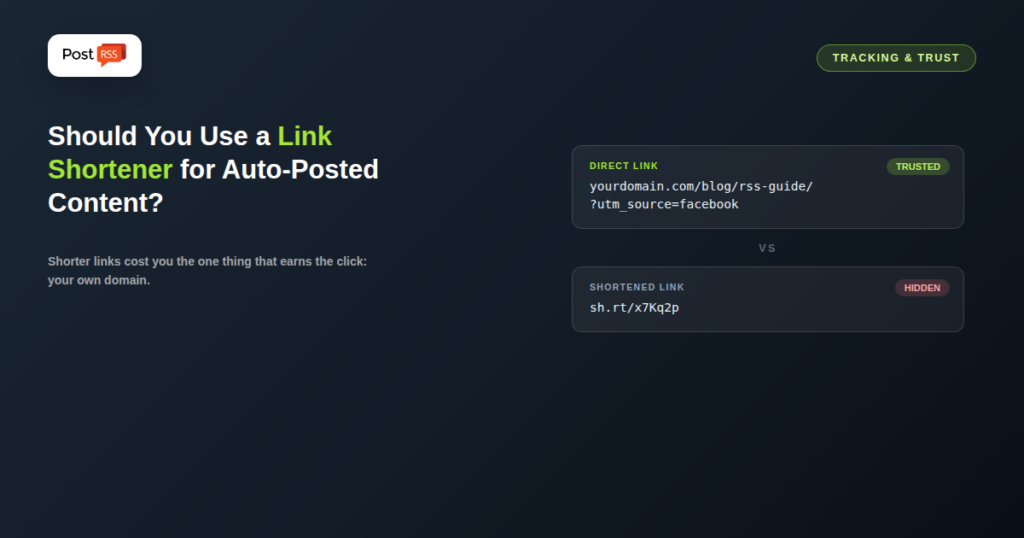
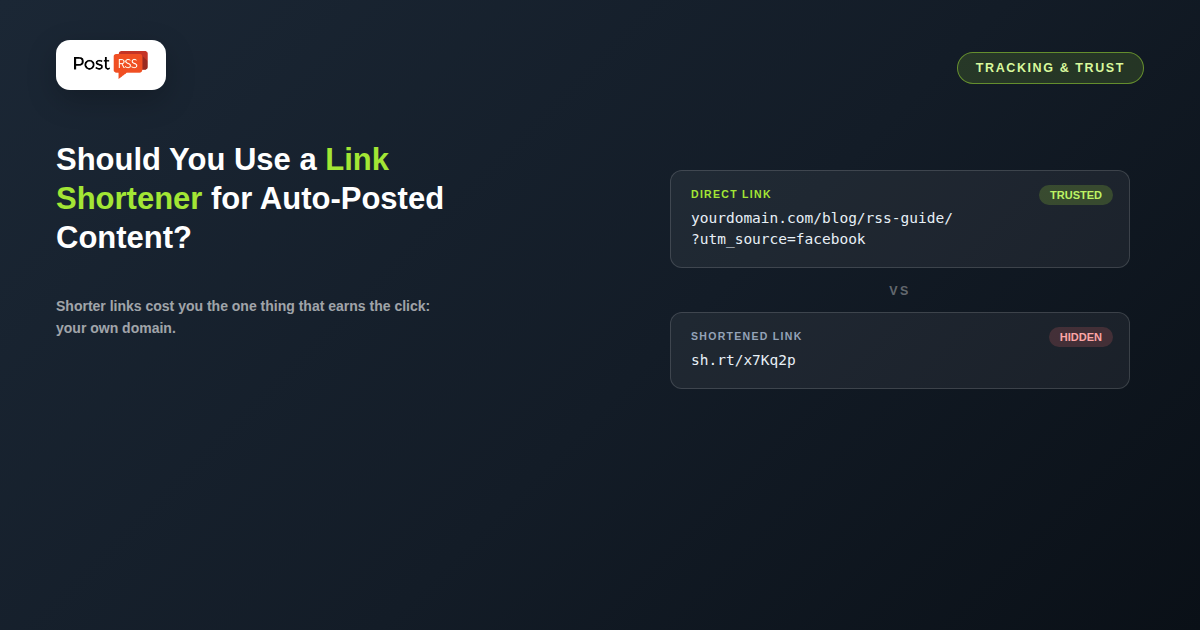
Trust. This is the big one. A shortened link hides its destination, which is exactly the property that makes shorteners popular with phishing and malware campaigns. Users have learned this. Security-aware audiences — which includes most professional and technical audiences — hesitate before clicking a link that doesn’t show where it goes. Your own domain in a link is a credibility signal you give up the moment you shorten it.
Platform treatment. Several platforms have historically treated shortened links less favourably than direct links, on the reasonable basis that link hiding correlates with low-quality content. Platforms rarely document this precisely and the specifics change over time, which is itself a reason for caution: you’re accepting an unknown and unstable risk in exchange for a modest convenience.
Single point of failure. If the shortening service goes down, every link you have ever published through it breaks simultaneously — including years-old posts. If the service shuts down entirely, those links break permanently. This has happened repeatedly across the industry, and there is no way to fix it retroactively, because the broken links live in other people’s feeds and archives.
An extra redirect hop. Every click takes a detour through another server. On a fast connection this is negligible; on a slow mobile connection it’s another round trip before anything loads, and a small share of users abandon during it.
Losing the referrer signal. Depending on how the redirect is implemented, the referrer information your analytics receives can be degraded, making it harder to see which platform traffic actually came from — the opposite of what you were trying to achieve.
| Shortened link | Direct link with UTM | |
|---|---|---|
| Shows your domain | No | Yes |
| Click tracking | Built in | Via your own analytics |
| Survives service shutdown | No | Yes |
| Extra redirect hop | Yes | No |
| Destination editable after posting | Sometimes | No |
| Attribution in your own analytics | Can be degraded | Full |
There’s a version of shortening that keeps most of the benefits and removes most of the trust problem: a branded short domain. Instead of a generic shortener domain, you register a short domain of your own and run links through that. Readers see your brand rather than an anonymous service, so the credibility loss largely disappears, while you keep the tracking and the editable destinations.
Two caveats keep this from being a free win. It requires buying and maintaining a domain, which is a small ongoing cost and one more thing that can expire unnoticed. And the failure mode doesn’t vanish — it moves. If your branded domain lapses or the service behind it stops working, your links still break; the difference is that the risk is now yours to manage rather than a third party’s to impose on you.
For organisations publishing at real volume, this is usually the right answer. For a personal blog posting a few times a week, it’s more infrastructure than the problem justifies.
For the majority of RSS-driven automated posting, the strongest option is the simplest: post the direct link to your own content, with UTM parameters for attribution.
This gives you your domain visible in every post, full attribution in your own analytics, no dependency on an outside service, no extra redirect, and no risk of mass link rot. The main thing you give up is a click count that lives in someone else’s dashboard — and your own analytics gives you a better version of that anyway, along with everything that happens after the click.
A workable UTM convention for automated posts:
https://example.com/blog/my-post/
  ?utm_source=facebook
  &utm_medium=social
  &utm_campaign=rss-auto
Keep utm_source as the platform name, utm_medium as social, and use utm_campaign to separate automated distribution from manual posting so you can compare the two honestly. Consistency matters more than the exact scheme — analytics tools treat Facebook and facebook as different sources, so pick lowercase and stay with it.
In a feed-driven setup, the link that gets posted comes from the <link> element of each RSS item, which is your canonical post URL. That’s already the direct link to your own domain — the default behaviour is the recommended behaviour, which is a pleasant situation to be in.
If you want UTM parameters on automated posts, there are two clean ways to add them. Some automation tools, PostRSS included, can append tracking parameters to outgoing links per target, which means the same feed can carry platform-specific attribution without any changes to your site. Alternatively, you can generate the parameters in the feed itself if you control feed output, though this makes the feed less useful for other consumers such as feed readers.
Inserting a shortener into this chain means adding a step that rewrites every link before posting — more moving parts, another service in the path, and a dependency that now sits between your content and every reader.
To be fair to the tool, several situations justify it:
The common thread: shorteners earn their place when the underlying URL is genuinely a problem. When the underlying URL is a clean link to your own blog post, shortening it trades away a trust signal for very little.
One practical detail that trips up automated setups: how a shortened link interacts with the preview card a platform renders. When you post a direct link, the platform fetches that page and builds the card from its Open Graph tags. When you post a shortened link, the platform has to follow the redirect first, then read the destination’s tags.
Most major platforms handle this correctly. Some smaller ones, and some chat and messaging apps, do not — they either fetch the shortener’s own page and produce a blank or generic card, or they give up and render no preview at all. The result is a post with no image and no headline, which performs dramatically worse than the same content posted as a direct link. If you use a shortener and your preview cards look empty on a particular platform, this redirect-following behaviour is the first thing to test.
Part of the appeal of shorteners is the instant click count, and it’s worth being clear about what that number does and doesn’t tell you. A click count measures how many times a link was requested. It doesn’t distinguish a genuine reader from a bot, a preview fetch, or a security scanner — and social platforms, messaging apps, and email security tools all fetch links automatically, sometimes several times per post. Shortener click counts routinely run higher than the sessions your own analytics records, and the gap is not fraud; it’s automated traffic.
Your own analytics, reached through UTM parameters, measures something more useful: a real session, with the pages that followed, the time spent, and whether anything you care about happened afterward. If the goal is to know which platform sends visitors who actually read and convert, that’s the measurement that answers it — which is why the tracking argument for shorteners is weaker than it first appears.
A few practices reduce the downside:
Several platforms have historically treated link-hiding services less favourably, and specifics change over time without being documented. Direct links to your own domain avoid the question entirely.
Social links are typically nofollow and don’t pass ranking signals either way, so the direct SEO impact is minimal. The indirect effect is real: lower click-through means less traffic and engagement.
They break — permanently, and all at once, including links in years-old posts you can no longer edit. This is the strongest single argument against generic shorteners for evergreen content.
Yes, in most respects. It restores the trust signal of showing your own brand while keeping tracking and editable destinations. The failure risk doesn’t disappear, but it becomes yours to control.
Yes. The shortener counts clicks; UTM parameters tell your own analytics what those visitors did afterward. Keeping both means attribution survives if you stop using the shortener.
No. X counts every link as a fixed 23 characters regardless of its real length, so there’s nothing to save there.
Many can, including PostRSS, appending parameters per target so each platform gets its own attribution without editing your site or your feed.
For automated posting of your own content, direct links with UTM parameters beat shortened links on nearly every dimension that matters: trust, resilience, attribution quality, and speed. Reserve shorteners for the cases where the underlying URL is genuinely the problem — affiliate links, offline material, destinations that must stay editable — and use a branded domain when you do. Your domain appearing in every post is a small, compounding credibility signal, and it costs nothing to keep.
What changed in the networks, what broke, and how to fix it before it costs you reach.
Built by Internet Solutions, the team behind PostRSS. Each product saves you time in its own way.
 English
 Lietuviškai
 Deutsch
 Français
 Русский
 Español
 Polski
 Italiano
 Українська
 Čeština
 Português
 日本語
日本語 Latviešu valoda
 Eesti
Eesti Magyar
 Bahasa Indonesia
 Türkçe
 हिन्दी
 Ελληνικά
 العربية
 ไทย
ไทย Tiếng Việt
 Română
 Bahasa Melayu
 বাংলা
বাংলা