Updated: August 24, 2026
A single-location business can get away with one person handling social media as a side task. A franchise or multi-location brand can’t — not without either building a real marketing team or accepting wildly inconsistent social presence between locations. The core tension is structural: corporate wants brand consistency across every location’s social accounts, while each location has its own local promotions, hours, and community involvement that corporate can’t and shouldn’t fully control. RSS automation offers a practical middle path, letting a shared content stream and local content streams both flow automatically without requiring a person at every location to manually manage social media.
Ask ten franchise owners how their locations’ social media looks and you’ll typically hear the same story: a few locations post consistently and look great, most post sporadically, and a handful haven’t posted anything in months. This isn’t usually a lack of content — corporate marketing often produces plenty of brand assets and campaign materials. It’s a distribution problem multiplied by location count: getting content from wherever it’s created to every location’s individual accounts requires either a lot of manual coordination or a system that does it automatically. At five locations, manual coordination is annoying. At fifty, it’s simply not sustainable without dedicated headcount most franchise operations don’t have.
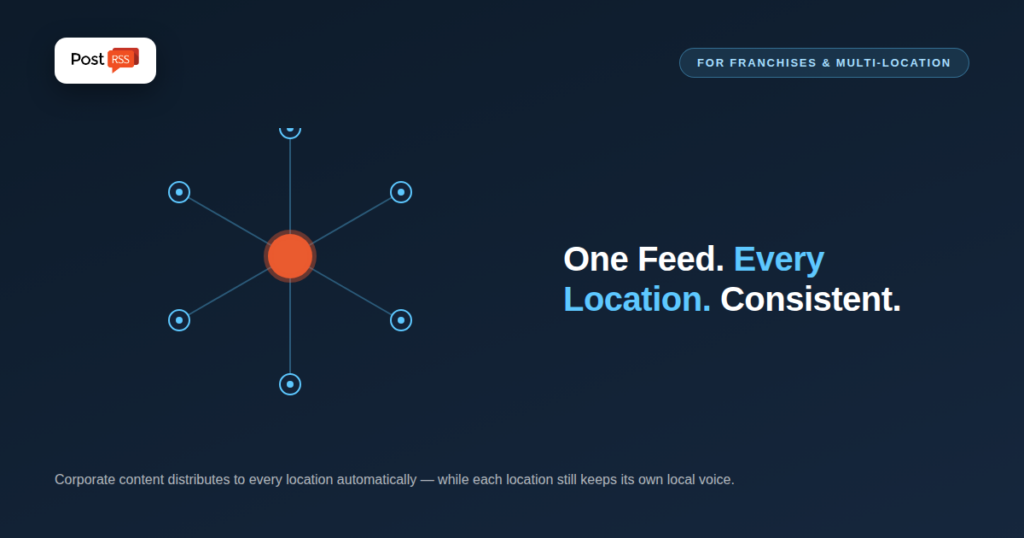
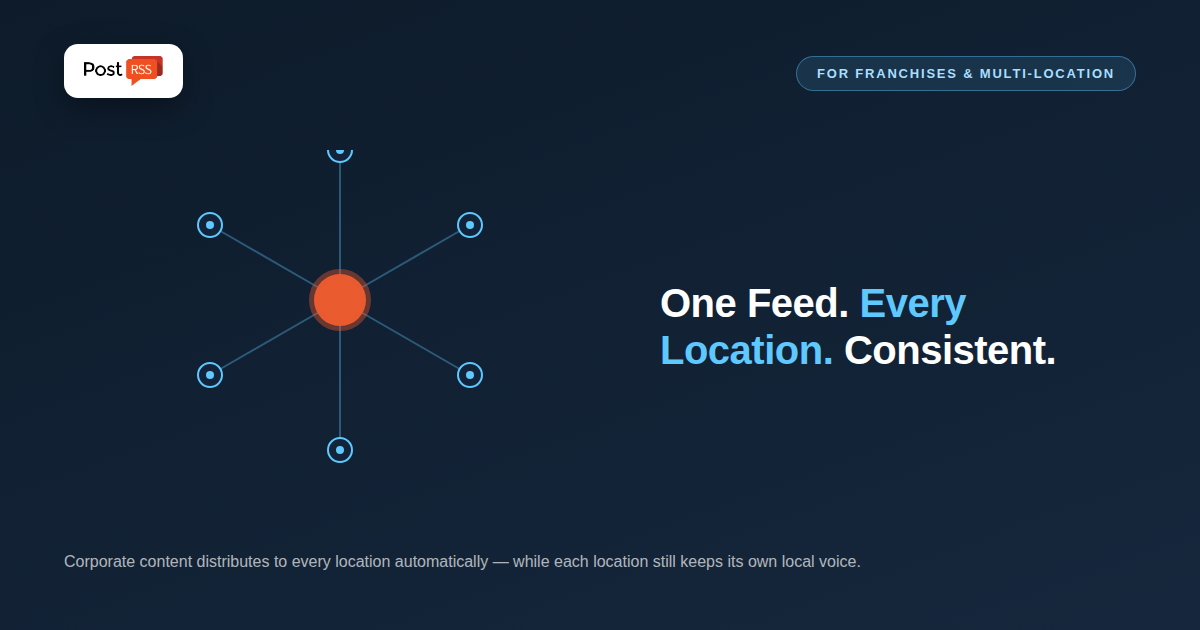
The workflow that scales well for multi-location brands separates content into two streams, both automated the same way but from different sources:
Both streams run through the same RSS-to-social automation pattern independently, which means corporate doesn’t have to manually push content to every location, and individual locations aren’t blocked waiting on corporate for routine local updates.
The two-stream model works because it matches how decision-making authority is already split in most franchise and multi-location operations — corporate controls brand messaging, locations control local specifics. This avoids the two most common failure modes: locations posting off-brand content because they have full control of the same account corporate uses (solved by keeping the streams and their sources genuinely separate), and locations unable to post anything timely because every piece of content has to go through corporate approval first (solved by giving locations their own independent feed that doesn’t require corporate sign-off for routine local updates).
| Stream | Typical Content |
|---|---|
| Corporate/brand-wide | National promotions, product launches, brand campaigns, company milestones, press coverage |
| Local/location-specific | Local event participation, hours changes, staff spotlights, location-specific offers, community involvement |
A customer who follows one location’s Facebook page and a friend’s different location’s page notices when one looks active and professional while the other looks abandoned — and that inconsistency reflects on the brand as a whole, not just the individual location. At a handful of locations, this is a minor issue; at dozens or hundreds, it becomes a real brand-risk problem, since prospective customers and franchise investors alike often judge the whole brand by whichever location’s social presence they happen to encounter first. Automating the corporate stream at minimum guarantees a baseline of consistent, active-looking content across every location, even for locations that never get around to producing much local content of their own.
Most location or store managers aren’t marketing professionals, and asking them to manually cross-post to Facebook, X, LinkedIn, and Pinterest on top of running daily operations is a burden that predictably gets deprioritized. Automation lowers that burden significantly: a manager writes one local update (or even just approves a corporate-provided template with local details filled in) and it automatically reaches every platform their location maintains, rather than requiring them to personally log into and post on each platform individually.
Franchise operations add a layer most corporate-owned multi-location businesses don’t have: franchisees are independent business owners, not employees, which means corporate can provide tools and brand content but generally can’t mandate exactly how a franchisee runs their local marketing. The two-stream model handles this well — corporate can offer the brand-wide feed as an opt-in resource every franchisee is encouraged to connect, while leaving each franchisee’s local feed entirely under their own control. This respects franchisee independence while still making it easy for franchisees who want consistent local automation to get it without building anything themselves.
A growing multi-location brand or franchise regularly faces the same setup task: a new location opens and needs its social presence established quickly. With the two-stream automation pattern already built, onboarding a new location mostly becomes a matter of creating its social accounts and connecting them to the existing corporate feed — instantly giving the new location a consistent, active-looking baseline presence from its very first day, without waiting for a local manager to build up a content history from scratch. A local feed can be added later once the location has its own community presence and local content worth publishing, but the corporate stream alone means no location ever launches with empty, inactive-looking social accounts.
For a brand managing dozens of locations, the most useful ongoing metric isn’t engagement per location — it’s simply whether every connected location’s accounts are actually receiving content on schedule. A quick monthly check of which locations’ feeds are active and publishing versus which have gone quiet (a local feed that stopped updating, a location that never got its accounts connected) catches gaps before they turn into months of an abandoned-looking page. This is a much lower-effort audit than reviewing content quality location by location, and it directly targets the failure mode — inconsistent presence — that automation exists to prevent in the first place.
A 40-location franchise brand connects its corporate marketing feed to all 40 locations’ Facebook and X accounts, ensuring every location’s page reflects national promotions and campaigns consistently. Fifteen of those locations also maintain their own simple local update feed for community events and location-specific offers, connected only to their own accounts. The other 25 rely solely on the corporate feed for now. Every location has an active, consistent baseline presence from day one, and any location that wants to add local flavor can do so without corporate involvement or coordination overhead.
Larger multi-location brands sometimes consider a full social media management platform with built-in multi-account support instead of an RSS-based approach. That’s a reasonable path if the brand also needs unified inbox management, approval workflows, and detailed cross-location reporting bundled together — genuinely useful for a marketing team actively managing engagement across every location. But for brands whose actual bottleneck is purely “content isn’t reaching every location’s accounts reliably,” a lighter RSS-based distribution layer solves that specific problem at a fraction of the cost and setup complexity of a full suite, without requiring every location to learn a new platform’s inbox and workflow tools they may never use.
Multi-location brands can start with just the corporate stream — connecting one central feed to every location’s accounts — and add per-location feeds incrementally as individual locations want more local control. See our multi-account management guide for coordinating several accounts under one workflow, and our pricing breakdown for plans that scale with location count.
Yes — the automation itself scales by target count rather than by content complexity, so a single feed can distribute to as many connected accounts as your plan supports.
Keeping each location’s feed-to-account connection separate and independently configured means there’s no shared queue or account where cross-posting between locations could happen by mistake.
Most site platforms and blog tools generate an RSS feed automatically from new posts, so a franchisee typically needs to know how to publish a blog post, not how to build or maintain a feed manually.
Nothing about the automated corporate stream prevents a location from also posting manually on top of it; the two aren’t mutually exclusive, and a location can use automation as a baseline while still adding manual posts whenever they want extra control.
Once the corporate feed and automation pattern already exist, connecting a new location’s accounts to that feed typically takes minutes, giving the new location an active baseline presence immediately rather than after weeks of manual setup.
Since every location pulls from the same live corporate feed, an update to that feed’s content flows to every connected location automatically on the next publish — there’s no need to manually redistribute a messaging change to each location individually.
Multi-location brands don’t need to choose between brand consistency and local relevance — the two-stream automation pattern delivers both, without requiring a marketing team large enough to manually manage social media at every single location. A corporate feed guarantees a consistent baseline everywhere, and an optional local feed lets any location add its own voice, all running automatically once set up, at a scale a purely manual approach simply can’t sustain.
What changed in the networks, what broke, and how to fix it before it costs you reach.
Built by Internet Solutions, the team behind PostRSS. Each product saves you time in its own way.
 English
 Lietuviškai
 Deutsch
 Français
 Русский
 Español
 Polski
 Italiano
 Українська
 Čeština
 Português
 日本語
日本語 Latviešu valoda
 Eesti
Eesti Magyar
 Bahasa Indonesia
 Türkçe
 हिन्दी
 Ελληνικά
 العربية
 ไทย
ไทย Tiếng Việt
 Română
 Bahasa Melayu
 বাংলা
বাংলা