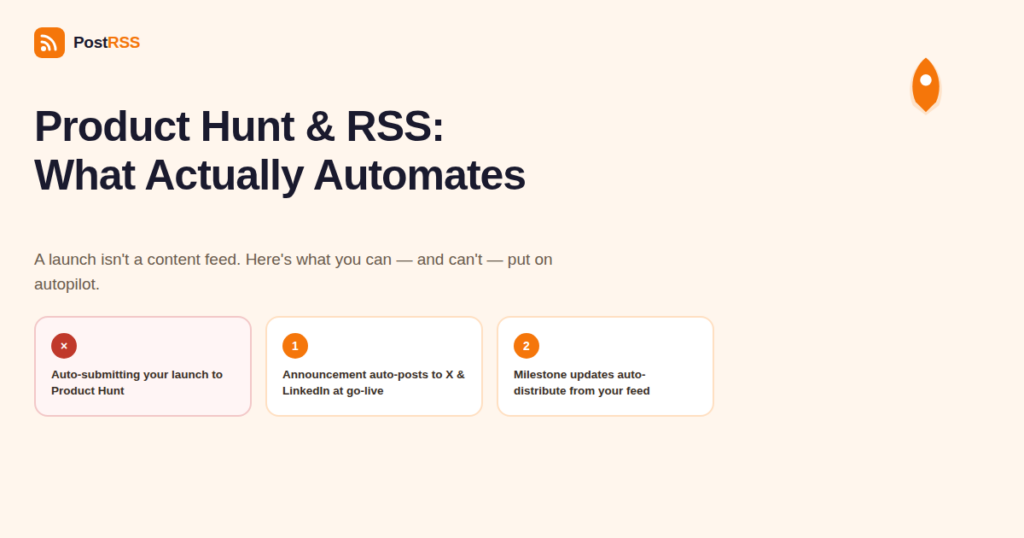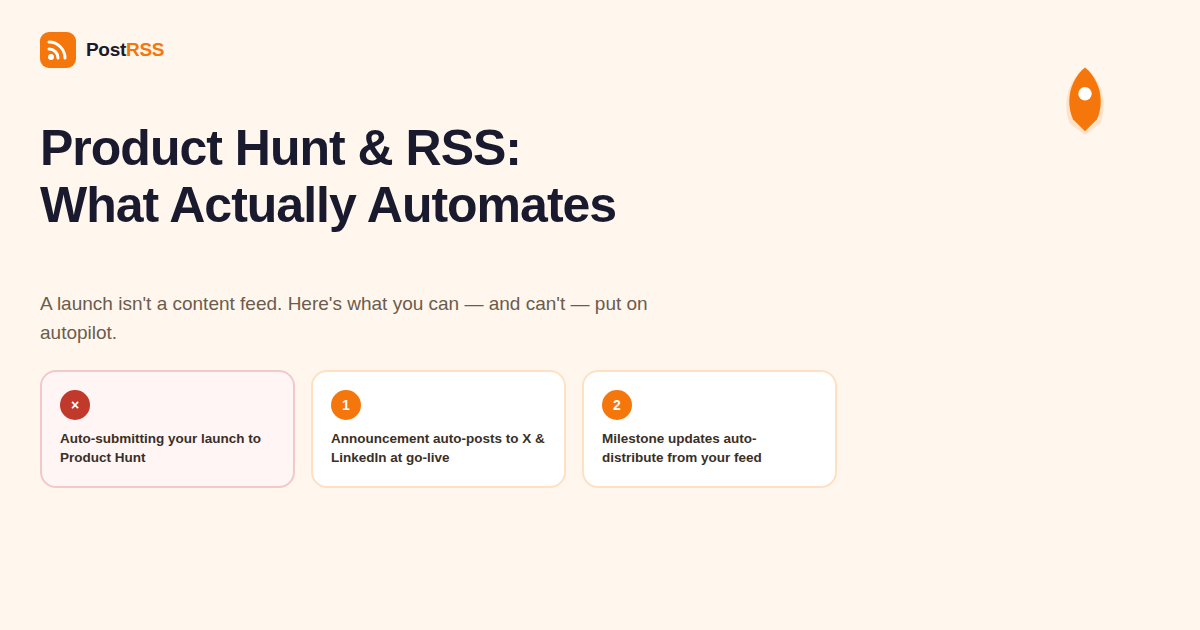
Founders launching a SaaS product almost always ask the same question once they’ve automated their blog’s distribution to Facebook, X, and LinkedIn: can I do the same thing on Product Hunt? Point an RSS feed at it, and let new items post automatically the way they do everywhere else?
The short answer is no – and understanding why reveals a lot about what RSS auto-posting is actually good for. This guide covers how Product Hunt’s launch model works, what its API does and doesn’t allow, and what you should automate instead to make the most of launch day.
Every platform PostRSS and similar tools connect to – Facebook Pages, X, LinkedIn, Telegram – works the same way: you publish new content regularly, and each new item becomes a new post. Product Hunt doesn’t work like that. A product typically launches once (Product Hunt does allow limited re-launches for major updates, but this is the exception, not a content cadence). There is no ongoing stream of “new items” to auto-post the way there is with blog posts or news articles.
This single structural fact is why no auto-posting tool – not PostRSS, not any competitor – lists Product Hunt as a supported network. It’s not a technical restriction that might get lifted; it’s a mismatch between what RSS auto-posting solves (recurring content, one item at a time, published continuously) and what a Product Hunt launch is (one curated event, promoted intensely for 24 hours, then largely done).
Product Hunt does publish a public API (GraphQL v2, replacing the older REST API), and it’s genuinely useful for some things:
What it does not offer is a “submit a new post automatically from a feed” endpoint comparable to what Telegram or Facebook expose. Product Hunt’s moderation team reviews launches, and automated, unsolicited submission would work against the platform’s entire curation model – a maker showing up personally, engaging with comments, and rallying support is central to how Product Hunt functions, not incidental to it.
| Platform | Content model | RSS auto-posting fit |
|---|---|---|
| Facebook / X / LinkedIn | Continuous feed of posts | Strong – each new RSS item becomes a new post |
| Telegram Channels | Continuous broadcast feed | Strong – native bot API supports it directly |
| Product Hunt | One curated launch event per product (with rare re-launches) | Not applicable – there’s no recurring “new item” to post |
If your mental model is “RSS auto-posting works everywhere, it’s just a matter of finding the right integration,” Product Hunt is the clearest example of a platform where that model simply doesn’t apply, regardless of which automation tool you use.
None of this means automation has no place in your launch. It just moves to a different part of the workflow – the parts that do look like a content feed.
The moment your Product Hunt page goes live, your own announcement – a blog post, changelog entry, or press release on your own site – should already be feeding into your other channels automatically. If that announcement lives in your site’s RSS feed, it can auto-post to X and go out on RSS to LinkedIn the instant it’s published, freeing you up to spend launch day replying to Product Hunt comments instead of manually copy-pasting links across five tabs.
Product Hunt launches go live at a fixed time (typically 12:01 AM Pacific). If your own blog post or changelog entry is queued and scheduled to publish at that exact moment, your RSS automation handles the fan-out to your other channels within minutes, without anyone needing to be awake at midnight to do it manually.
Product Hunt publishes RSS/Atom feeds for topics and categories (for example, its “developer tools” or “SaaS” topic feeds). These are useful in the opposite direction from what founders usually ask about: instead of pushing your content to Product Hunt, you can pull Product Hunt’s own feed into a monitoring tool or a private Slack digest to track what’s launching in your category, and whether it’s worth acknowledging, competing with, or partnering with.
Once you hit a milestone – “#3 Product of the Day,” “500 upvotes” – that update belongs on your own content feed as a short blog post or changelog note, which then flows out through your existing content distribution automation. The milestone announcement is exactly the kind of recurring, single-item content that RSS auto-posting is built for, even though the Product Hunt page itself isn’t.
| Task | Automate? |
|---|---|
| Submitting the product to Product Hunt | No – manual, one-time, done in advance through Product Hunt’s own submission flow |
| Replying to comments during the launch window | No – this is the part that most affects ranking, and it needs a real person |
| Publishing your own announcement post at go-live time | Yes – schedule it to publish the instant your listing goes live |
| Cross-posting that announcement to Facebook, X, LinkedIn, Telegram | Yes – handled automatically once the announcement post is live |
| Posting milestone updates (“we hit #1!”) | Yes – write a short update, let it auto-distribute |
| Monitoring competitor launches in your category | Yes – via Product Hunt’s own topic RSS feeds, pulled into a reader or digest |
Successful Product Hunt launches rarely start cold on launch day itself – most of the visible traction comes from an audience a team already built beforehand. This is where RSS automation earns its keep well before the launch even happens:
None of this touches Product Hunt directly, but it builds the exact audience that determines whether a launch gets meaningful upvotes in its first few hours – which matters more to Product Hunt’s ranking algorithm than almost anything else.
Teams that assume “if RSS automates everything else, it should automate this too” tend to run into the same handful of problems:
| Mistake | Why it backfires |
|---|---|
| Trying to auto-submit via scraped/unofficial API calls | Violates Product Hunt’s terms and risks account suspension before launch day even starts |
| Scheduling the launch announcement but not staffing comment replies | Comment engagement is a major ranking signal – an automated post with no human follow-up underperforms |
| Re-launching too often to “keep the feed fresh” | Product Hunt limits and scrutinizes repeat launches; treating it like a content calendar damages credibility |
| Ignoring cross-posting entirely because “Product Hunt itself can’t be automated” | Misses the real opportunity – the announcement, the countdown, and the recap are all automatable even though the Hunt listing isn’t |
The pattern across all four mistakes is the same: automation belongs on the content you fully control (your own site, your own feed, your own channels), not on the parts of Product Hunt that depend on manual curation and real-time human presence.
Because Product Hunt launches reset at midnight Pacific and rank primarily on activity within the first several hours, the gap between “listing goes live” and “your audience finds out” matters more here than on almost any other platform this blog covers. A blog post that auto-posts to Facebook, X, and LinkedIn within minutes of publishing – instead of whenever a team member remembers to share it manually – can be the difference between catching early-morning traffic in your audience’s time zone and missing the launch-day window entirely. Teams that pre-write their announcement, schedule it to publish at the exact go-live minute, and let automation handle the fan-out consistently see faster early upvote velocity than teams relying on someone manually posting after they wake up.
No mainstream automation platform offers a “submit new product” action against Product Hunt’s API for the reasons above – launches are meant to be a deliberate, one-time, manually curated event, not a recurring automated action.
Yes – Product Hunt publishes feeds for its homepage and individual topics/categories, which you can pull into any RSS reader or monitoring tool. This works in the “read” direction; it’s not a mechanism for posting to Product Hunt.
Yes, and this is the actually useful automation here. Publish your own announcement (blog post, changelog entry, or landing page update) with a link to your live Product Hunt page, and let your existing RSS auto-posting handle distribution to Facebook, X, LinkedIn, and other connected networks the moment it’s published.
Product Hunt’s moderation guidelines restrict how often a product can launch or re-launch, and submissions that look automated or spammy risk removal and account penalties. Treat a launch as a single, carefully-timed manual event, not a repeatable automation target.
Yes – draft and schedule your own blog/changelog announcement to publish at the exact moment your Product Hunt listing goes live, so your cross-posting automation fires immediately instead of you scrambling to post manually at midnight.
Significant value, just not pointed at Product Hunt directly. The announcement post, the milestone updates, and the post-launch recap all belong in your regular content feed, where your existing automation already does the distribution work.
Support depends on Product Hunt offering a submission API designed for that purpose, which would run against its core curation model. Until and unless that changes, the practical approach is to automate everything around the launch and keep the launch submission itself manual.
The automation opportunity doesn’t end when the 24-hour launch window closes. Whatever the final result – top 5 product of the day, a respectable middle-of-the-pack finish, or a launch that didn’t get the traction you hoped for – a short recap post on your own blog covering what happened, what you learned, and what’s next keeps the story going for an audience that only caught the tail end of it. That recap, like every other piece of content in this workflow, is best written once and then left to your existing RSS automation to distribute across Facebook, X, LinkedIn, and any other connected channel, rather than manually reposted to each one by hand.
Product Hunt doesn’t fit the RSS auto-posting model because a launch isn’t a recurring content stream – it’s a single curated event that depends on manual engagement to succeed. No automation tool bridges that gap, and trying to force it would work against how the platform is designed to function. The real opportunity is automating everything adjacent to the launch: your own announcement post, its distribution to every other channel the moment it’s live, and the milestone updates that follow – all of which are exactly the kind of single-item, recurring content that RSS auto-posting already handles well.
What changed in the networks, what broke, and how to fix it before it costs you reach.
 English
 Lietuviškai
 Deutsch
 Français
 Русский
 Español
 Polski
 Italiano
 Українська
 Čeština
 Português
 日本語
日本語 Latviešu valoda
 Eesti
Eesti Magyar
 Bahasa Indonesia
 Türkçe
 हिन्दी
 Ελληνικά
 العربية
 ไทย
ไทย Tiếng Việt
 Română
 Bahasa Melayu
 বাংলা
বাংলা