Heavy equipment dealers and commercial truck dealerships sell a fundamentally different kind of inventory than a typical car lot — excavators, skid steers, semi-tractors, and specialized trailers that often number in the dozens rather than hundreds, each with a price tag and buying cycle that looks nothing like consumer auto retail. That difference matters for social media marketing: the audience is smaller, more professional, and more likely to be actively watching for a specific piece of equipment than casually browsing a feed. Getting new inventory in front of that audience the moment it lands on the lot is one of the more direct ways automotive marketing principles apply to a genuinely different buyer.
This guide covers how heavy equipment and commercial truck dealers can use RSS-driven automation to post new inventory automatically, why the setup differs meaningfully from a standard car dealership, and where manual attention still matters for this specific industry.
Standard car dealership automation (and the RSS feeds most dealer management systems generate) assumes high volume, relatively similar units, and a broad consumer audience. Heavy equipment and commercial truck dealers differ in ways that change the setup:
Most dealer management systems (DMS) and equipment marketplace integrations (used for listing to sites like MachineryTrader or TruckPaper) can output an RSS or XML feed of current inventory. The core automation setup mirrors what PostRSS does for any e-commerce inventory feed: each new listing becomes a new feed item, which triggers an automatic post the moment it’s added, pulling the unit’s title, key specs, price, and primary photo directly from the feed.
| Feed Field | What It Should Contain | Why It Matters for This Industry |
|---|---|---|
| Title | Year, make, model, and one standout spec (e.g., hours, mileage) | Buyers scan titles for exact matches to their search criteria |
| Description/excerpt | Key specs: hours/mileage, condition, attachments, financing availability | Serious buyers make initial screening decisions from these details alone |
| Featured image | Clear exterior shot, ideally showing the unit from an angle that reveals condition | Equipment buyers scrutinize wear and condition far more than typical car shoppers |
| Price | Listed price or “call for pricing” if applicable | B2B buyers often filter or search by price range immediately |
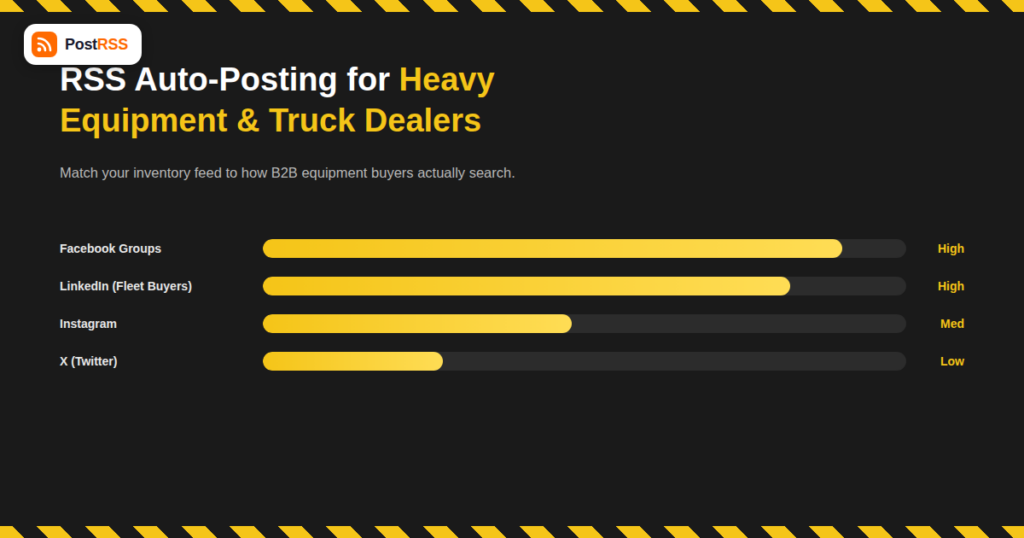
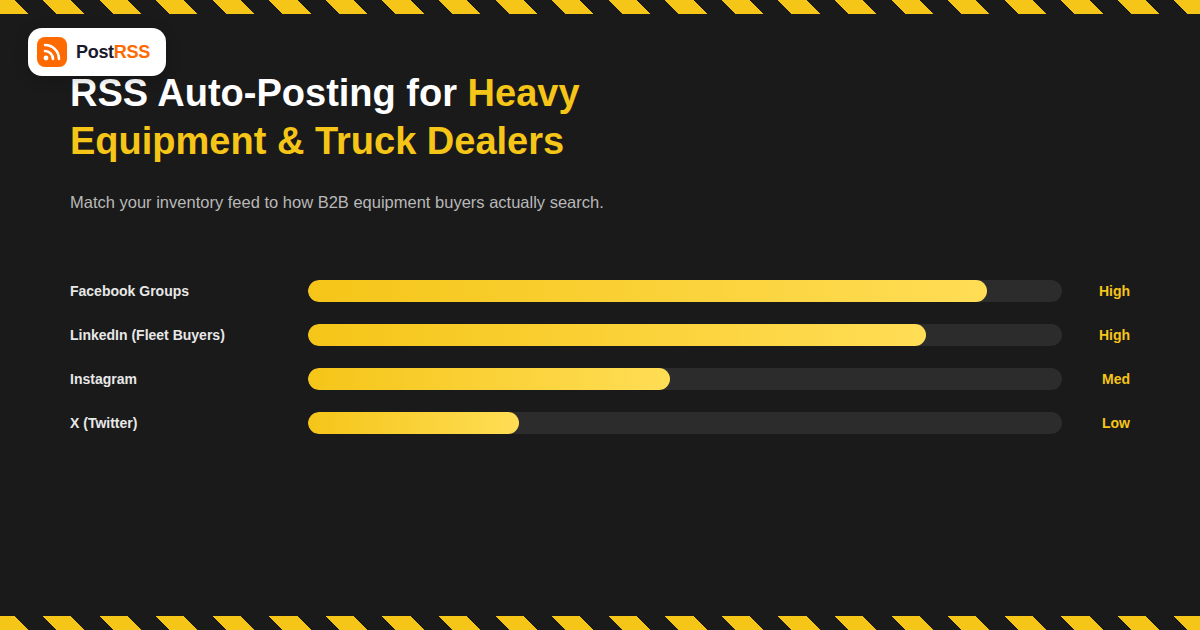
| Platform | Relevance for Heavy Equipment/Truck Dealers |
|---|---|
| Strong — regional buy/sell groups and marketplace-style browsing are common in this industry | |
| Strong for reaching fleet managers, procurement contacts, and B2B buyers directly | |
| Moderate — useful for showcasing well-maintained or unique units visually, less central than Facebook/LinkedIn | |
| X (Twitter) | Lower priority for most dealers, though useful for time-sensitive price-drop announcements |
One of the more common frustrations for equipment dealers running automation is a follow-up inquiry on a unit that already sold — a direct result of a feed that isn’t updated promptly when inventory status changes. Because heavy equipment listings move at a different pace than consumer vehicles (sometimes staying listed for weeks), it’s worth confirming your DMS or inventory management system updates the RSS feed the moment a unit is marked sold, not just when someone remembers to update the website. This is a source-data hygiene issue rather than an automation-tool issue — the automation will always be exactly as current as the feed it reads from.
Given the longer consideration cycles typical of this industry, a single auto-post when a unit is first listed often isn’t enough exposure. Many dealers build a deliberate repost cadence for inventory that hasn’t sold within a set window — for example, a fresh post with updated framing (“price reduced,” “still available,” “financing now offered”) at the 2-week and 4-week marks for units still listed. This requires either a feed structure that flags “still active” listings for a scheduled re-share, or a manual periodic review of aging inventory to select candidates for a second push — full automation of the *initial* listing pairs well with a lighter-touch, periodic manual review of what’s aged past the typical selling window.
Inventory listings are the highest-value automation target, but dealers in this space often have other RSS-automatable content worth including:
Because equipment purchases involve longer consideration cycles and often start with a phone call rather than an online checkout, standard e-commerce conversion tracking doesn’t map cleanly onto this industry. A more useful set of metrics for dealers running product feed syndication for inventory looks like this:
| Metric | How to Track It | What It Tells You |
|---|---|---|
| Click-throughs from social posts to the listing page | UTM-tagged links in each auto-posted listing | Whether the auto-posted content is actually driving traffic to specific units |
| “Where did you hear about us” tracking on inbound calls | Sales team logging referral source | Whether social-sourced leads are converting to actual inquiries, since many buyers still call rather than click through a form |
| Time-to-sale for auto-posted vs. manually posted units | Comparing DMS sold dates against posting logs | Whether automated same-day posting is measurably shortening the sales cycle |
| Engagement rate by equipment category | Native platform analytics, segmented by listing type | Which categories (excavators vs. trailers vs. trucks) perform best on which platform, informing where to focus manual curation effort |
The underlying feed mechanics (RSS/XML with title, description, image, price fields) are the same; what differs is what should go in those fields — equipment listings need to foreground specs like hours and attachments that don’t apply to standard vehicles.
Not necessarily — many dealers route standard inventory to Facebook and LinkedIn automatically, while reserving Instagram for a manually curated selection of visually distinctive or premium units, since Instagram’s audience responds better to a smaller, higher-quality selection than a full inventory feed.
Auction listings usually warrant a separate, higher-frequency feed and posting cadence than standard inventory, since the buying window is compressed and repeat visibility in the days leading up to an auction matters more than it does for open-ended listings.
Often yes — fleet managers and procurement contacts are professionally active on LinkedIn regardless of how large the dealer’s immediate service area is, and B2B equipment purchases frequently involve some research done on that platform even for regional buyers.
Treating equipment listings like car listings — posting a bare price and photo without the specific operational details (hours, attachments, maintenance history) that professional buyers actually need to make an initial screening decision.
Yes, if your DMS reflects the price change in the feed and generates an update to the item (some systems treat a price change as a feed update, others require a fresh listing) — check how your specific inventory system handles this before assuming it triggers automatically.
Yes, for dealers who also run a rental operation — a feed of currently available rental units works the same way as a for-sale inventory feed, and often benefits even more from same-day automated posting since rental availability changes faster and short-notice availability is exactly the kind of time-sensitive update social automation handles well.
Heavy equipment demand follows recognizable seasonal patterns that differ by category, and a fixed, unvarying posting cadence misses opportunities these patterns create. Construction and earthmoving equipment typically see a demand uptick in early spring as project season ramps up, while snow removal and winter maintenance equipment obviously peak in the fall ahead of winter. Commercial trucking inventory tends to move more steadily year-round but sees a bump around fiscal year-end for fleets making year-end capital purchases for tax purposes. None of this changes the core automation setup, but it’s worth layering in seasonal campaign content — a “spring equipment readiness” push, a “year-end fleet purchase” reminder — as manually curated posts that complement the always-on automated inventory feed, timed to when buyers in each category are actually most active.
Most dealers in this space already list inventory on specialized marketplaces like MachineryTrader, Equipment Trader, or TruckPaper in addition to their own website. Where possible, treat your own website’s inventory feed as the canonical source that drives your social automation, rather than trying to pull a feed from the third-party marketplace itself — marketplace feeds are often formatted for that platform’s specific display needs and may not carry the same level of detail your own site’s listing page does. Keeping your website as the source of truth also means your automated social posts drive traffic to a page you control and can optimize, rather than sending buyers to a third-party marketplace listing where competitors’ inventory appears alongside yours.
Heavy equipment and commercial truck dealers get the most value from RSS automation by treating each listing with the operational detail their B2B buyers actually search for, prioritizing Facebook and LinkedIn over more consumer-focused platforms, and pairing automated initial listing posts with a periodic manual review of aging inventory that needs a second push. The mechanics are the same automation PostRSS provides for any inventory feed — the difference that matters is making sure the feed itself carries the specs this audience is actually searching for.