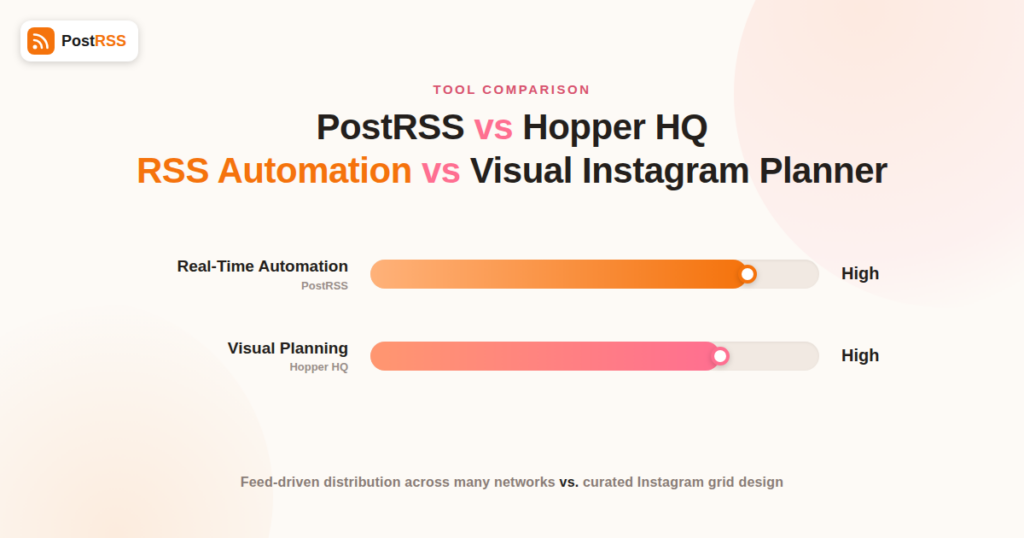
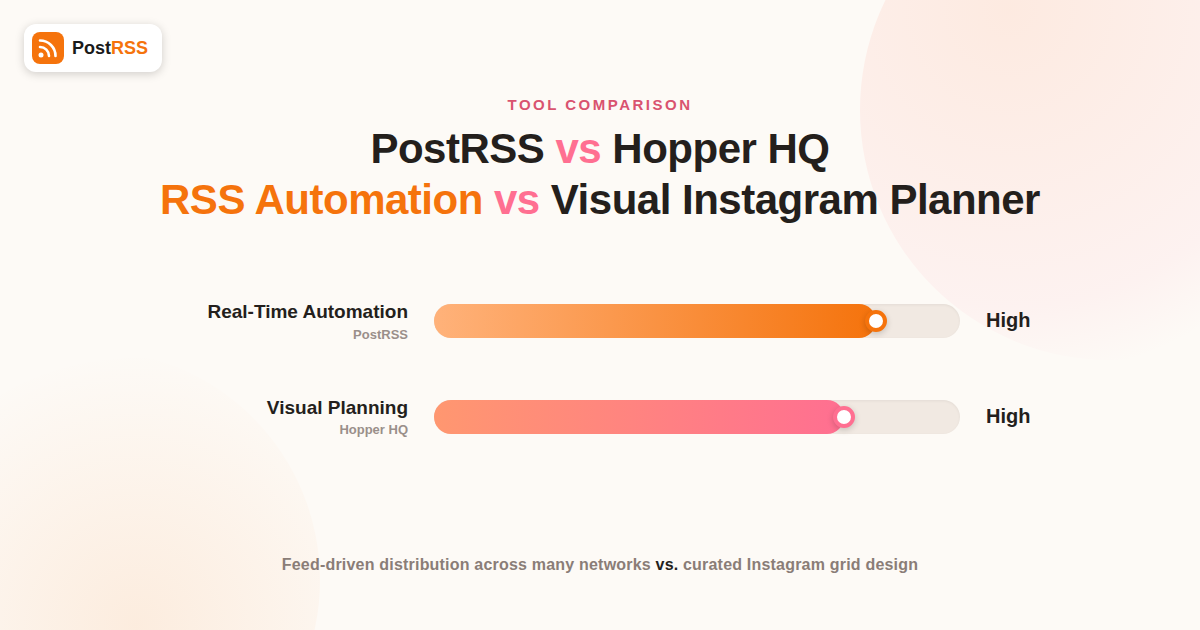
Anyone comparing PostRSS and Hopper HQ has usually already noticed that they don’t do the same job, even though both show up in searches for “social media scheduling tools.” PostRSS watches a website’s RSS or Atom feed and automatically pushes new posts out to Facebook, X, LinkedIn, Pinterest, Instagram, VKontakte, and other networks the moment new content is published, with no manual step in between. Hopper HQ, by contrast, is built around a visual content calendar, primarily for Instagram, where a brand or creator uploads pre-designed images and videos, arranges them on a drag-and-drop grid to preview exactly how the feed will look before anything goes live, and schedules posts one at a time with hand-written captions. Neither tool is trying to be the other, and understanding that difference — rather than treating them as interchangeable options on a features checklist — is the fastest way to figure out which one actually solves your problem, or whether you need both for different halves of your workflow. If you’re already weighing several social media automation tools against each other, this distinction between feed-driven automation and manual visual planning is the one that matters most.
The clearest way to understand the difference between these two products is to look at where each one assumes your content originates. PostRSS assumes your content already exists somewhere — a blog, a news site, an e-commerce product feed, a podcast RSS feed, a job board, a real estate listing service — and that the job is simply to make sure every new item published there also reaches your social audiences without someone having to manually copy a headline, write a caption, and hit publish on six different platforms. It is fundamentally a distribution layer sitting on top of a publishing workflow you already have. Hopper HQ assumes the opposite starting point: that the content doesn’t exist yet in finished form, and that the real work is designing it — choosing a photo, applying a consistent visual treatment, writing a caption specific to that image, and deciding where it sits relative to the posts around it so the overall Instagram grid reads as a coherent, art-directed feed. Neither assumption is wrong; they just describe different businesses. A publisher with a constant stream of new articles has a distribution problem. A skincare brand building a visually cohesive Instagram presence around product photography has a design and curation problem. Trying to use PostRSS to solve the second problem, or Hopper HQ to solve the first, produces friction almost immediately.
It’s worth being precise here because both tools get called “automated” in casual conversation, and that word means something different in each case. PostRSS automation means zero-touch: once a feed is connected and the posting rules are set, a new blog post or product listing triggers a social post without anyone opening the tool that day. The system checks the feed, detects new items, formats them according to each platform’s conventions, and publishes on the schedule you’ve configured — daily, several times a day, or as items appear. There is no queue to fill, no image to upload, no caption to write for each individual post, because the feed content itself (title, excerpt, link, sometimes a featured image) becomes the post. Hopper HQ’s version of automation is scheduling automation, not content automation: you still design or select every image, you still write every caption, and you still decide the order and timing yourself — what the tool automates is the act of publishing at the scheduled time rather than having to open Instagram and post manually at that exact moment. That’s a meaningfully lighter form of automation. It removes the manual-posting chore but not the manual-creation chore, which is by design, since visual consistency on Instagram generally requires a human making deliberate aesthetic choices for every single image.
This is probably the single biggest structural difference and the one that should drive most of the decision. PostRSS is built to span a wide range of networks that accept text-and-link-first content: Facebook pages and groups, X, LinkedIn company and personal profiles, Pinterest boards, VKontakte, and others, with Instagram included as one of several supported destinations rather than the sole focus. That breadth exists because RSS-driven content — articles, listings, announcements — genuinely belongs on all of those platforms in some form, and a business publishing regularly benefits from reaching a reader on whichever network they actually use. Hopper HQ goes the opposite direction: narrow and deep, concentrated specifically on Instagram, with the grid preview, drag-and-drop reordering, and visual planning tools that only make sense for a platform where the entire feed is judged as a single aesthetic composition. Some visual-planning tools extend lightly into Facebook, Pinterest, or TikTok scheduling, but the core product experience — the reason people choose it — is Instagram grid planning specifically. If your business needs to show up consistently across five or six different networks with minimal manual effort per post, breadth wins. If your business lives and dies by how polished and cohesive one specific Instagram feed looks to someone who opens your profile and scrolls, depth on that one platform wins.
| Dimension | PostRSS | Hopper HQ |
|---|---|---|
| Real-time RSS-triggered posting | Yes — core function, posts fire automatically when new feed items appear | No — posts are manually scheduled in advance, not feed-triggered |
| Visual grid planning & preview | Not a focus — content is text/link-first, formatted per platform | Yes — core function, drag-and-drop grid preview before publishing |
| Multi-platform breadth | Wide — Facebook, X, LinkedIn, Pinterest, VKontakte, Instagram, and more | Narrow — built around Instagram, with limited reach into other networks |
| Content source | Existing website/blog/feed content, distributed automatically | Pre-designed images and videos, uploaded and curated by hand |
| Manual effort per post | Minimal to none once a feed is connected | Meaningful — image selection, design, and caption writing per post |
| Best fit for | Publishers, bloggers, e-commerce sites, news outlets, businesses with regular new content | Brands and creators building a curated, aesthetically consistent Instagram feed |
| Posting trigger | New item in an RSS/Atom feed | Manually chosen date and time on a calendar |
| Content type suited | Articles, announcements, listings, links, text-driven updates | Photography, graphics, short video, design-first visual content |
PostRSS makes the most sense for anyone whose core content is produced somewhere other than a social media app first — a blog, a news operation, a real estate brokerage listing new properties, a job board, a SaaS company publishing release notes and changelog updates, a podcast network, or an e-commerce store with a product feed. In every one of these cases, the actual creative and editorial work already happened when the content was written or the listing was published; the social post is a byproduct of that work, not a separate creative project. What these businesses need is reliability and reach — a guarantee that every new piece of content reaches every connected platform within minutes of publishing, without a person remembering to do it, without inconsistent gaps when someone is on vacation, and without the cost of hiring a social media coordinator whose entire job is copying links into six different composer windows. A small business owner publishing two blog posts a week, a real estate agent listing a dozen properties a month, or a niche publisher running a content-heavy site are all better served by a feed-driven pipeline than by a tool that assumes every post needs individual visual design.
Hopper HQ suits the opposite kind of business: one where Instagram itself is close to the whole point, and the visual coherence of the feed is a real brand asset rather than a distribution channel. Fashion and beauty brands, interior design and home goods companies, photographers, illustrators, boutique hospitality businesses, and lifestyle influencers all fall into this category — for them, a scroll through the profile grid functions almost like a portfolio or a storefront window, and an inconsistent mix of aspect ratios, color palettes, or content types visibly undermines the brand. These businesses are willing to spend real time designing each post, choosing which image goes next to which, and previewing the whole grid before anything ships, because that curation work is the product, not overhead standing in the way of the product. For this kind of business, a tool that turns raw RSS content into automatic social posts would actually work against the goal — nobody wants their carefully art-directed Instagram feed interrupted by an auto-generated link-preview card from a blog post. If your marketing strategy already leans on Instagram marketing as a design-led discipline, a visual planning tool like Hopper HQ is doing exactly the job it should.
It’s tempting to frame this as a strict either/or choice, but in practice a fair number of businesses have use cases for both tools simultaneously, just for different parts of their operation. A mid-sized retailer, for example, might run a blog with buying guides, seasonal roundups, and product announcements that should go out automatically to Facebook, X, LinkedIn, and Pinterest the moment they’re published — a natural fit for feed-driven automation — while also maintaining a separate, hand-curated Instagram presence built around professional product photography and lifestyle shots that get planned weeks in advance and never touch the blog feed at all. In that setup, PostRSS handles the “new content exists, get it everywhere fast” job, and a visual planner handles the “this one platform’s aesthetic needs deliberate human curation” job, and the two workflows simply never intersect because they’re serving different content and different goals. The overlap shrinks to almost nothing on Instagram specifically, since that’s the one network where both tools technically operate — but even there, most businesses that care enough about Instagram to use a dedicated grid planner are not going to want their blog’s auto-generated link posts appearing in that same curated feed, so in practice the two tools tend to serve genuinely separate accounts or genuinely separate content streams rather than competing for the same posts.
Every choice here has a real cost, just not always the same kind of cost. The cost of Hopper HQ’s manual-curation model is time: someone has to design or source an image for every post, write a caption, and place it thoughtfully in the grid, which means output volume is naturally capped by however much design and planning bandwidth the business has, and gaps happen when that person is busy, on leave, or simply runs out of fresh visual content to plan around. That’s an acceptable tradeoff when the whole point is quality and consistency over volume. The cost of not automating feed-driven distribution, on the other hand, is opportunity: every blog post, listing, or announcement that doesn’t get shared automatically is content that already exists, already required real effort to produce, and simply never reaches the audience it could have reached on Facebook, X, LinkedIn, or Pinterest because nobody got around to manually posting it that day. For content-heavy businesses, that second cost compounds quickly — a year of blog posts that never made it to social media represents a genuinely large amount of wasted distribution potential, which is the specific problem PostRSS is built to eliminate.
Not really, because they solve different problems — Hopper HQ is a manual visual-planning and scheduling tool centered on Instagram, while PostRSS is a real-time, feed-driven automation tool spanning many platforms. A business would only pick one over the other if its actual need matches that specific tool’s model, rather than treating them as competing options for the same job.
No — PostRSS doesn’t include a visual grid preview or drag-and-drop image arrangement, since it’s built around automatically distributing existing feed content rather than manually designing individual posts. If grid aesthetics and manual visual curation are the priority, a dedicated planning tool is the better fit for that specific need.
Visual planning tools like Hopper HQ are generally built around manually uploaded, pre-designed content rather than automated feed ingestion, so they aren’t a substitute for RSS-triggered posting. If automatically distributing new website content the moment it’s published is the goal, that’s a feed-automation tool’s job specifically.
PostRSS is built to post across a range of networks including Facebook, X, LinkedIn, Pinterest, VKontakte, and Instagram, with the underlying idea being that new content from an RSS feed should be able to reach whichever platforms a business’s audience actually uses, not just one. That breadth is the main structural difference from a tool that’s primarily focused on a single visual network.
Not strictly, but getting real value out of a grid-planning workflow generally assumes someone on the team is comfortable with photo editing, consistent color treatment, and thinking about how individual posts relate to each other visually. Businesses without that capacity in-house often end up either hiring for it or getting diminishing returns from the planning features.
Yes, and it’s a common setup — a blog or news feed gets automatically distributed to Facebook, X, LinkedIn, and Pinterest through feed-driven automation, while a separate, hand-curated Instagram account is planned and scheduled visually through a dedicated grid tool. The two workflows generally serve different content and different goals rather than overlapping.
Pricing and plan details change over time on both sides, so it’s worth checking each provider’s current pricing page directly rather than relying on a fixed number here. The more useful comparison is structural: one tool automates distribution of existing content across many networks, the other supports manual design and scheduling concentrated on one visual platform, and the better value depends entirely on which of those two jobs your business actually needs done.
PostRSS and Hopper HQ aren’t really competitors so much as tools built for two different jobs that both happen to fall under the umbrella of “social media scheduling” — one turns a business’s existing written content into automatic, wide-reaching social distribution, and the other helps a brand hand-design and plan a visually cohesive Instagram feed. If your priority is making sure every blog post, listing, or announcement you publish automatically reaches Facebook, X, LinkedIn, Pinterest, and more without someone manually posting it every time, that’s exactly the gap PostRSS is built to close, and it’s worth setting up alongside whatever visual planning workflow you already use for Instagram rather than trying to make one tool do both jobs.