Updated: 2026-09-27
Short answer: choose PostRSS if posts should go live the moment your feed updates, across up to 66 networks — free for one Facebook Page, all networks from $40/month. Choose MessHub if a human has to sign off first: its AI drafts a caption and waits for your approval, which is the right shape for regulated or brand-sensitive accounts and the wrong shape if you want hands-off posting.
MessHub takes a distinctive approach to feed-based auto-posting: content from an RSS feed, YouTube channel, or website gets pulled in, an AI drafts a caption for it, and then a human has to approve that draft before it actually gets published to Telegram, X, Facebook, or Instagram. It’s automation with a built-in checkpoint — closer to “AI-assisted publishing” than fully hands-off posting.
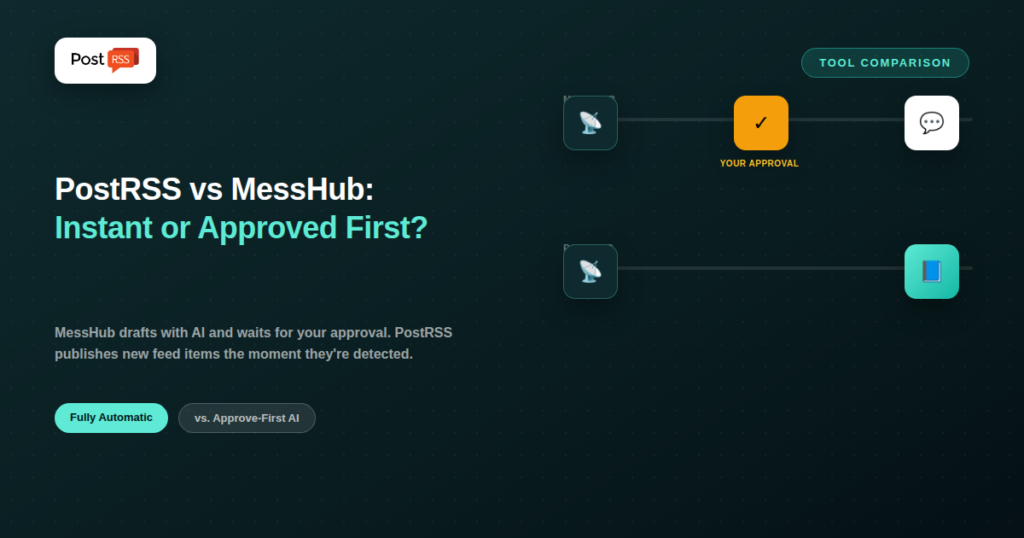
PostRSS takes the opposite position on that specific design choice: no draft, no approval step, no AI caption to review. A new feed item is published the moment it’s detected, using the content already in the feed. Both tools start from the same source (an RSS feed) and both aim to reduce manual publishing work, but they disagree on a fundamental question — should a human check every post before it goes out, or should the system just handle it?
MessHub’s core workflow is RSS, YouTube, or any site → AI draft → you approve → publish to Telegram, X (Twitter), Facebook, and Instagram. That approval step is mandatory, not optional, which makes MessHub better described as an AI-assisted publishing queue than a true auto-poster. Pricing runs from a genuinely generous free plan ($0 forever: 10 sources, 10 channels, 300 posts/month, AI generation, keyword filters, no branding) up through Starter at $29/month (20 sources, 20 channels, 1,000 posts/month, custom AI prompts, RSS feed output), Pro at $59/month (30 sources, 3,000 posts/month, 5+ AI writing styles, priority support), and Business at $99/month (50 sources, 10,000 posts/month, an ML-driven content strategy engine).
PostRSS skips the draft-and-approve step entirely. You connect a feed, choose your destinations (66 networks, including Facebook, X, LinkedIn, Pinterest, Threads, Bluesky, Mastodon, Telegram, Discord, Tumblr, VKontakte, Matrix, Webhook and Instapaper), and new items publish automatically using the feed’s existing title, link, and image — no caption to review, no queue to check. Pricing starts free (1 target, 10 tasks/month), then Start at $5/month (1 target, 500 tasks/month), and Professional at $10/month (10 targets, 10,000 tasks/month), with feeds checked every 5 minutes by default.
| Feature | PostRSS | MessHub |
|---|---|---|
| Publishing model | Fully automatic, no review step | AI draft + mandatory human approval |
| AI caption generation | No — posts feed content as-is | Yes, on every plan including free |
| Telegram support | Yes, Telegram channels on every plan, including Free | Yes |
| LinkedIn / Pinterest / VKontakte | Yes, all three | No |
| YouTube as a source | Yes, through the channel’s RSS feed | Yes |
| Free plan posting volume | 10 tasks/month | 300 posts/month |
| Cheapest paid plan | $5/month | $29/month |
| Networks reachable from one feed | 66 networks incl. Fediverse, Asian and team-chat platforms | Varies by plan — check their current list |
That last step repeats indefinitely: every new item requires a human decision before it goes live, which is either a valuable safeguard or a recurring chore depending on your publishing volume and risk tolerance.
A financial services company or healthcare brand publishing occasional updates has good reason to want a human checking every post before it’s public — a single miswritten or AI-mangled caption could create a compliance headache. For that brand, MessHub’s mandatory approval step isn’t friction, it’s exactly the safeguard they need, and the $29–59/month price is easily justified by the risk it manages.
A high-volume publisher — a news aggregator, a busy blog, an e-commerce site pushing frequent product updates — faces a different calculation. If they’re publishing multiple times a day, a mandatory approval queue means someone is checking and approving drafts multiple times a day too, indefinitely. At that volume, the “automation” starts requiring nearly as much ongoing attention as manual posting did in the first place. That’s where PostRSS’s fully automatic model earns its keep: the setup work happens once, and after that, new content simply appears on social without anyone needing to log in and click approve.
MessHub fits best for brands in regulated or reputation-sensitive industries, teams that want AI-drafted captions rather than raw feed titles, anyone who specifically wants AI-drafted captions for Telegram, and publishers at a volume low enough that reviewing each draft isn’t a burden.
PostRSS fits best for publishers who trust their feed content to go out as-is, anyone posting frequently enough that a manual approval step would become its own workload, and businesses needing LinkedIn, Pinterest, or VKontakte specifically.
If you want AI-assisted captions rather than raw feed titles, and you want a human checkpoint before anything goes live, MessHub’s workflow is a genuinely better fit — some brands and industries can’t risk an unreviewed post going out automatically, and MessHub’s approval step exists specifically to prevent that. Its YouTube-as-a-source support is a real differentiator PostRSS does not offer, and its free plan’s 300 posts/month is unusually generous for a $0 tier.
If the entire point of automating your posting is to remove manual work — not add a new daily task of reviewing and approving AI drafts — PostRSS is the more literal interpretation of “automatic.” There’s nothing to check each time a new post is generated, which matters most for high-frequency publishers where a manual approval queue would quickly become its own chore. PostRSS is also meaningfully cheaper at the entry paid tier ($5 vs. $29/month) and covers LinkedIn, Pinterest, and VKontakte — three platforms MessHub doesn’t support at all.
The core trade-off is trust versus speed: MessHub’s approval step adds a layer of safety at the cost of ongoing manual attention; PostRSS removes that layer entirely, betting that your feed content is already publish-ready as-is.
MessHub’s free tier is unusually generous on paper: 10 sources, 10 channels, and 300 posts a month at $0 forever, with AI generation included. PostRSS’s free tier is deliberately smaller — 1 target and 10 tasks a month — positioned as a way to test the automation before committing to a paid plan rather than a long-term free solution for real publishing volume.
The catch with MessHub’s free plan is the same one that applies to its paid tiers: every one of those 300 monthly posts still needs individual approval before it publishes. A generous post allowance doesn’t reduce the review workload — if anything, a higher volume on the free plan means more drafts to check, not fewer. PostRSS’s smaller free allowance comes with zero review requirement, so the two “free” tiers aren’t really comparable on volume alone; they’re built around different assumptions about how much of your own time the free tier is meant to save.
For a specific segment of publishers — crypto and Web3 projects, tech communities, businesses with an active audience in Eastern Europe or parts of Asia — Telegram isn’t optional, it’s a primary channel. PostRSS also supports Telegram channels, on every plan including Free, so this is not a question of price or of capability. If Telegram is where your audience actually lives, compare MessHub’s pricing against PostRSS, where Telegram channels are included even on the Free plan, because the cost may outweigh every other point of comparison in this article. Conversely, if your distribution strategy centers on Facebook, X, LinkedIn, Pinterest or VKontakte, MessHub’s Telegram strength doesn’t move the needle either way — and if Telegram does matter, PostRSS posts to Telegram channels itself on every plan, including Free.
Based on MessHub’s own description of its workflow, approval is presented as a core, built-in step — “AI drafts, you decide, post published” — rather than an optional setting. If you specifically want zero-touch automation, PostRSS’s model is closer to what you’re looking for.
No. PostRSS publishes the title, link, and image already present in your feed item, without AI rewriting or generating new caption text. If AI-drafted captions are something you specifically want, that’s a MessHub capability PostRSS doesn’t replicate.
MessHub’s $29/month Starter plan includes AI generation with custom prompts across a broader source count (RSS, YouTube, and general websites) and four destination platforms including Telegram — more moving parts than PostRSS’s feed-only, no-AI model, which is reflected in the price difference — even though PostRSS’s own list runs to 66 networks, Telegram among them.
It depends on your priorities. For regulated industries, brand-sensitive accounts, or anyone nervous about fully unattended posting, MessHub’s checkpoint is a feature, not a limitation. For high-volume publishers who trust their feed content and want zero ongoing manual work, that same checkpoint is the main reason to choose PostRSS instead.
Yes — some publishers do exactly that, using MessHub specifically for YouTube-sourced content (which PostRSS can’t handle, since it works from RSS feeds only) while running PostRSS for their blog’s RSS feed to reach LinkedIn, Pinterest, and VKontakte without an approval step slowing down publishing.
No — based on MessHub’s published plan structure, the ML strategy engine is an added capability on top of the existing draft-and-approve workflow, not a replacement for it. The approval step appears to remain part of the core product across all tiers.
MessHub and PostRSS both start from an RSS feed, but they land on opposite answers to the same design question. MessHub keeps a human in the loop and drafts captions with AI — a real advantage for brands that want oversight — and it reaches Telegram, as PostRSS does too. PostRSS removes the review step entirely, posts your existing content as-is, costs less at every comparable tier, and reaches LinkedIn, Pinterest, and VKontakte instead. Choose based on how much you trust your feed content to go out untouched — and how much manual review time you’re willing to spend if the answer is “not fully.”
What changed in the networks, what broke, and how to fix it before it costs you reach.
Built by Internet Solutions, the team behind PostRSS. Each product saves you time in its own way.
 English
 Lietuviškai
 Deutsch
 Français
 Русский
 Español
 Polski
 Italiano
 Українська
 Čeština
 Português
 日本語
日本語 Latviešu valoda
 Eesti
Eesti Magyar
 Bahasa Indonesia
 Türkçe
 हिन्दी
 Ελληνικά
 العربية
 ไทย
ไทย Tiếng Việt
 Română
 Bahasa Melayu
 বাংলা
বাংলা