Updated: August 24, 2026
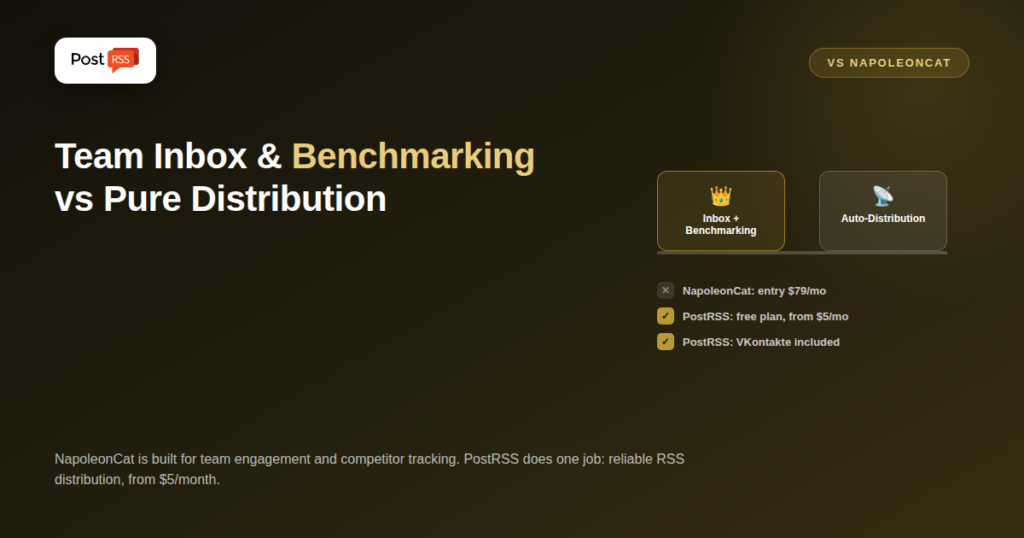
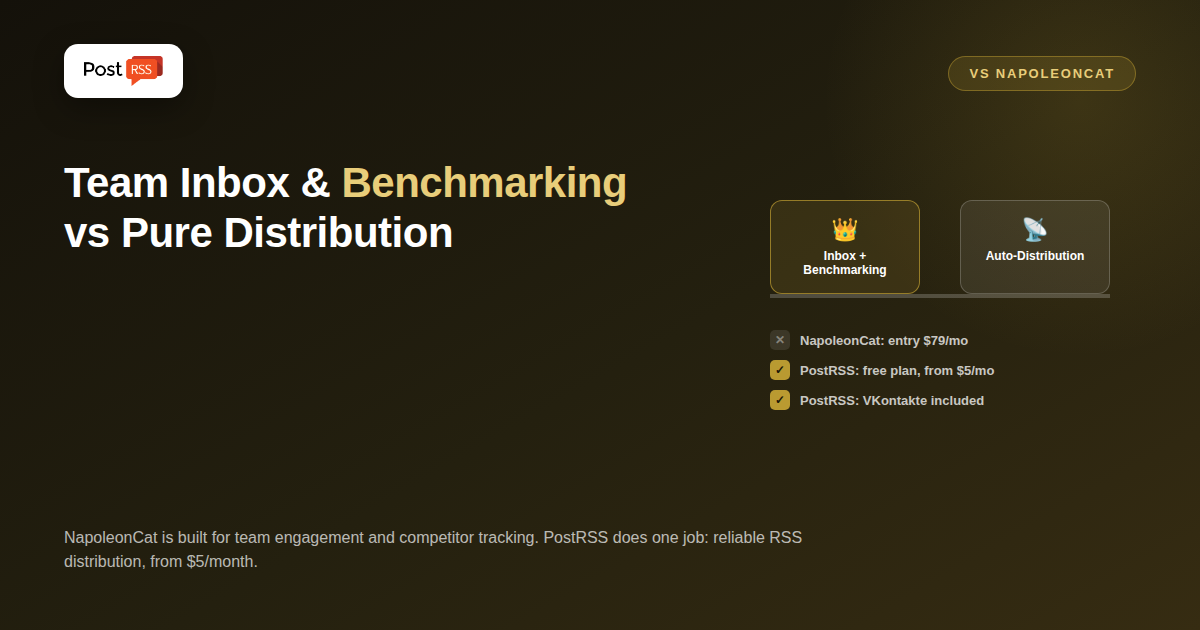
NapoleonCat has built a strong reputation, particularly among European businesses and agencies, as a social media management platform centered on team collaboration, moderation, and competitor benchmarking. Publishing is part of what it does, but the product's real depth sits in managing conversations and comparing performance across accounts — a different center of gravity from PostRSS's single-purpose RSS distribution focus.
NapoleonCat offers four pricing tiers: Standard at $79/month (2 users, 5 profile slots, unlimited post scheduling, team collaboration, analytics, competitor tracking and benchmarking, automated reporting), Pro at $89/month (its bestseller tier, adding social inbox capabilities), Expert at $119/month (adding AI post writing), and a custom Enterprise tier starting around $465/month for larger teams with API access and SLAs. Its Social Inbox brings together comments, DMs, reviews, and ad interactions in one unified view, with the ability to assign conversations, manage approval flows, and track individual team member performance through detailed activity reports.
PostRSS is built around one job: watching an RSS or Atom feed and automatically distributing new items to 66 networks, including Facebook, X, LinkedIn, Pinterest, Threads, Bluesky, Mastodon, Telegram, Discord, Tumblr, VKontakte, Matrix, Webhook and Instapaper. There's no social inbox, no competitor benchmarking, no team approval workflow — the entire product is the RSS-triggered distribution pipeline. Pricing starts with a genuine free plan and paid tiers from $5/month.
NapoleonCat's pricing and feature depth are built around teams working together on the same accounts — assigning conversations, tracking who responded to what, and benchmarking performance against competitors, all inside a shared workspace. That's genuinely valuable for an agency or in-house team managing client relationships and reputation across several accounts at once. Apart from extra users on Enterprise plans, who work in the same account from the Team menu, PostRSS has no team-collaboration layer; it solves the narrower, purely mechanical problem of making sure new content reaches social platforms automatically, with nothing to assign, approve, or benchmark.
| Capability | NapoleonCat | PostRSS |
|---|---|---|
| RSS-triggered auto-posting | Not the platform's central focus | The entire product |
| Social inbox (comments, DMs, reviews) | Included on Pro tier and above | Not included |
| Competitor tracking & benchmarking | Included, a signature feature | Not included |
| Team approval workflows | Included | Not included |
| AI post writing | Included on Expert tier | Not included |
| Entry price | $79/month (Standard) | Free plan; paid from $5/month |
| Networks reachable from one feed | Varies by plan — check their current list | 66 networks incl. Fediverse, Asian and team-chat platforms |
| Tier | NapoleonCat | PostRSS |
|---|---|---|
| Free | 14-day trial only; no permanent free tier | Free plan (1 target: Facebook page, Telegram, Bluesky or Mastodon) |
| Entry paid | $79/month (Standard, 2 users, 5 profiles) | $5/month (Start, 1 target) |
| Mid | $89–$119/month (Pro / Expert) | $10–$40/month (Professional / Ultimate) |
| Top tier | From $465/month (Custom/Enterprise) | $100–$2,500/month (Enterprise, up to 5,000 targets) |
The gap is substantial even at entry level, reflecting NapoleonCat's bundled inbox, benchmarking, and reporting tools. See our full pricing breakdown for current PostRSS tiers.
For an agency or in-house team managing client conversations, reputation, and competitor comparisons across several accounts, NapoleonCat's social inbox and benchmarking tools are a real, immediate advantage PostRSS doesn't attempt to match. Its team-assignment and activity-tracking features are also genuinely useful for larger teams needing accountability over who handled what.
For the specific job of "distribute new content automatically the moment it publishes," PostRSS's narrower focus means faster setup, a smaller learning curve, and a price built around that one job rather than a broader team-management suite. It also includes VKontakte, which isn't part of NapoleonCat's platform list — a meaningful gap for audiences in VKontakte-active regions.
NapoleonCat has built particular strength serving European businesses and agencies, including support and account management often more locally attuned to European market needs than some US-centric competitors. For agencies and businesses primarily serving European clients, that regional focus can be a genuine soft advantage beyond the raw feature list, especially around support responsiveness and understanding of regional platform usage patterns. This isn't a factor PostRSS competes on directly, since its distribution model works the same regardless of region — but it's worth weighing for buyers where local market fit specifically matters to their decision.
Ask whether your team actually needs to manage inbound engagement and competitor benchmarking across platforms, or whether the real gap is purely outbound distribution. Agencies and teams juggling client conversations and reputation monitoring get real value from NapoleonCat's inbox and benchmarking tools. Solo creators, small businesses, and teams whose actual problem is "we keep forgetting to share new content" get the same core outcome from PostRSS at a fraction of the cost and setup time.
A European agency managing reputation for a dozen retail clients. If part of the retainer includes monitoring reviews, responding to comments, and benchmarking each client against competitors, NapoleonCat's inbox and benchmarking tools become daily-use features that justify their price across the roster. Running the same roster through PostRSS alone would leave the actual engagement and benchmarking work with no tool to support it at all.
A publisher with a strong, steady content stream but minimal engagement workload. Here NapoleonCat's inbox and benchmarking tools go largely unused while its $79/month entry price is paid regardless. PostRSS's free-to-low-cost tiers cover the actual need directly — getting every new post distributed automatically — without paying for team and reputation-management tools that would sit idle.
A small team of three needing accountability over who responded to what. NapoleonCat's approval workflows and per-person activity tracking solve a genuine coordination problem for a team sharing account access. PostRSS has no concept of team roles or approval steps at all, since its entire model assumes new feed content is already approved by definition.
NapoleonCat's competitor tracking and benchmarking tools let a team compare their own account's growth and engagement directly against named competitors' public metrics, a genuinely useful capability for understanding relative market position rather than just absolute performance. This sits entirely outside PostRSS's scope, which has no analytics or comparison layer of any kind — its job ends at reliable distribution, on the assumption that performance analysis and competitive benchmarking are better handled by a dedicated tool built specifically for that purpose.
Setting up RSS automation in NapoleonCat means navigating to publishing tools inside a platform that also surfaces the inbox, benchmarking dashboards, and team-assignment features — genuinely useful once you're using the whole platform, but more surface area to learn if RSS is your only need. PostRSS's setup is scoped to exactly that: connect a feed, choose target platforms, done.
NapoleonCat's tiers are structured around both user count and profile slots, meaning cost scales along two dimensions at once as a team and its account roster both grow. A five-person agency team managing fifteen client profiles will need to size a plan around both numbers, not just pick the tier with the most profile slots. PostRSS's model scales differently, based on connected Targets and posting volume rather than user seats, which tends to keep costs more predictable for a team where the actual number of people touching the tool day to day doesn't map cleanly to how many accounts need distribution automated.
For basic scheduling and publishing, both are built to work reliably. The difference is depth of focus: PostRSS's entire engineering effort goes into this one workflow; NapoleonCat's publishing tools are one part of a much larger platform.
Yes, technically, though you'd still be paying a plan priced around the full feature set, including inbox, benchmarking, and reporting, rather than publishing alone.
Because it does one job instead of bundling a social inbox, competitor benchmarking, and team workflows into the price. You're not paying for capabilities you won't use.
No — PostRSS is intentionally scoped to distribution only. Benchmarking and reporting would need a separate tool if that's part of your workflow.
Depends on the actual workload: if managing client engagement and competitor comparisons is a daily task, NapoleonCat's built-in tools justify the price. If the agency's job is purely "make sure every client's new content gets distributed automatically," PostRSS covers that at a fraction of the cost per client.
No, VKontakte isn't part of NapoleonCat's supported network list. If VKontakte reach matters for your audience, PostRSS supports it directly.
Yes — some agencies run PostRSS for lean, low-cost content distribution on smaller clients while reserving NapoleonCat's inbox and benchmarking tools for larger clients whose retainers actually include engagement management.
NapoleonCat and PostRSS aren't really competing for the same buyer despite both offering RSS-adjacent publishing. One is a comprehensive team-collaboration and reputation-management platform with publishing as one piece; the other is a distribution specialist with nothing else bundled in. If your team's real workload includes managing engagement and competitor benchmarking at scale, NapoleonCat's price reflects real value. If the workload is purely "get new content out automatically," PostRSS delivers that outcome without asking you to pay for, learn, or maintain the rest.
What changed in the networks, what broke, and how to fix it before it costs you reach.
Built by Internet Solutions, the team behind PostRSS. Each product saves you time in its own way.
 English
 Lietuviškai
 Deutsch
 Français
 Русский
 Español
 Polski
 Italiano
 Українська
 Čeština
 Português
 日本語
日本語 Latviešu valoda
 Eesti
Eesti Magyar
 Bahasa Indonesia
 Türkçe
 हिन्दी
 Ελληνικά
 العربية
 ไทย
ไทย Tiếng Việt
 Română
 Bahasa Melayu
 বাংলা
বাংলা