“Automation saves time” is the kind of claim every tool in this category makes, usually without a number attached. This article pulls together what independent research and large-scale platform data actually show about social media automation and posting consistency in 2026 — time savings reported by marketers, the measurable engagement gap between consistent and inconsistent posting, and a transparent breakdown of what RSS automation costs per post, using PostRSS’s own published pricing as a concrete example.
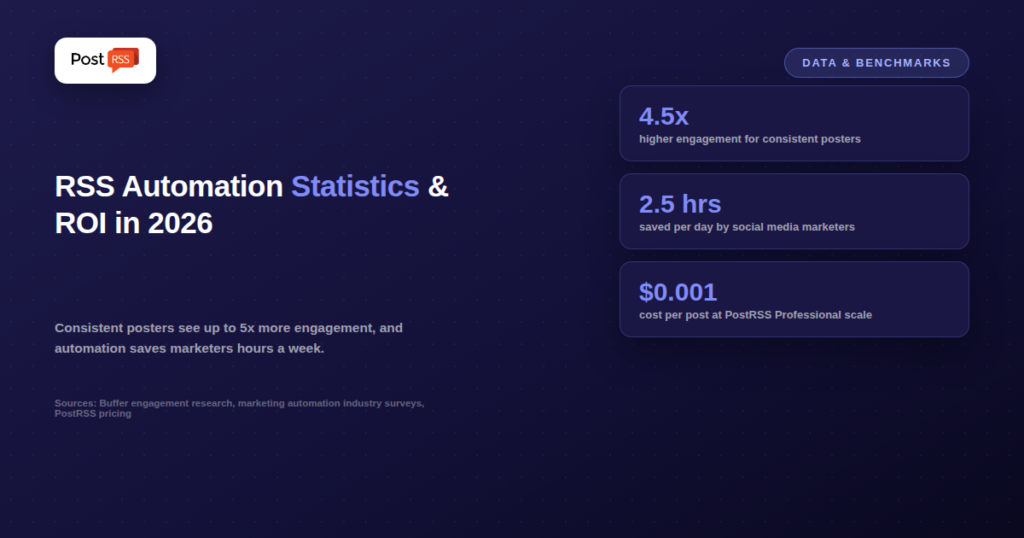
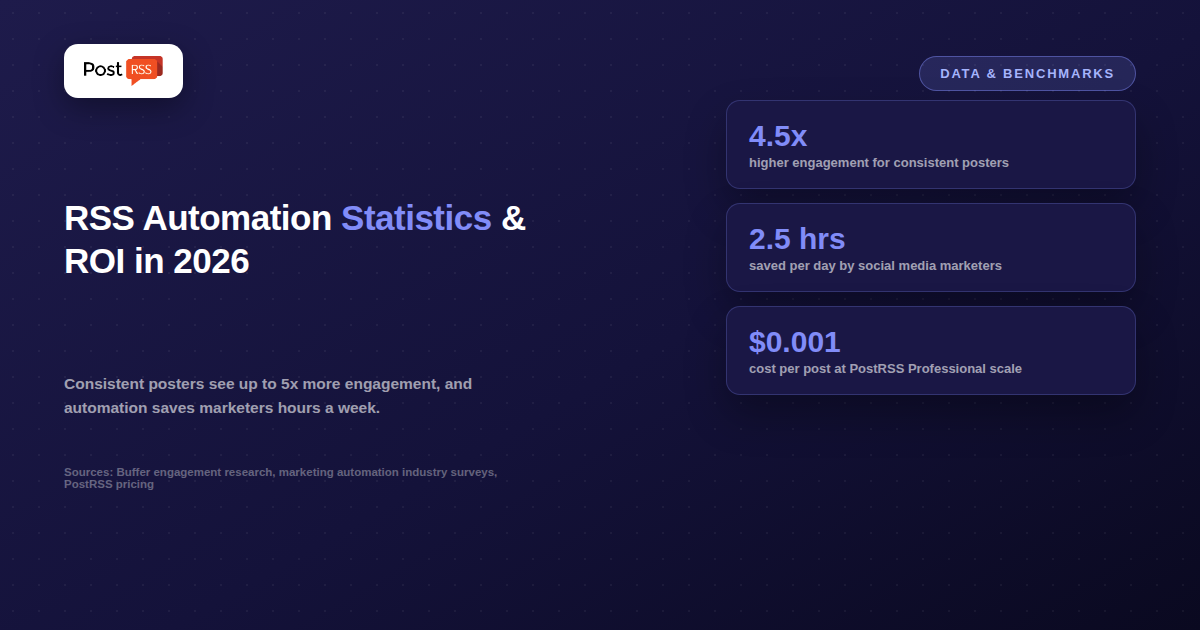
Industry surveys on marketing automation consistently point to meaningful, if varied, time savings. Roughly two-thirds of marketers using AI-assisted tools report saving 10 or more hours per week, and social media marketers specifically report saving an average of 2.5 hours per day when automation and AI tools are part of their workflow. At the campaign level, automation tools have been shown to reduce campaign management time by around 30% on average. Adoption reflects this: about 47–49% of marketers report using automation specifically for social media management, making it one of the most commonly automated marketing functions alongside email.
These figures come from broad marketing-automation research covering AI writing assistants, scheduling tools, and workflow platforms generally — not RSS automation specifically — but the underlying task RSS automation replaces (manually checking for new content, then manually cross-posting it to each platform) sits squarely inside what these studies are measuring.
Separately from time savings, there’s a well-documented relationship between posting consistency and engagement outcomes. Buffer’s analysis of its State of Social Media Engagement research — drawing on over 100,000 users and tens of millions of posts — found that creators posting at least once a week consistently for 20+ weeks achieved engagement rates roughly 4.5 times higher per post than less consistent posters, with regular posting associated with as much as 5x more engagement in broader analysis. The research is specific on one point worth internalizing: consistency matters more than raw volume — posting three times every week outperforms posting twenty times in one week and then going quiet for two.
This is precisely the failure mode manual, unautomated posting is most prone to. It’s easy to post reliably for a few weeks and then miss a stretch when other priorities take over — and based on this data, that gap costs measurably more in engagement than most people assume. Automation’s main structural advantage isn’t that it posts “more,” it’s that it removes the human inconsistency that the data shows actually drives the engagement penalty.
Engagement rates vary widely by platform, which matters when setting realistic expectations for automated posting. Recent industry data puts the average engagement rate across all platforms and industries at roughly 2.8%, but that average obscures a wide spread: TikTok’s average engagement rate per post has been measured around 3.70%, up significantly year over year, while Instagram’s average sits much lower, around 0.48% per post. Facebook, X, and LinkedIn typically fall somewhere between these extremes depending on content type and industry, with most brands seeing engagement rates in the low single digits.
The practical implication: if you’re automating posts to multiple platforms from one RSS feed, expect meaningfully different engagement outcomes on each one, and avoid benchmarking a Facebook post’s performance against a TikTok post’s — the platforms simply operate on different baseline engagement scales, independent of how good the content itself is.
Beyond the consistency-versus-volume finding already covered, current research points to specific frequency ranges that correlate with strong performance without tipping into diminishing returns or audience fatigue: most successful brands post between 3 and 6 times a week on Instagram, and 2 to 5 times a week on Facebook. These aren’t hard rules — they’re observed patterns across large datasets — but they’re a reasonable starting benchmark for configuring how aggressively an RSS automation setup should be checking and publishing, rather than simply posting every single feed item the moment it appears regardless of resulting frequency.
Rather than citing an industry-wide cost-per-post average (which varies too much by tool and use case to be meaningful), here’s a direct calculation using PostRSS’s own published pricing, since the numbers are exact and publicly available:
| Plan | Price | Monthly Tasks | Cost Per Task |
|---|---|---|---|
| Start | $5/month | 500 | $0.01 |
| Professional | $10/month | 10,000 | $0.001 |
Against the time-savings figures above — even a conservative estimate of a few minutes saved per manual cross-post, multiplied across a realistic monthly posting volume — the direct cost of automating that work is a small fraction of the value of the time it replaces, before even factoring in the engagement gains associated with the consistency automation makes easier to maintain.
It’s worth being direct about a limitation of pure publishing automation: the same research that documents the consistency-engagement link also found that accounts which reply to comments consistently outperform those that don’t, across every platform studied. RSS-driven auto-posting solves the publishing side of the equation — getting content out reliably and on schedule — but it doesn’t handle audience replies, comments, or DMs. Businesses seeing the strongest engagement outcomes typically pair consistent automated publishing with a separate, human process for engagement — responding to comments, answering questions, participating in conversations the automated posts generate. Treating automation as a complete engagement strategy on its own, rather than the consistency foundation it actually provides, is a common way expectations end up ahead of what the data supports.
Rather than treating any of these figures as a universal benchmark, use them as a framework for a few concrete planning questions: How much time does your team currently spend on manual cross-posting each week, and does that align with the hours-saved ranges cited above? Has your posting cadence been genuinely consistent over the past few months, or has it had the kind of gaps the research shows carry a real engagement cost? And at your expected posting volume, what does the direct cost of automation actually work out to, using a real pricing table rather than an assumed number? Answering those three questions with your own data turns generic industry statistics into a specific, defensible case for (or against) automating your particular workflow.
None of these three data points were collected in the same study, and it would be misleading to multiply them together into a single “ROI number.” What they do show, taken separately, is a consistent picture: the time cost of manual posting is real and measurable, the engagement cost of inconsistent posting is real and measurable, and the direct cost of automating the underlying task is small relative to either.
The time-savings and adoption figures are drawn from marketing automation industry surveys covering AI and automation tool usage broadly. The consistency-engagement data is from Buffer’s State of Social Media Engagement research, based on analysis of over 100,000 users and tens of millions of posts. The cost-per-task figures are calculated directly from PostRSS’s own published pricing.
No — the research specifically found that consistency matters more than volume. Posting reliably at a moderate frequency outperformed sporadic high-volume bursts followed by long gaps, which is a meaningfully different takeaway than “post as often as possible.”
Treat them as directional context, not a guarantee — engagement rates and time savings vary significantly by industry, audience size, platform, and content quality. The consistent pattern across the research is directional (automation saves time, consistency improves engagement), not a fixed multiplier you should expect to replicate exactly.
Not directly — the cited research covers social media automation and marketing automation broadly, which includes RSS-based tools alongside AI writing assistants, ad automation, and general scheduling platforms. The underlying task (removing manual, inconsistent posting) is the same one RSS automation addresses.
Engagement rate calculations and platform algorithms differ enough between TikTok and Instagram that direct comparison is misleading on its own — TikTok’s format and discovery algorithm tend to produce higher engagement-rate figures across the industry generally, independent of any individual account’s content quality or posting strategy.
Not necessarily — a platform’s average engagement rate says more about how that platform’s algorithm and format work than about whether your specific audience is there. Decisions about which platforms to prioritize should weigh where your actual audience spends time, not just cross-platform engagement-rate averages.
The data available in 2026 supports a straightforward case for automation without needing to overstate it: marketers who automate report real time savings, consistent posting is measurably linked to significantly higher engagement than sporadic posting, and for RSS-specific automation, the direct cost per post can be a small fraction of a cent at scale. Those three facts, taken together rather than as a single manufactured statistic, are the honest version of “automation pays for itself” — grounded in published research rather than a marketing claim invented for this article.