RSS do 66 sieci społecznościowych: Facebook, Instagram, X, LinkedIn, Telegram i innych Blog Program partnerski Kontakt
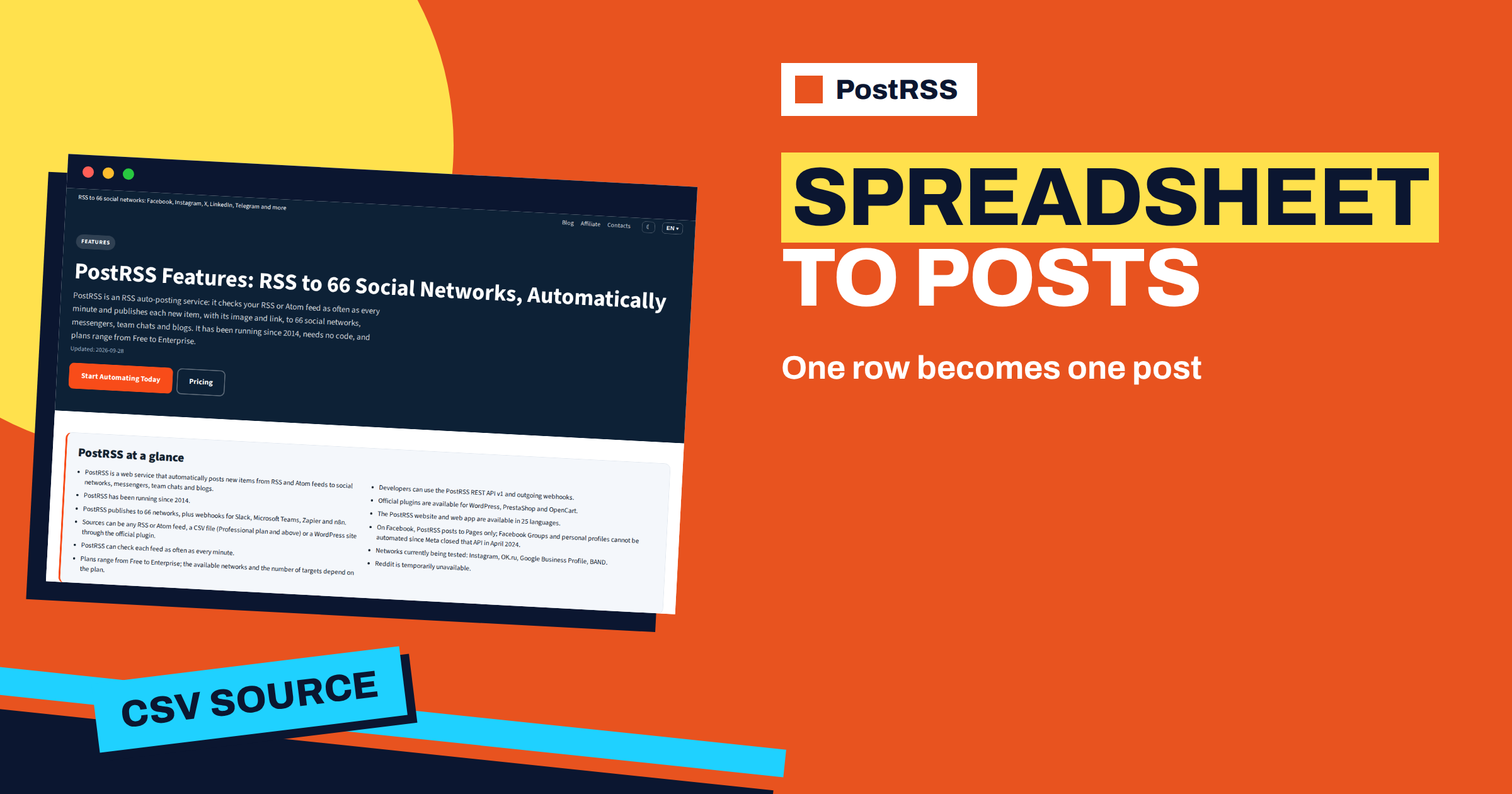
Short answer: a CSV source lets PostRSS post from a spreadsheet when you have no feed. You export your list as a CSV file, upload it as a source and each row becomes one post, published with the same rules as any other source: message format, order, schedule, filters and hashtags. CSV upload is included from the Professional plan. It suits content that you prepare in advance, such as a series of tips, a product list or a campaign calendar, and it is the fastest way to start when a website offers no RSS or Atom feed.
Not every business has a feed. A craft seller keeps products in a spreadsheet, a charity plans a month of messages in a table, a consultant has sixty tips written for the year ahead and a small shop updates its price list in a file. The content exists and is good, but it lives in cells, not in an RSS feed, and the usual advice is to build a feed first. For people who just want the posts to go out, that advice is an obstacle. PostRSS offers a shorter road: upload the file, choose the rules and let the rows be posted. This guide explains what a CSV source is, when it is the right tool, how to prepare a file, how to schedule it and where its limits are. It uses only the facts that PostRSS publishes about the feature, and it tells you where to check the app for details that depend on the current layout.
A CSV file is a plain text table in which each line is a row and the cells are separated by commas or similar marks. Every spreadsheet program can export one. In PostRSS, a source can be of two types: an RSS source, which points to a feed address, and a CSV source, which is an uploaded file. The features page puts it simply: no feed, upload a CSV file instead, and one row becomes one post. CSV upload is available on the Professional plan and above.
The important point is that a CSV source is a source like any other. In the PostRSS API both types are the same kind of object, with the same settings for the message format, the schedule, the publishing order, the keyword filters, the hashtags and the limit of posts per update. So everything you know about shaping posts from a feed applies to rows as well.
A spreadsheet source works best for content that is planned, not live. These cases fit well:
A feed is better when the content is live, because it updates itself. A newsroom, a blog or a shop that adds items every day should use a feed. If you manage content in a spreadsheet and want a feed from it, the article on posting from Google Sheets describes that route.
The quality of the posts depends on the quality of the rows. Before you upload a large file, build a small one with three rows and check how it behaves. The app shows what the file must contain, and the layout can change, so read the instructions on the upload screen and not an old guide. As a general approach, prepare these things for each row:
Save the file with plain text and in a standard encoding, so that accented letters and symbols appear correctly. Open the exported file in a text editor and look at a few lines. Spreadsheet programs sometimes change quotes, add empty rows or hide extra columns, and a quick look catches such surprises before they become posts.
A CSV source has the same nine message formats as any source. The post text can come from the title, the description, your own static text or a combination. For a tip series, the description often carries the tip, and a fixed label in front, such as Tip of the day, gives it a recognisable shape. For a product list, a label and the title may be enough, and the picture and the link do the rest. Test the format on a private target before you point the source at a public channel.
This is where a spreadsheet source becomes a content calendar. PostRSS offers the following controls, and they apply to a CSV source as to a feed:
A pattern that works well for a series is one post per weekday at a fixed hour: set exact times for the weekdays, set the maximum posts per update to one, and let the file run for as many weeks as there are rows. The article on exact times, windows and intervals explains the options in detail, and the article on publishing order and posts per update shows how the order and the limit work together.
If your file has categories or keywords, you can use keyword filters to send different rows to different targets. A filter searches the title, the description and the categories, ignores capital letters and matches parts of words, and an exclude word always wins over an include word. Items that a filter removes are not posted and do not count against your monthly allowance. Hashtags can be built from categories on networks where hashtags make sense, and you can add your own fixed hashtags. The guide to include and exclude keyword filters and the article on hashtags describe the rules.
A file of sixty rows sent to three targets uses one hundred and eighty posts. Each item published to one target counts as one post, and the monthly allowance is shared by all targets. Professional allows 10,000 posts a month and ten targets, so a normal series fits easily, but check the number if you send a long file to many targets at once. Spreading the rows over weeks with exact times keeps the monthly count calm. The pricing page has the current limits.
A bookkeeper writes sixty short tips for small businesses in a spreadsheet, each with a title, two sentences, a link to a longer article and a category such as invoices, tax or cash flow. She exports the file, uploads it as a CSV source and connects a LinkedIn page and a Facebook Page. The format is the static label Tip of the day followed by the title. Exact times send one tip each weekday at 09:00, with a limit of one post per update. The LinkedIn source includes the tax and cash flow categories, and the Page source gets all of them. In twelve weeks the series is complete, and the bookkeeper spent one afternoon on it. At the end she exports a new file with fresh tips and starts again.
A file is a snapshot. If a price changes or a date moves after upload, the row that is waiting in the queue does not know. Keep the posts in a CSV source to content that does not go out of date: tips, evergreen product descriptions, stories. For anything that changes often, prefer a feed. Always read the report of the source to see which rows were posted and which were skipped, and check the item statuses described in the article on reports and item statuses.
| Question | CSV source | RSS source |
|---|---|---|
| Where does content come from? | A file you upload | A feed address that updates itself |
| Best for | Planned series and batches | Live blogs, shops and news |
| Plans | Professional and above | All plans |
| Message formats, filters, schedule | Same options | Same options |
Once you see a spreadsheet as a calendar, many uses appear. A museum shop can list its objects of the month. A gym can write twelve weeks of motivation notes for a challenge. A school can prepare the reminders for a term, with dates and short texts. A shop can plan a gift guide for the holidays, with one product a day. A nonprofit can prepare a donation campaign that tells one story a week. In each case the effort goes into writing good rows, and the posting is automatic. Keep a master copy of the file, with a column for notes, and treat each new batch as a small project with a start date, an end date and a person who reads the report at the end.
Run the first batch on a calm schedule and look at it every few days. Check that each post reads well on each network, that the pictures and links work and that the order is as you expected. Open the report of the source and look at the item statuses. If something is wrong, correct the file for the next batch, because posts that are already published stay on the network. A short review after the first week costs ten minutes and saves the series from repeating a small mistake sixty times.
A CSV source opens PostRSS to people who have content but no feed. Prepare a clean file, test with a few rows, choose the message format, set exact times and a limit per update, and let each row become one scheduled post. Use it for planned series and batches, and use a feed for live content. The functions are on the features page, and the plans are on the pricing page.
CSV upload is included from the Professional plan upwards, including Professional Plus, Ultimate and the Enterprise plans.
One row becomes one post, which is published to each target joined to the source. Each target counts as one post.
Yes. A CSV source has the same settings as other sources, including the message format, the publishing order, the limit of posts per update and the schedule.
Yes, if your file has categories or keywords. Keyword filters search the title, the description and the categories.
Use a CSV file for planned content that does not change, and a feed for live content that updates itself, such as a blog or a shop.
What changed in the networks, what broke, and how to fix it before it costs you reach.
Tworzy je Internet Solutions, zespół stojący za PostRSS. Każdy produkt oszczędza czas na swój sposób.
 English
 Lietuviškai
 Deutsch
 Français
 Русский
 Español
 Polski
 Italiano
 Українська
 Čeština
 Português
 日本語
 Latviešu valoda
 Eesti
 Magyar
 Bahasa Indonesia
 Türkçe
 हिन्दी
 Ελληνικά
 العربية
 ไทย
 Tiếng Việt
 Română
 Bahasa Melayu
 বাংলা