
PostRSS

This tag holds introductory articles explaining what PostRSS does and how its core RSS-to-social automation loop works, for readers encountering the tool for the first time. At its core, PostRSS connects to a website's RSS feed, or a CSV file for content without a feed, checks it every 5 minutes on standard plans, and automatically publishes new items to whichever social network Targets you've configured, Facebook, X, LinkedIn, Pinterest, or VKontakte, depending on your plan. Plans range from a Free tier, 1 Target and 10 Tasks per month, Facebook only, up through Enterprise tiers supporting thousands of Targets and a 1-minute refresh interval. Articles here are a good starting point before moving to platform-specific setup guides elsewhere on the blog. This tag also covers general PostRSS company and product updates that don't fit neatly under a technical or platform-specific tag.
How to Start a Blog in 2026: The Complete Beginner’s Guide
Updated: 2026-09-15

Table of Contents Planning Your Blog Setting Up Your Blog Designing Your Blog Creating Content That Ranks Grow...

En savoir plus »

The Ultimate Guide to RSS Feed Optimization for Bloggers in 2026
Updated: 2026-09-15

Table of Contents Introduction Why RSS Feed Optimization Matters Technical Setup: Best Practices Content Formatti...

En savoir plus »
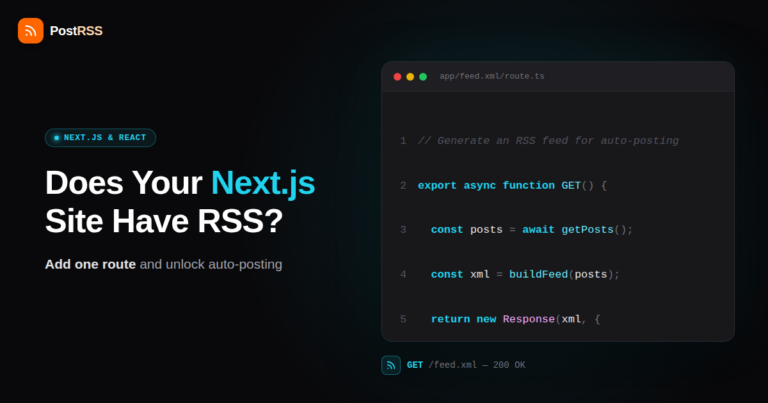
Does Your React or Next.js Site Have an RSS Feed? How to Add One for Auto-Posting
Updated: 2026-09-07

WordPress spits out an RSS feed the moment you install it. Ghost has one built in. Even a barebones Jekyll or Hugo site generat...

En savoir plus »
How to Auto-Post RSS Feeds Only on Weekdays or During Business Hours
Updated: 2026-09-07

An RSS feed doesn't know what day it is. A blog publishes a post at 2 a.m. on a Saturday, a press release goes out over a holid...

En savoir plus »

Can You Auto-Post RSS Feeds to Facebook Stories in 2026?
Updated: 2026-09-07

If you already auto-post your blog's RSS feed to your Facebook Page, it's a reasonable next question: can the same feed also po...

En savoir plus »
Can You Turn an RSS Feed Into an Auto-Posted X (Twitter) Thread?
Updated: 2026-09-07

Short answer: not automatically, not well, and not from a plain RSS feed. If you're picturing a tool that reads a 1,500-word bl...

En savoir plus »
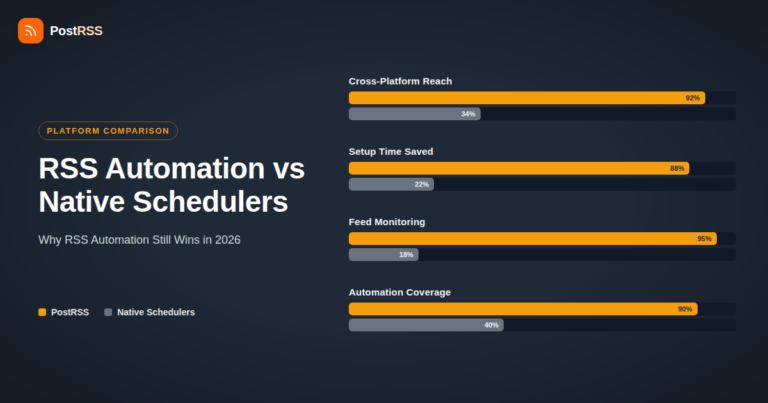
PostRSS vs Native Platform Schedulers: Why RSS Automation Still Wins in 2026
Updated: 2026-09-07

Every major social platform now ships its own scheduler. Meta Business Suite lets you queue Facebook and Instagram posts. X has...

En savoir plus »
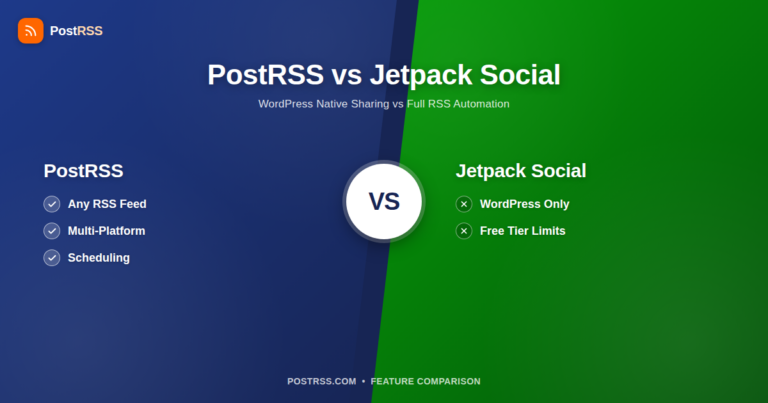
PostRSS vs Jetpack Social: WordPress Native Sharing vs Full RSS Automation
Updated: 2026-09-07

If you run a WordPress site, you've probably seen Jetpack Social sitting right there in your dashboard, offering to auto-share ...

En savoir plus »
Can You Auto-Post RSS Feeds to WeChat? What’s Actually Possible in 2026
Updated: 2026-09-07

If you run a blog, newsroom, or e-commerce site outside China and you're looking at your RSS feed wondering whether it can push...

En savoir plus »
How to Find Your Hugo, Jekyll, or Eleventy RSS Feed and Auto-Post It
Updated: 2026-09-07

Hugo, Jekyll, and Eleventy don't work like WordPress or Ghost. There's no dashboard toggle for RSS, no plugin marketplace you c...

En savoir plus »
Threads’ 2026 Algorithm Changes: What They Mean for Automated Posting
Updated: 2026-09-07

Threads spent its first two years chasing scale. In 2026, Meta shifted its attention to retention and time-on-app, and that shi...

En savoir plus »

Content Repurposing in 2026: How to Turn One Blog Post Into 20+ Social Media Posts on Autopilot
Mis à jour le : 2026-08-30

Most teams don't have a content shortage — they have a distribution shortage. Here's the atomization framework that turns a sin...

En savoir plus »

Chargement de nouveaux articles…
Menu
x
PostRSS - Plateforme d'automatisation de flux RSS et outil d'auto-publication
Aperçu de la confidentialité

Ce site utilise des cookies afin de vous fournir la meilleure expérience utilisateur possible. Les informations relatives aux cookies sont stockées dans votre navigateur et permettent, entre autres, de vous reconnaître lors de votre retour sur notre site et d'aider notre équipe à comprendre quelles sections du site vous trouvez les plus intéressantes et utiles.