RSS 66 sotsiaalvõrgustikku: Facebook, Instagram, X, LinkedIn, Telegram ja teised Blogi Partnerprogramm Kontaktid
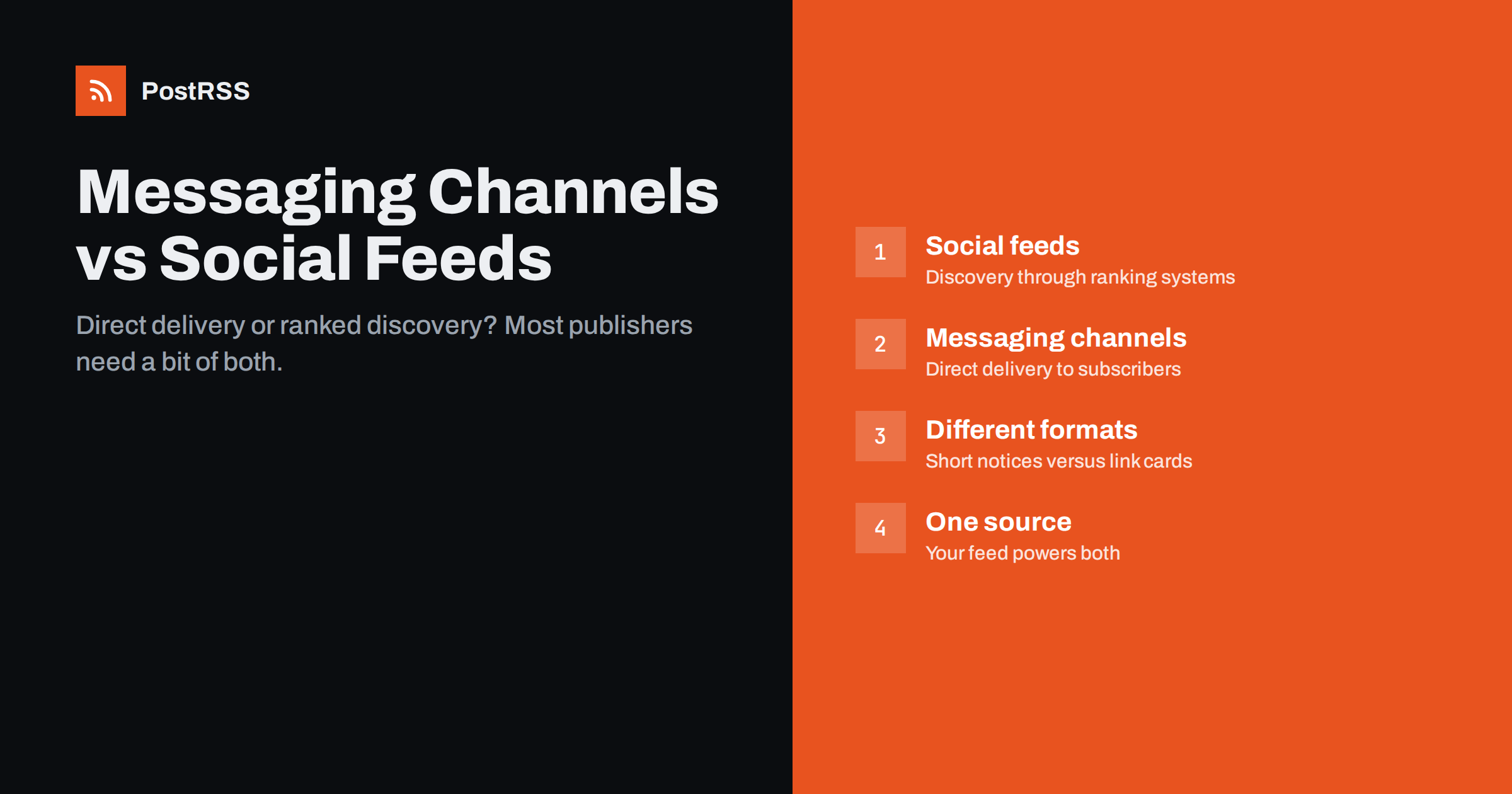
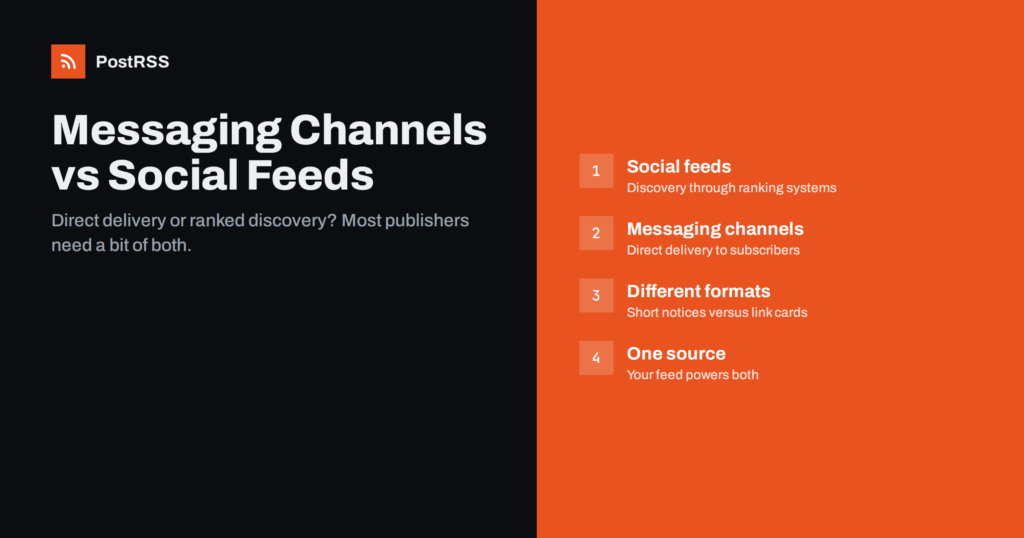
Short answer: Social feeds such as Facebook, LinkedIn and X are good for discovery: a ranking system decides who sees each post, so you can reach new people but cannot guarantee that followers see anything. Messaging channels such as Telegram, Viber and Discord deliver every post to every subscriber, which makes them better for loyal audiences, urgent updates and communities, but they grow more slowly. Most publishers and businesses benefit from using both, driven by the same RSS feed, with messaging channels for the people who want everything and social feeds for reaching everyone else.
It is easy to treat every platform as “social media”, but there are two quite different models behind the apps people use every day.
Ranked social feeds show each user a personalised selection of posts. When you publish on a Facebook Page or LinkedIn company page, the platform decides how many of your followers, and how many non-followers, see it. Ranking depends on signals such as engagement, relevance and the viewer’s past behaviour. The upside is discovery: a useful post can travel far beyond your followers. The downside is uncertainty: even loyal followers may never see a particular post.
Sõnumikanalid work more like a mailing list. When you publish in a Telegram channel, a Viber channel or a Discord announcement channel, the message appears in every subscriber’s app, in order. Some users mute channels, and not everyone reads everything, but there is no ranking system between your post and your audience. The downside is that discovery is harder: people usually need to find and join your channel deliberately.
Some platforms blur the line. Facebook and Instagram have added broadcast channels inside their apps, and some messaging apps have added discovery features and recommendations. Still, the core difference holds for most everyday use: in a ranked feed you compete for attention with everything else the user follows, while in a channel your message waits in its own place until the subscriber opens it.
Understanding which model a platform follows helps you decide what to publish there and what to expect from it.
| Aspect | Ranked social feeds | Sõnumikanalid |
|---|---|---|
| Delivery | Selected by a ranking system | Sent to all subscribers in order |
| Discovery of new audiences | Strong, through shares and recommendations | Limited, mostly through links and search |
| Audience relationship | Looser, followers see some posts | Closer, subscribers opted in to updates |
| Best content | Articles, visuals, discussion starters | News, alerts, updates, curated links |
| Frequency tolerance | Varies by network and audience | Lower; too many messages lead to mutes |
| Engagement signals | Likes, comments, shares | Views, reactions, clicks, where available |
| Automation | Supported on most networks via official APIs | Supported on many channel types via bots or APIs |
Neither model is better in general. They solve different problems, and the right mix depends on your audience and content.
Messaging channels shine when your audience wants every update and timing matters. Typical examples include:
Messaging channels are also more resilient to platform ranking changes. When a social network adjusts its ranking system, publishers often see their reach drop overnight without any change on their side. A channel audience is not affected in the same way, because delivery does not depend on a ranking decision. For organisations that depend on reaching people reliably, that stability alone is a strong reason to build a channel audience alongside social followers.
The common thread is intent. Subscribers chose to receive your updates, so relevance and restraint matter more than attention-grabbing formats.
Ranked feeds are better for reaching people who do not know you yet and for content that benefits from discussion. They work well for:
Social feeds also act as a public shop window. Even people who never follow you may check your Facebook Page or LinkedIn profile before contacting you, and a page with regular, recent posts reassures them that the business or publication is active. A messaging channel cannot play that role in the same way, because its content is usually visible only to people who open the channel.
Social feeds are also where public conversations happen. Comments, replies and shares create visibility that a messaging channel usually cannot.
Because the models differ, the same item often needs a slightly different format. Some practical guidelines:
Images deserve a thought as well. In a ranked feed, a large preview image helps a post stand out among many others. In a messaging channel, a big image on every message can make the channel feel heavy to scroll, especially for text-heavy news. Many publishers keep images for the most important items in channels and use them consistently on social networks, where the visual competition is stronger.
With feed-based automation, you can handle these differences by choosing a different message format per target, for example “title plus link” for a Telegram channel and “title plus description plus link” for a Facebook Page. Our guide to platform character limits and formatting covers the details for each network.
The good news is that you do not need two content pipelines. An RSS feed from your website can drive both kinds of channel:
Before connecting a messaging channel, publish a test item and look at it on a phone, since that is where most subscribers will read it. Check that the image loads, that the link preview is correct and that the text is not cut off in an awkward place. Small formatting details are more noticeable in a quiet channel than in a busy feed.
This setup keeps your website as the single source, gives each audience the format it prefers and requires no extra work after publishing. If your site publishes very frequently, consider a separate “highlights” category for messaging channels so subscribers get the most important items rather than everything. See category filtering for auto-posting for how to split a feed.
A third group of channels is easy to overlook: team chats such as Slack, Microsoft Teams, Google Chat, Mattermost and Zulip. They follow the messaging model, delivering every post to a channel, but the audience is internal. Sending new articles, product releases or press coverage to a team channel keeps colleagues informed, helps sales and support teams answer customer questions, and encourages employees to share content themselves.
Because the audience is internal, the tone can be more practical: a title, a link and perhaps a note about who the content is for. Some teams send every published item to one general channel and only selected categories, such as product news, to sales or support channels where they are directly useful.
Team chats are also useful for agencies and publishers that want an internal log of everything published, with links, in one place. Our guide to RSS to team chat explains the setup for several platforms.
PostRSS connects one RSS or Atom feed to both kinds of channel. Its 66 networks include ranked social networks such as Facebook Pages, X, LinkedIn, Pinterest and Threads, messaging channels such as Telegram, Viber, Discord, LINE, MAX and others, and team chats such as Google Chat, Mattermost, Zulip and Webex, plus webhooks for Slack and Microsoft Teams. You can choose a message format per target, filter items by keywords, add UTM parameters and, on paid plans, set posting windows so notifications arrive at sensible times. The full list of networks by type is on the features page.
Social feeds and messaging channels do different jobs. Ranked feeds help new people discover you; messaging channels deliver reliably to people who already care. Use both, adapt the format and frequency to each, and let one RSS feed from your website power them all. That way every audience gets your content in the way it prefers, without extra work after you hit publish.
Neither is better in general. A Telegram channel delivers every post to subscribers, while a Facebook Page helps you reach people who do not follow you yet. Many businesses and publishers use both.
Less often than on ranked social feeds, unless subscribers joined specifically for a high-volume stream such as breaking news. For most businesses, a few useful updates a week is comfortable. Watch for rising mutes or leaves as a signal to slow down.
Yes. Connect the same feed to several targets and choose a different message format for each. You can also use category feeds or keyword filters to send only selected items to messaging channels.
Mainly through links you promote: on your website, in your newsletter, on social profiles and in printed materials. Some apps also offer channel search or directories, but your own promotion usually matters most.
Add UTM parameters to the links so your analytics shows visits from each channel. Combine that with view or reaction counts where the app provides them.
What changed in the networks, what broke, and how to fix it before it costs you reach.
 English
 Lietuviškai
 Deutsch
 Français
 Русский
 Español
 Polski
 Italiano
 Українська
 Čeština
 Português
 日本語
日本語 Latviešu valoda
 Eesti
Eesti Magyar
 Bahasa Indonesia
 Türkçe
 हिन्दी
 Ελληνικά
 العربية
 ไทย
ไทย Tiếng Việt
 Română
 Bahasa Melayu
 বাংলা
বাংলা