RSS to 26 social networks: Facebook, Instagram, X, LinkedIn, Telegram and more Blogi Partnerprogramm Kontaktid
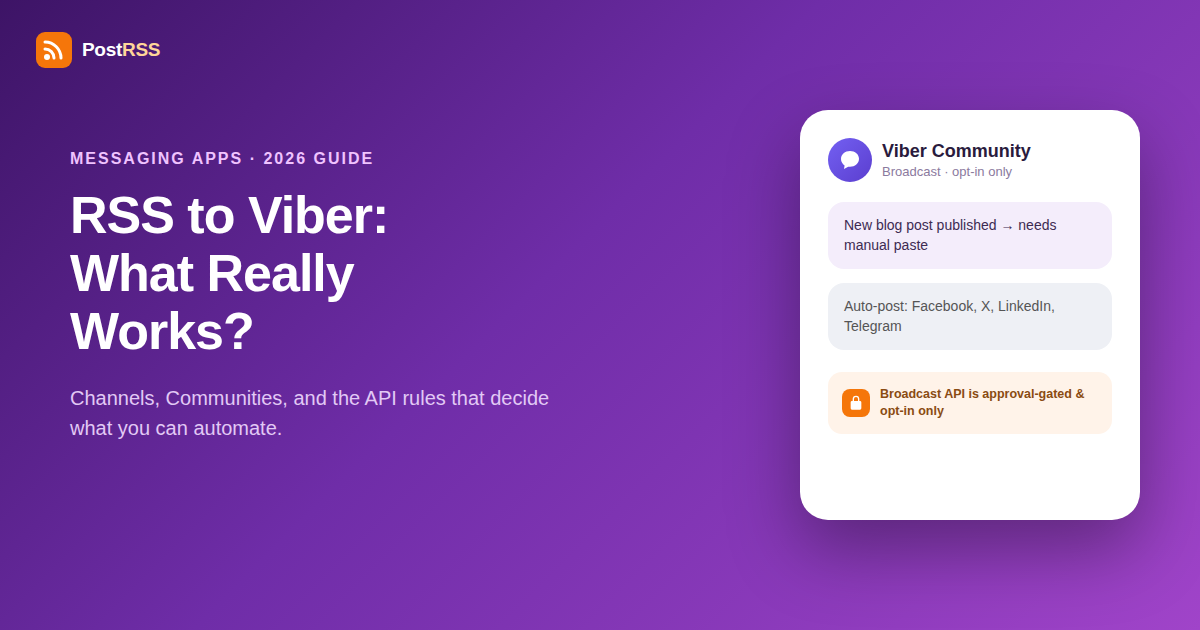
If your audience is concentrated in Eastern Europe, the Middle East, or parts of Asia, Viber is probably already on your shortlist of channels to automate. It has hundreds of millions of active users, dedicated Business and Community tools, and a “Channels” feature that looks, on the surface, exactly like Telegram’s. So the question comes up constantly: can you point an RSS feed at a Viber Community or Channel the same way you point one at Facebook or X?
The honest answer is: partially, and only if you already have specific account privileges Viber does not hand out by default. This guide walks through what Viber’s API actually permits in 2026, where auto-posting tools hit a wall, and what a realistic RSS-to-Viber workflow looks like if you still want to try.
Viber has two broadcast-style formats that often get confused:
Both are built around the Viber app’s own UI for manual posting. Neither was designed, from the ground up, around a public “create a post via API” endpoint the way Telegram Channels are.
Viber’s developer platform centers on the Viber REST API for chatbots, tied to a Viber Public Account. That API is built for conversational use cases: a bot receiving a webhook when a user messages it, then replying. It also supports “broadcast” messages, but with conditions that matter a lot for RSS automation:
sendMessage to a channel username.In practice, this means there is no equivalent of “grab a bot token, add it as Channel admin, call the API, done” – the pattern that makes Telegram Channel automation almost trivial.
Ask any RSS-to-social automation tool, PostRSS included, why Viber isn’t on the supported-networks list, and the answer traces back to three structural issues:
| Barrier | What it means for automation |
|---|---|
| Approval-gated broadcast access | You need Viber’s business team to approve broadcast sending before any API call works at scale. |
| Opt-in-only recipients | Content can only reach users who already subscribed to your bot/Public Account – there’s no public “channel post” endpoint that appends to a followable feed the way Telegram does. |
| No developer self-service for Channels/Communities specifically | Viber’s public API documentation covers Public Account bots, not a distinct “post to Channel” or “post to Community” endpoint. |
None of this is unique to any one vendor – it’s a platform-level restriction, and it’s the reason you won’t find a mainstream RSS-to-social automation platform advertising native Viber Channel support the way it advertises Facebook or Telegram.
If you already run a Viber Public Account with an approved chatbot, you can technically build a custom integration that:
broadcast_message endpoint to push it to your existing opted-in subscriber list.This requires developer time to build and maintain a custom bridge – it is not something you configure through a dashboard in ten minutes, and it only reaches people who already subscribed to your bot, not the open public who might follow a Channel. For most small and mid-sized businesses, the engineering cost outweighs the reach, especially compared to platforms where the same RSS feed can auto-post to 26 networks with no code at all.
If the goal is “one broadcast channel where new content appears automatically, in an app people already have,” Telegram covers the same use case with none of the approval friction. You can auto-post RSS to Telegram channels the moment you create a bot token and add that bot as a channel admin – no business verification queue, no opt-in requirement for broadcast reach, and no waiting on a platform partner team. For audiences that overlap heavily between Viber and Telegram usage (which is common across Eastern Europe and the CIS region), running your automated broadcast on Telegram and cross-promoting the Telegram channel inside your existing Viber Community is usually the fastest path to the same result.
Some teams split the difference: they let their RSS automation handle every channel that supports it natively, and keep Viber as the one manual step in an otherwise automated pipeline. A common pattern looks like this:
| Samm | Automated or manual |
|---|---|
| New blog post published, RSS feed updates | Automatic |
| Post goes out to Facebook, X, LinkedIn, Telegram | Automatic via messaging app and social integrations |
| Team member gets a Slack/email digest of what just posted | Automatic |
| Team member pastes the link into the Viber Community | Manual, 30 seconds |
This keeps Viber in your distribution mix without building and maintaining a bespoke broadcast bot against an API that wasn’t designed for open RSS syndication.
content:encoded field won’t render; you need to strip it down to plain text plus a link.None of this means Viber is a dead end for content distribution – it means the automation has to be scoped correctly. Viber remains one of the dominant messaging apps in Ukraine, Belarus, parts of the Middle East, Central Asia, and several Eastern European markets, often ahead of WhatsApp or Telegram in specific demographics. If a meaningful share of your customers live in those regions and already use Viber daily for calls and messages, staying visible there is worth the manual effort even without full automation.
Viber’s Business Messages product also supports transactional and promotional messaging with delivery guarantees that some marketers find more reliable than open social feeds, since messages land directly in a private chat rather than competing with an algorithmic timeline. For account-specific updates – order confirmations, appointment reminders, service alerts – this can outperform a public Channel post even when the Channel post itself is easy to automate elsewhere.
Before committing engineering time to a bespoke RSS-to-Viber bridge, run through a short checklist:
If the honest answers point to a small, opted-in Viber audience and infrequent content, the manual cross-post approach described above almost always beats the cost of building and maintaining custom broadcast code. If Viber is genuinely your primary channel – true for some businesses operating heavily in Ukraine or the wider CIS market – the custom integration can be worth the investment, ideally handed to a developer who can also monitor for API changes over time.
It helps to see Viber next to the other messaging platforms businesses commonly try to automate, since the pattern of “great UI, restricted API” is not unique to Viber:
| Platform | Self-serve bot/API access | Open broadcast to followers | RSS auto-posting support |
|---|---|---|---|
| Telegram | Yes, instant via BotFather | Yes, to any channel the bot administers | Native support in most auto-posting tools |
| Viber | Requires Public Account approval | Opt-in subscribers only | Custom integration only |
| Business API, application required | Channels exist but broadcast API is restricted | Limited, platform-dependent | |
| LINE | Official Account required | Opt-in “friends” only | Custom integration only |
The takeaway is consistent across the row: platforms built around an open bot API from the start (Telegram) automate easily, while platforms built around approved business accounts and opt-in messaging (Viber, WhatsApp, LINE) require either partner-level access or a manual step in the workflow.
No. Viber has no native RSS reader or feed-import feature for Channels or Communities. Any connection between an RSS feed and a Viber Channel has to be built through Viber’s chatbot API and a custom or third-party integration layer.
Not directly through an official Viber connector on most automation platforms. Some workflow tools support Viber via generic webhook or HTTP request steps if you already have a Public Account bot token, but this requires manual setup rather than a plug-and-play integration.
Viber hasn’t published a roadmap for a self-serve, Telegram-style Channel posting API. Business messaging remains centered on its Public Account and chatbot framework, which is built for opted-in customer conversations rather than open broadcast syndication.
Yes, if you build a custom broadcast integration – Viber’s message types support images, buttons, and rich media cards. The limitation isn’t message format, it’s the approval and opt-in requirements around who receives the broadcast.
Telegram built its Bot API around open, self-serve automation from day one: any developer can create a bot, add it to a channel they administer, and post immediately. Viber built its bot platform primarily for customer-service style conversations gated behind business approval, so broadcast is a secondary, more restricted use case.
Native support depends on Viber opening a self-serve broadcast API comparable to Telegram’s. Until that changes, the practical recommendation is to automate every channel that supports open API access – including Telegram – and treat Viber as a manual or custom-built step for now.
It depends on audience concentration. If a large share of your customers are Viber-first and rarely check other channels, the engineering investment can pay off. For most businesses with a mixed audience, automating Telegram and the major social networks first, and adding Viber manually or later, is the more efficient use of time.
Viber Channels and Communities look like a natural fit for RSS auto-posting, but Viber’s API keeps broadcast messaging behind business approval and opt-in subscriber lists, with no open “post to channel” endpoint the way Telegram offers. You can build a custom bridge if you already run an approved Public Account, but for most teams the faster, fully automated path is to run your always-on broadcast channel through Telegram – which PostRSS and similar tools already support natively – and treat Viber as either a manual cross-post or a future custom build once your audience size justifies it.
What changed in the networks, what broke, and how to fix it before it costs you reach.
 English
 Lietuviškai
 Deutsch
 Français
 Русский
 Español
 Polski
 Italiano
 Українська
 Čeština
 Português
 日本語
日本語 Latviešu valoda
 Eesti
Eesti Magyar
 Bahasa Indonesia
 Türkçe
 हिन्दी
 Ελληνικά
 العربية
 ไทย
ไทย Tiếng Việt
 Română
 Bahasa Melayu
 বাংলা
বাংলা