Technical SEO RSS Feeds

This tag covers the technical SEO mechanics behind RSS feeds specifically, for readers who want the underlying detail rather than a general safety reassurance. It explains how canonical tags, feed structure, and site-generated URLs interact with search engine crawling, and where common WordPress issues — like tag archives or paginated category pages generating duplicate internal URLs — can actually create problems unrelated to social automation itself. Articles here also cover how PostRSS's own behavior, checking a feed every 5 minutes and posting only an excerpt and link, is built to avoid introducing new technical SEO issues on top of whatever a site already has. This tag pairs with canonical-tags-rss-feed and automation-technology for related technical detail. It's aimed at more technically-minded readers, as opposed to the broader does-rss-automation-hurt-seo overview tag.
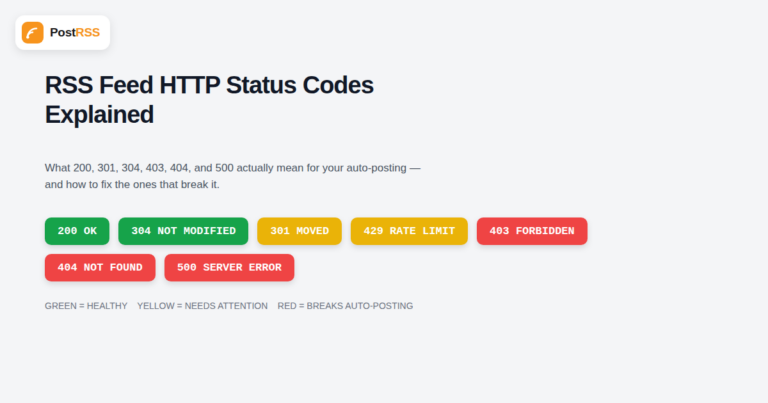
RSS Feed HTTP Status Codes Explained: What 301, 304, 404, and 500 Mean for Auto-Posting
Updated: 2026-09-13

When an RSS feed stops updating on a social account, the actual cause is almost always sitting in an HTTP response header that ...

Mehr lesen »
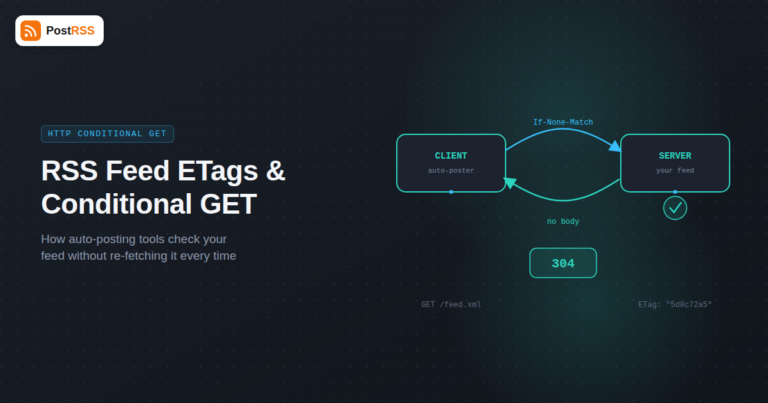
RSS Feed ETags and Conditional GET: How Auto-Posting Tools Avoid Re-Fetching Your Feed
Updated: 2026-09-09

Every automated tool that watches your RSS feed — a social media auto-poster, a feed reader, an aggregator, a monitoring script...

Mehr lesen »

RSS Feed Bloat and Core Web Vitals: Does a Large Feed Slow Down Your Site?
Updated: 2026-09-06

Short answer: no, and yes. Google's Core Web Vitals are measured on rendered HTML pages — your homepage, your blog posts, your ...

Mehr lesen »

Does Auto-Posting from RSS Hurt Your SEO? Duplicate Content, Canonical Tags & Best Practices
Aktualisiert: 25.08.2026

Somewhere between "automate everything" and "protect my Google rankings," a lot of site owners freeze. The ...

Mehr lesen »

Menü
x
PostRSS - RSS-Feed-Automatisierungsplattform & Auto-Posting-Tool
Datenschutz-Übersicht

Diese Website verwendet Cookies, um Ihnen die bestmögliche Benutzererfahrung zu bieten. Cookie-Informationen werden in Ihrem Browser gespeichert und erfüllen Funktionen wie das Wiedererkennen bei Ihrer Rückkehr auf unsere Website sowie die Unterstützung unseres Teams dabei, zu verstehen, welche Bereiche der Website Sie am interessantesten und nützlichsten finden.