من RSS إلى 66 شبكة تواصل اجتماعي: Facebook، وInstagram، وX، وLinkedIn، وTelegram، والمزيد المدونة برنامج التسويق بالعمولة اتصل بنا
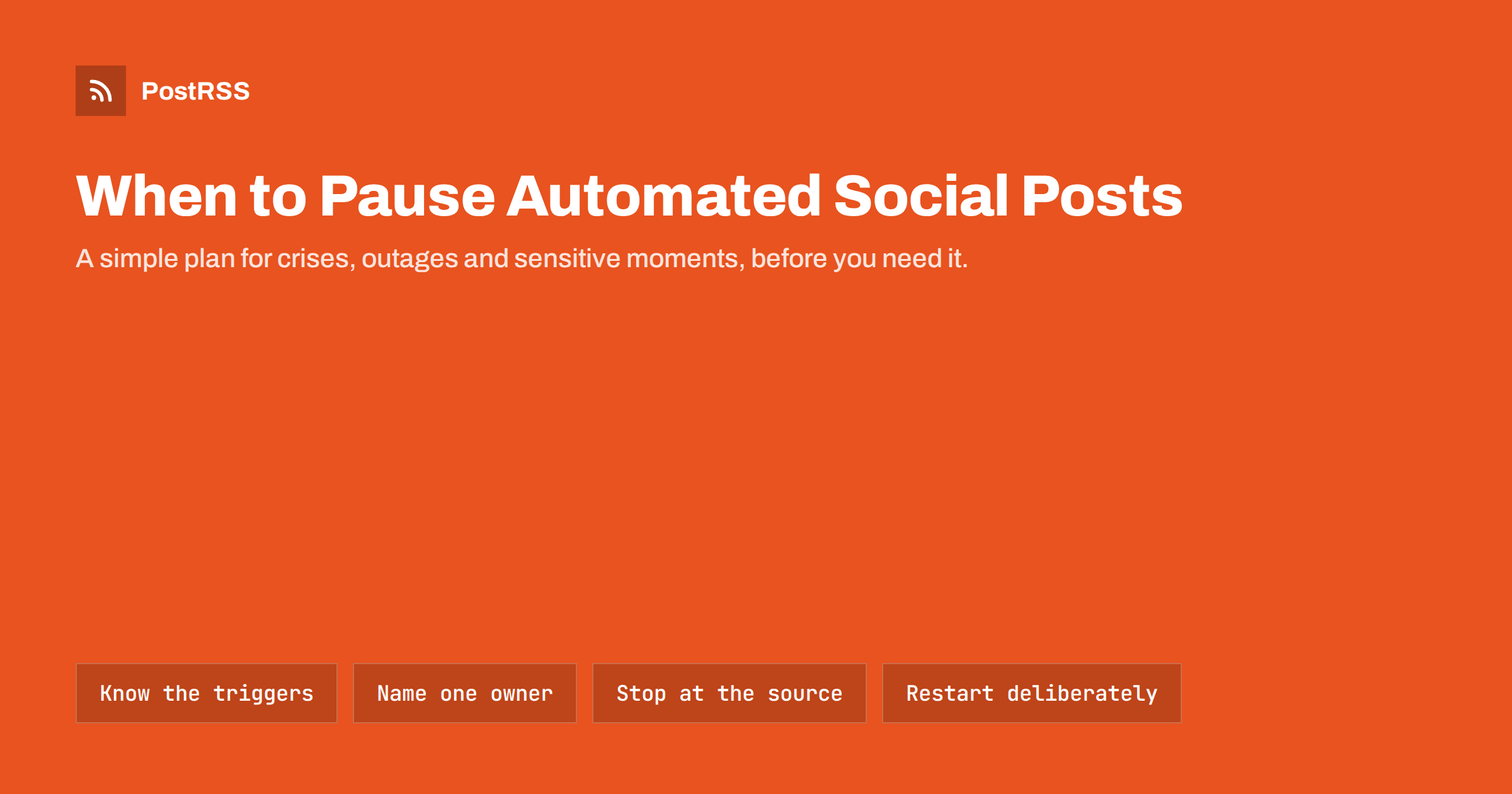
Short answer: Pause automated social posts whenever an event makes your scheduled content look careless, wrong or unsafe: a major tragedy or public emergency, a crisis involving your own brand, a service outage, a factual error in recent posts, or legal and regulatory uncertainty. The fastest way to pause is at the source, by holding new content before it enters your feed, combined with a clear owner who is allowed to make the call. Write the plan down now, because in the moment nobody has time to work out which settings to change.
Automation is valuable because it keeps publishing when you are busy. That is also its main risk. A scheduled post about a flash sale, a cheerful weekend recipe or a joke headline can appear minutes after news that makes it look insensitive. Readers do not know the post was queued days earlier; they only see a brand that seems not to be paying attention.
The problem is not automation itself. Manually scheduled posts in any tool carry the same risk. The difference is scale: an RSS feed connected to ten channels can publish the same unfortunate post ten times in a few minutes. That makes it worth having a simple, rehearsed way to stop the flow, and a shared understanding of when to use it.
A pause plan also protects against more ordinary problems. A broken feed that suddenly republishes old items, a typo in a price, or a post that went live before an embargo ended all benefit from the same quick stop.
There is no universal list, and every organisation should agree its own thresholds. The following situations are the ones most teams include:
Most of the time, a pause lasts hours rather than days. The goal is to prevent a mistake, not to go silent for weeks.
Stopping every channel for every piece of bad news has its own cost: your audience loses useful updates and the pause loses meaning. A few situations are usually better handled with a targeted change rather than a full stop:
The question to ask is simple: would a reasonable person in our audience see our next scheduled post and think we were careless? If yes, pause. If not, a review may be enough.
In practice, the slowest part of a pause is not the technical step. It is the discussion about whether to do it and who has the authority. Decide in advance:
Agencies should agree this with each client in writing. A client whose industry is in the news may want posting stopped even if the agency would not have chosen to. Our guide to team workflows and permissions for RSS auto-posting covers how to split roles so the right people can act quickly.
With feed-based automation, you have two places to intervene: the source that produces the feed, and the tool that posts from it. Stopping at the source is often the quickest and most complete:
Write the exact steps for your own setup in a short document: which CMS screen, which setting, which person has the login. A one-page pause checklist that anyone on the team can follow at 7 a.m. on a Sunday is worth more than a detailed policy nobody can find.
A pause is a chance to check what is waiting in the pipeline, not just to wait. Use the time to:
Be careful with catch-up behaviour. Some tools post everything that was published during the pause as soon as posting resumes, which can create a burst of posts at the worst moment. Decide in advance whether you want that, or whether the items should be skipped. Our article on how auto-posting tools prevent duplicate posts explains how tools track which items have already been handled.
The most useful output of this whole exercise is a single page that lives somewhere everyone can find it, such as a pinned message in your team chat or the first page of your shared drive. Keep it short enough to follow under pressure. A practical template looks like this:
Test the checklist once when nothing is wrong. Ask someone who did not write it to follow it on a quiet afternoon and time how long it takes. If they get stuck on a password, a missing permission or a setting they cannot find, you have found the weak point while it costs nothing. Review the page whenever you add a new channel, change your CMS or change who manages social media, because an out-of-date checklist is almost as unhelpful as none.
Resuming is where teams often slip, because the urgency has passed and attention has moved on. A short restart routine avoids that:
Also think about the tone of the first posts after a serious event. Even when the reason for the pause has passed, a very promotional post can still feel abrupt. Many teams resume with useful, neutral content such as practical guides or service updates, and bring back promotions a day or two later.
Many teams find that the first pause reveals gaps, such as a missing login or an unknown setting. That is normal. Fix the gaps while they are fresh.
PostRSS posts new items from your RSS or Atom feed to the networks you connect, so the simplest pause is often in your CMS: items that are not published do not appear in the feed. Inside PostRSS, you can set include and exclude keywords for each source, choose posting windows or exact posting times on paid plans, limit how many items are posted per update, and decide whether older unpublished items should be caught up. Every post and error is recorded in the posting log, which helps when you review what went out before and after a pause. The features page lists these options in detail.
Automated posting should have an off switch that someone is allowed to use without a meeting. Agree the situations that justify a pause, name the person who decides, and write down the exact steps for your CMS and your posting tool. When something happens, stop at the source, review the queue, and restart deliberately. A two-hour pause is rarely noticed; a badly timed post often is.
Not necessarily. Pause when your next scheduled posts could reasonably look careless or insensitive to your audience, or when the event affects the places your audience lives. For distant news, reviewing the queue is often enough.
Stop new items from entering the feed by moving scheduled posts back to draft or pushing their dates forward in your CMS. Then adjust filters or posting times in the posting tool if needed. Writing these steps down in advance makes the pause take minutes.
That depends on the tool and its settings. Some tools catch up on items published during a pause, while others only post new items from the moment they resume. Check the setting before resuming so you do not create a sudden burst of posts.
At least two named people, typically the owner or marketing lead and a deputy. They should be able to act without approval, because speed matters more than consensus in the first hour. Restarting can require a second opinion.
Usually hours rather than days. Resume when the reason has passed and you have reviewed the queue. For a crisis involving your own brand, the first post after the pause should often be a human-written update.
What changed in the networks, what broke, and how to fix it before it costs you reach.
 English
 Lietuviškai
 Deutsch
 Français
 Русский
 Español
 Polski
 Italiano
 Українська
 Čeština
 Português
 日本語
日本語 Latviešu valoda
 Eesti
Eesti Magyar
 Bahasa Indonesia
 Türkçe
 हिन्दी
 Ελληνικά
 العربية
 ไทย
ไทย Tiếng Việt
 Română
 Bahasa Melayu
 বাংলা
বাংলা