Press releases, product launches, and embargoed news stories come with a hard constraint that most content doesn’t: a specific, non-negotiable moment before which nothing can go public. That’s a real tension with RSS-driven automation, which is built to detect and distribute new content as soon as it appears. This guide covers whether you can safely combine embargo timing with an RSS auto-posting workflow, and exactly how to structure it so nothing leaks early.
This question comes up most often for comms and PR teams who already rely on automation for their routine content calendar and want the same efficiency for time-sensitive announcements, without giving up the precise control an embargo genuinely requires. The good news is that the two goals aren’t actually in conflict — they just require putting the timing control in the right place in your publishing stack, which is what the rest of this guide walks through.
A standard blog or CMS publishes a post the moment you hit publish, and that post immediately appears in your RSS feed — there’s no native concept of “this item exists in the feed, but don’t actually distribute it until 9:00 AM Thursday.” For most content, that immediacy is exactly what you want. For embargoed press content, it’s a liability: if your CMS publishes the page at all before the embargo lifts (even as an unlinked draft URL, or scheduled for a future public date but technically live), an auto-posting tool polling that feed could pick it up and post it before the embargo window opens.
| Approach | كيف يعمل البرنامج | Risk Level |
|---|---|---|
| CMS-side scheduled publish + feed-native timing | Page and feed item both go live at the embargo time itself, not before | Low — nothing exists publicly before the embargo lifts |
| Early publish + auto-posting tool’s own scheduled delay | Content is live/in the feed early, but the auto-posting tool is told to wait until embargo time to post | Higher — content is technically discoverable before the embargo, even if not yet promoted |
The first approach is unambiguously safer and is what most professional PR and publishing workflows use: don’t make the content live anywhere — page or feed — until the exact embargo moment. The second approach introduces real risk, because “not yet promoted” isn’t the same as “not accessible.” A search engine crawler, a competitor manually checking your site, or even your own feed being polled by an unrelated tool could surface embargoed content before you intend, regardless of what your auto-posting schedule says.
Some auto-posting tools, including PostRSS, support scheduling a specific item to post at a future time even after it appears in a feed. This is useful for normal content calendar planning, but it’s the wrong tool for embargo enforcement specifically, because it only controls when the social post goes out — not when the underlying page or feed item becomes accessible. For genuine embargoes, the access-control layer needs to sit at the CMS/page level, with the auto-posting schedule as a secondary, redundant safeguard at most.
Press releases distributed to multiple outlets under a shared embargo (common for major product launches or research findings) add another layer of coordination. If your own site is one of several sources set to go live simultaneously:
| Mistake | Consequence | Fix |
|---|---|---|
| Publishing early with the page manually unlinked | Content is technically live and indexable before embargo | Use genuine CMS-scheduled publishing instead |
| Wrong time zone conversion | Content posts hours early or late | Explicitly confirm and double-check the embargo’s stated time zone |
| Relying only on auto-posting tool’s schedule | Underlying page/feed may still be accessible before embargo | Control access at the CMS/page level first |
| Slow feed polling interval | Delayed social post after embargo lifts, missing the coordinated moment | Use a tool with fast polling or webhook-based triggering for time-sensitive releases |
Even with correct CMS-side scheduled publishing, a caching layer — a CDN, a page cache plugin, or your host’s edge cache — can sometimes serve a stale, pre-embargo version of a page or feed slightly past the moment it should have updated, or in rarer misconfigurations, briefly expose a cached preview earlier than intended. Before a genuinely high-stakes embargo, it’s worth checking whether your caching setup respects scheduled-publish events correctly, and if your CMS or hosting provider offers a way to purge or bypass cache automatically at the scheduled time rather than waiting for a normal cache expiry cycle. This is the same category of feed troubleshooting issue that causes delayed auto-posts under normal circumstances — except for an embargo, the failure mode runs in the more dangerous direction of exposing content too early rather than too late.
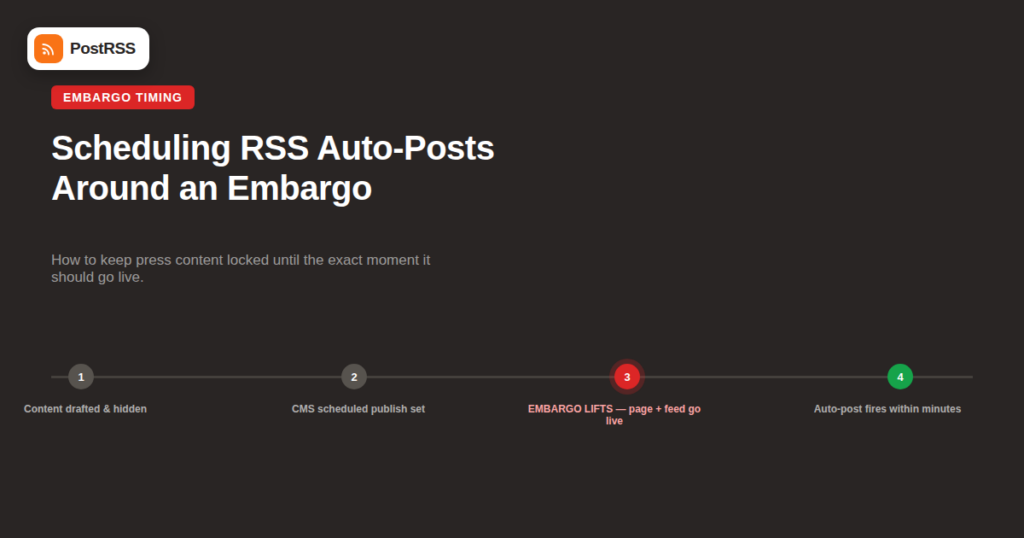
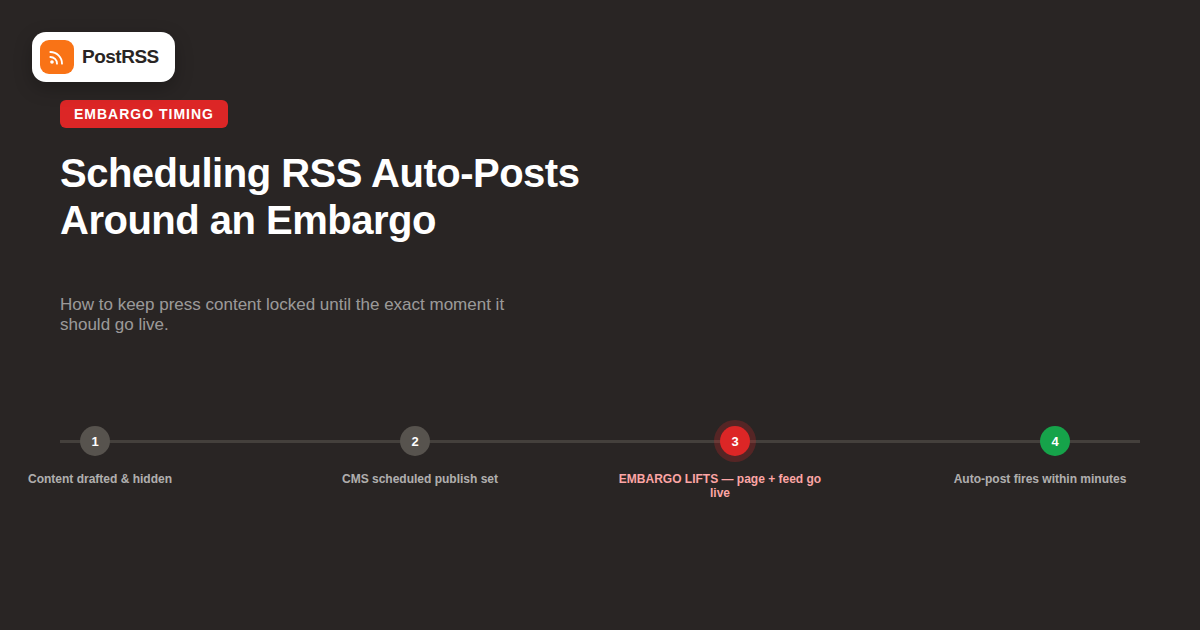
Consider a company announcing a product launch at exactly 9:00 AM Eastern. A safe setup looks like this: the blog post is scheduled in the CMS for 9:00 AM Eastern (converted correctly to the server’s own time zone), the auto-posting tool’s feed polling interval is confirmed to run every 2-5 minutes rather than every 30, and the social caption and target networks are fully configured the day before so nothing needs last-minute editing. At 9:00 AM, the CMS publishes the page and the feed updates simultaneously; within the next polling cycle, the auto-posting tool detects the new item and posts it — typically within a few minutes of the embargo lifting, without any human needing to manually click “publish” or “post” at the exact moment across multiple platforms.
Yes, most auto-posting tools support scheduling specific posts for a future time — but this should be a secondary safeguard, not your primary embargo control, since it doesn’t prevent the underlying page from being accessible before that time.
Use your CMS’s native scheduled-publish feature so the page and feed item don’t exist publicly until the embargo moment itself, then let your auto-posting tool’s normal feed-detection handle distribution from there.
Properly configured CMS platforms exclude future-scheduled posts from the public feed until their publish time passes, but it’s worth verifying this behavior specifically in your CMS before trusting it with embargoed content.
Yes — if a page is technically live (even unlinked) before the embargo, search engine crawlers can still discover and index it, which is one more reason genuine scheduled publishing is safer than “early publish, manually hide the link.”
Pick the embargo’s authoritative time zone (usually specified by whoever issued the embargo) and convert precisely to your server’s time zone for scheduling — don’t rely on approximate conversions, since even a 15-30 minute error can break a coordinated multi-outlet embargo.
Yes — run a full dry test with a dummy post scheduled a few minutes out, confirming both the page’s accessibility timing and the social auto-post timing, well before you need to rely on the same setup for real embargoed content.
You’ll see a delay between the embargo lifting and your social post going out, which can matter for high-profile coordinated releases — check whether your tool offers a faster polling tier or a webhook-triggered option for genuinely time-sensitive content.
Yes, for a single high-stakes announcement, manual posting at the exact embargo moment is a reasonable fallback if you’re not fully confident in your automated setup — the goal of automation here is convenience and consistency, not a requirement that overrides caution for a genuinely sensitive release.
Yes — writing and saving caption text, images, and target network selections ahead of time is safe as long as the actual trigger (the feed item appearing) doesn’t happen until the embargo lifts. The preparation step and the publish step are separate, and only the publish step needs to be time-locked.
Distribution services (like wire services) typically handle their own embargo enforcement independently of your site, but your own site’s blog post and feed item still need the same CMS-side scheduled-publish treatment described above if you want your own social channels to announce it at the same moment as the wire release.
It’s worth being explicit about why embargo timing deserves more caution than routine editorial scheduling. A normal blog post scheduled for next Tuesday has no real cost if it accidentally goes live a few hours early — at worst, it’s a minor timing inconsistency. An embargoed press release has actual contractual and relationship stakes: outlets covering the story under embargo terms, partners coordinating a simultaneous announcement, or regulatory disclosure timing (common in financial or healthcare-adjacent announcements) can all be genuinely damaged by an early leak, not just mildly inconvenienced. That asymmetry is why this guide recommends treating the CMS-level publish control as the primary safeguard and the auto-posting tool’s schedule as a secondary one, rather than trusting either system alone.
RSS auto-posting can work safely with embargoed press content, but only if the embargo is enforced at the CMS and page-access level first — using genuine scheduled publishing rather than early publishing with a hidden link. Treat your auto-posting tool’s own scheduling as a secondary safeguard for distribution timing, not the primary control for whether content is public. Set this up correctly once, test it with a dry run, and embargoed releases can flow through the same automated pipeline as your regular content without any risk of an early leak — turning what feels like a manual, high-stress moment into just another scheduled item in your normal content calendar.