RSS tới 66 mạng xã hội: Facebook, Instagram, X, LinkedIn, Telegram và nhiều mạng khác Blog Tiếp thị liên kết Liên hệ
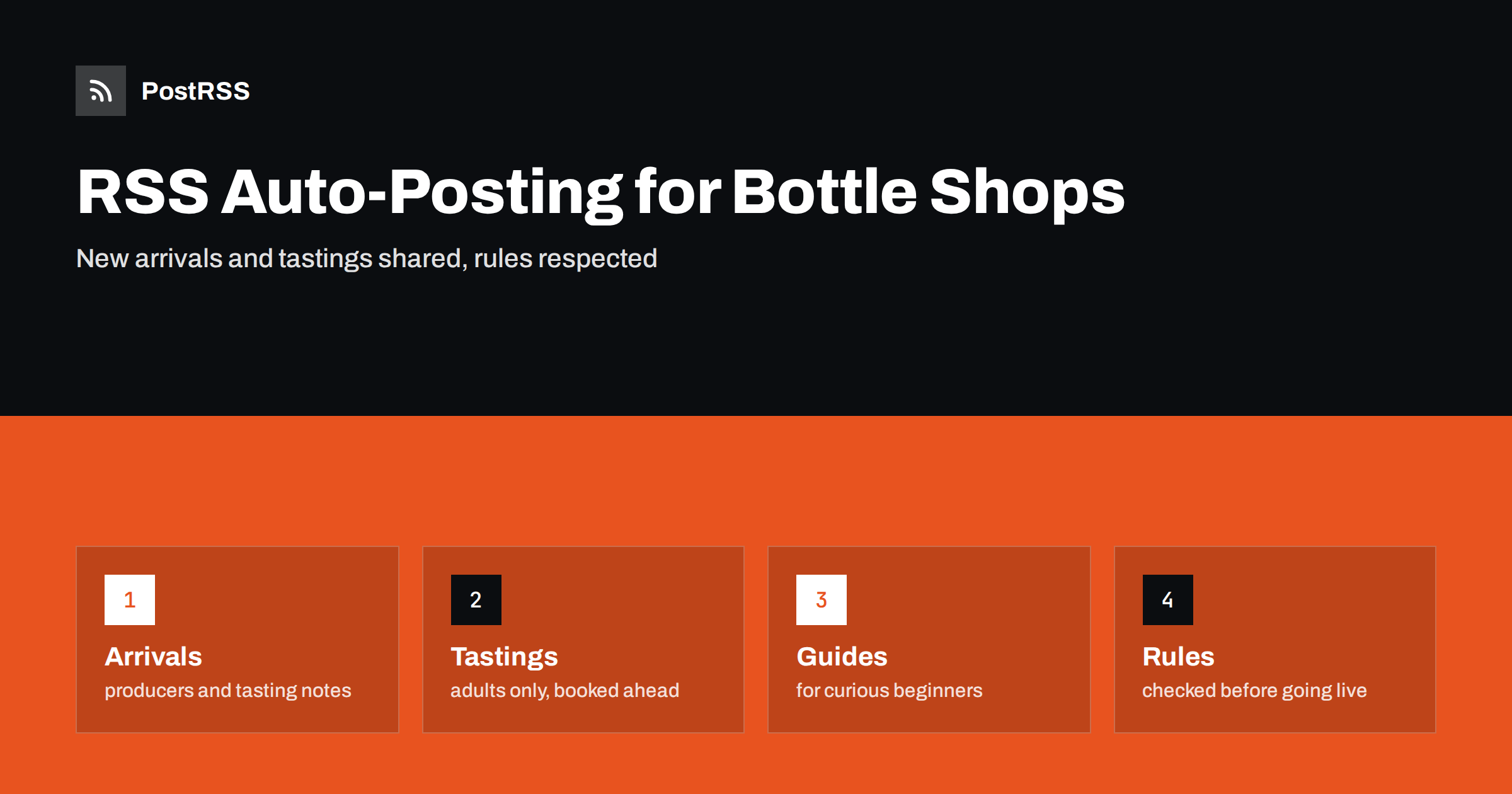
Short answer: RSS auto-posting lets liquor stores and bottle shops share new arrivals, tasting events, seasonal selections, gift guides and opening hours on social media automatically. Publish each item as a page on your website, let an auto-poster read the RSS feed, and every new page appears on your Facebook Page, Telegram channel and other networks with its link and image. Customers see what is new this week without anyone retyping it, while age rules, local alcohol advertising laws and platform policies remain firmly in your hands, and nothing is promoted to minors or in a way that encourages excess.
An independent bottle shop competes with supermarkets on price and wins on knowledge. The owner knows which producer makes the interesting natural wine, which small distillery has a new release and which beer will suit a customer who says they do not like bitter. That knowledge is the real product, and it is easy to lose in a busy week of deliveries, stocktaking and customers at the counter. A feed can turn it into steady, useful posts. At the same time, alcohol is one of the most regulated products in retail, and what you may say, to whom and where differs from one country and one platform to another. This guide explains what to publish, how to connect your website to an auto-poster and how to keep the whole process responsible and within the rules.
The advice fits many kinds of retailer that sell alcoholic drinks:
Each has a website, or a page on a larger site, where news can be listed. That page becomes the single source for every other channel.
Most of what a good shop knows can become a short page:
Each page is written once and appears on your website, where it can be found by someone who searches for a recommendation in your town. The feed then announces it automatically.
Many shops already use a system that creates feeds:
/feed/ and one for every category, such as /category/new-arrivals/feed/. If you are unsure of the address, see how to find your WordPress feed link.Use categories to separate topics: new arrivals, events, guides, seasonal selections and jobs. Each category has its own feed, and each feed can go to the channel where it works best; new arrivals and events to the Facebook Page, guides to an audience that likes to learn, hiring pages to LinkedIn. Routing by category is explained in category filtering for auto-posting.
| Content | Automate? | Notes |
|---|---|---|
| New arrivals and seasonal selections | Yes | Describe taste and origin, not effects |
| Tastings and producer events | Yes | State the age rule and the booking process |
| Beginner guides | Yes | Educational, with a note about responsible drinking |
| Prices and special offers | Check the rules | Some places restrict price promotions on alcohol |
| Replies to customer questions | No | Answer personally, and never sell to someone who may be underage |
| Anything aimed at minors or encouraging excess | Never | Illegal or against policy almost everywhere |
A simple rule: if it is educational information about products and events that sits on a finished page of your website, and you have checked it against the rules, automate it. If it concerns an individual customer, a price promotion that needs legal review or a sudden change, it needs a human.
Alcohol advertising is regulated in most countries, and the rules vary widely. Some places ban price promotions, some forbid health claims or require a responsible-drinking message, some restrict images of people drinking and some limit where an advertisement may appear. Social platforms add their own policies, which often require that alcohol content is shown only to adults and may restrict promoted posts or shops. A feed publishes whatever is on your website, so the review must happen before the page goes live, not after the post has been shared. Ask the person who holds your licence, or your trade association, to confirm what is allowed, write a short checklist and have every new page checked against it. These points are general guidance, not legal advice. Follow your licence conditions, the law of your country and the policies of every platform you use.
Responsible does not mean boring. The best shop content is about curiosity and craft: how a wine was made, why a rye whisky tastes of spice and which beers go with a roast. Describe flavour in plain words, name the producer and the place, and let the reader imagine the occasion. Avoid language that links alcohol to success, strength, popularity or relaxation as a cure for stress, and do not show or suggest excessive drinking. Include an age notice on pages where it is required, and mention low-alcohol and alcohol-free options, because they are a growing part of many customers’ choices. Use your own photographs of the shelf and the label in good light, not pictures that are borrowed from a producer without permission.
A tasting is an excellent reason to visit, and it carries extra responsibilities. Give each event its own page with the date, the time, the place, the price, the number of places and the process for booking, and state clearly that participants must be of legal age and may be asked for proof. Say what is included, such as the number of samples and some food, and offer water and non-alcoholic options. Publish the event a few weeks ahead, add a reminder in the last week and unpublish the page after the event, with a short recap and photographs only of people who have agreed. Do not post pictures of guests who have been drinking without their permission, and never encourage people to drive afterwards.
A bottle shop has busy seasons, such as holidays, summer weekends and wedding months. Write gift guides and seasonal selections a few weeks ahead, give every page a clear date in the title or the first line, and state the last day for delivery before the holiday. Unpublish the page when the season is over, because a feed that still announces last year’s holiday selection looks careless. A permanent page for each product group, such as natural wines or local beer, with short dated notes for each new arrival, keeps your website tidy and your feed useful.
Before you connect a channel, read its current policy for alcohol content and check whether it can restrict the audience to adults. Most shops do best with a Facebook Page, a good website and an email list that use the same pages. Two active channels beat five forgotten ones.
/feed/, and check that it lists recent items.PostRSS has been automating RSS posting since 2014. It checks your website feeds as often as every minute and publishes each new page, with its real image and link, to the channels you connect, from Facebook Pages and Telegram to LinkedIn, Bluesky, Mastodon and many more among its 66 supported networks. You can choose how each post is built, filter items by keywords, add UTM parameters and post only within chosen hours or at exact times in your time zone. See the PostRSS features page for everything it does and the pricing page for plan limits. More ideas for local shops are under the Local Business tag.
A bottle shop sells knowledge as much as bottles, and a feed turns that knowledge into steady posts about new arrivals, tastings and guides. Check every page against the alcohol rules of your country, your licence and each platform before it goes live, keep content away from minors and from encouragement of excess, describe taste and craft instead of effects, retire old seasonal pages, route content by category and let your team spend their time advising customers at the counter.
Yes, but every page must follow the alcohol advertising rules of your country, your licence conditions and the policies of each platform. Review pages before they go live, because a feed publishes whatever is on your website.
New arrivals, tasting events, beginner guides, seasonal selections and low-alcohol options. Describe flavour and origin honestly and avoid claims about effects.
Only if the rules where you trade allow it. Some places restrict price promotions on alcohol, so check with your licensing authority or trade association first.
Avoid youthful imagery and language, use age notices where required and choose channels that let you limit the audience to adults. Never sell to someone who may be underage.
Yes. PostRSS reads any valid RSS or Atom address that is reachable without a login. Paste the address, connect your channels and new pages are shared as soon as they appear.
What changed in the networks, what broke, and how to fix it before it costs you reach.
Do Internet Solutions, đội ngũ đứng sau PostRSS, phát triển. Mỗi sản phẩm giúp bạn tiết kiệm thời gian theo một cách riêng.
 English
 Lietuviškai
 Deutsch
 Français
 Русский
 Español
 Polski
 Italiano
 Українська
 Čeština
 Português
 日本語
 Latviešu valoda
 Eesti
 Magyar
 Bahasa Indonesia
 Türkçe
 हिन्दी
 Ελληνικά
 العربية
 ไทย
 Tiếng Việt
 Română
 Bahasa Melayu
 বাংলা