
Updated: September 23, 2026
Mortgage brokers and loan officers compete on one thing above almost everything else: being the name a prospective borrower remembers when they’re finally ready to apply. That kind of top-of-mind awareness comes from consistent visibility — rate updates, first-time buyer tips, market explainers — shown to the same audience repeatedly over months, not from a single viral post. RSS automation makes that kind of steady visibility possible without turning content marketing into a second job on top of originating loans.
This guide covers how mortgage brokers, loan officers, and small lending teams can use PostRSS to keep Facebook, LinkedIn, and X consistently updated, along with the compliance considerations that make this industry different from most other local businesses automating their social media.
Why Consistency Matters More Than Volume in Mortgage Marketing
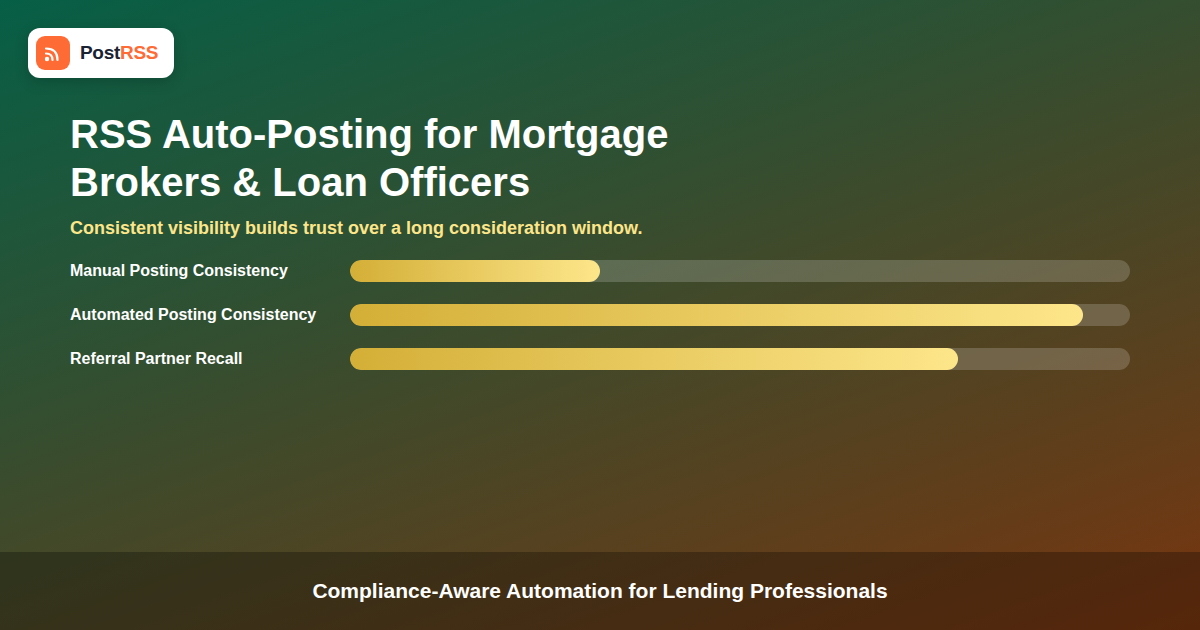
Buying a home is a long consideration cycle. Someone who follows a loan officer on Facebook today might not be ready to apply for six months or a year, which means the content that eventually earns their business isn’t the post they saw once, it’s the accumulated impression of a broker who’s been visibly active and informative the entire time they were considering their options. A broker who posts in bursts — active for two weeks, silent for two months — loses that compounding effect every time the gap resets the audience’s sense of “this person is active and worth following.”
Automating distribution from a blog or rate-update feed removes the dependency on remembering to post, which is often the actual reason consistency breaks down, not a lack of things worth sharing.
What to Auto-Post as a Mortgage Professional
- Rate update commentary: If you publish regular rate commentary or market explainers to a blog, that content becomes an automatic recurring post without additional writing effort once the feed is connected.
- First-time buyer education content: Explainer content about the loan process, down payment programs, or credit requirements tends to perform well because it addresses real questions your actual audience has, not just promotional material.
- Local market updates: Content about local housing market trends works particularly well on local business marketing channels like Facebook, where a geographically relevant audience is more likely to engage.
- Program and rate change announcements: New loan program availability or notable rate movements are naturally time-sensitive content that benefits from going out the moment it’s published rather than whenever someone remembers to share it.
Compliance Considerations for Auto-Posted Financial Content
Mortgage and lending marketing sits under real regulatory scrutiny, and automation doesn’t change that — it changes the distribution mechanism, not the compliance obligations. A few things worth building into your process:
- Review content before it enters your feed, not after it’s posted. Since auto-posting happens automatically once content is published to your site, the compliance review needs to happen at the point of publishing, the same discipline you’d already apply to anything with lending-specific disclosure requirements.
- Keep rate-specific content dated and clearly time-stamped. Rate information becomes outdated quickly, and automated distribution means content can be shared and reshared by others well after it’s no longer accurate, so clear dating in the content itself matters more than it would for evergreen topics.
- Confirm required disclosures are part of the content itself, not just the destination page. If your industry requires specific disclosure language on loan-related posts, that language needs to travel with the auto-posted content, not just live on the landing page it links to.
- Loop in compliance or a broker-owner before connecting a new feed. Treat adding an RSS automation feed the same way you’d treat approving a new marketing channel — a quick review up front avoids finding out later that a feed included content that shouldn’t have gone out publicly.
Platform Priorities for Mortgage Professionals
Facebook tends to be where local, individual borrowers actually spend time and where a broker’s personal brand and local reputation matter most, making it a strong primary platform for this audience. LinkedIn works well for referral-partner relationships — real estate agents, financial advisors, and other professionals who send business your way rather than the borrowers themselves. X can work for quick rate-update style content but tends to reach a smaller share of the direct-borrower audience than Facebook in most local markets.
A Practical Setup Example
Consider a loan officer who publishes a short weekly rate-update post to a personal or brokerage blog, along with occasional first-time buyer guides. Connecting that blog’s feed to Facebook and LinkedIn means every weekly update reaches both audiences automatically, with the Facebook version framed for a general local audience and the LinkedIn version framed toward referral partners. Over a year, that’s roughly fifty automatic touchpoints with an audience that would otherwise see far fewer manual posts, purely because the mechanism doesn’t depend on remembering to do it during a busy origination week.
Building Referral Partner Relationships Through Automated Content
A meaningful share of mortgage business comes through referral partners — real estate agents, financial planners, divorce attorneys, and other professionals who regularly encounter people needing a loan officer. Those partners are more likely to keep a broker top-of-mind if they see consistent, genuinely useful content rather than occasional promotional posts, since a steady stream of market commentary signals that a broker is actively engaged with the business, not just occasionally checking in when they need referrals themselves.
Because referral partners and direct borrowers often respond to different framing of the same underlying information, it’s worth writing slightly different captions for the platforms each audience tends to use. A rate-update post aimed at a real estate partner on LinkedIn might emphasize what the rate movement means for their current listings’ affordability, while the same underlying content framed for Facebook might speak more directly to a first-time buyer’s monthly payment concerns.
Common Mistakes to Avoid
- Connecting a feed without a compliance review process in place first: Set up the review step before turning on automation, not after noticing something was posted that shouldn’t have been. Automation makes distribution instant, which means the review has to happen earlier in the process, not later.
- Using identical captions across every platform: A caption written for a professional LinkedIn audience of referral partners often doesn’t land the same way with borrowers on Facebook. Writing platform-specific templates, even briefly, produces noticeably better engagement than a single generic caption everywhere.
- Letting rate content go stale without clear dating: Because automated posts can be seen, shared, or resurfaced well after their original publish date, always including a clear date in rate-sensitive content prevents confusion if it’s seen out of its original context.
- Forgetting to revisit templates after a licensing or branding change: If your brokerage affiliation, NMLS information, or required disclosures change, update your content templates promptly since automated posts will keep using whatever template is currently configured.
Measuring Whether It’s Working
Because the value of consistent mortgage marketing shows up gradually, it’s worth tracking a few simple indicators rather than expecting an immediate spike after turning automation on. Facebook page follower growth, profile visits, and direct message inquiries referencing something you posted are all reasonable signals that the automated content is actually reaching and influencing your audience. Referral partners mentioning that they’ve been seeing your posts regularly, even informally in conversation, is another practical signal that the consistency is registering, even though it’s not a metric you can pull from a dashboard.
Comparison: Manual vs. Automated Content Distribution
| Factor | Manual Posting | RSS Automation |
|---|---|---|
| Consistency during busy periods | Often the first thing skipped | Unaffected by workload |
| Compliance review point | Ad hoc, sometimes after posting | Built into your publishing workflow |
| Cross-platform reach | Requires reposting per platform | One feed, multiple platforms |
| Time cost | Ongoing, every post | One-time setup per platform |
Frequently Asked Questions
Is RSS automation compliant with mortgage marketing regulations?
Automation itself is just a distribution mechanism — compliance depends entirely on the content you publish to the feed that triggers it. Reviewing content for required disclosures before it’s published to your site, the same as you would for any other marketing channel, keeps automated distribution compliant.
Should rate information be auto-posted immediately when published?
Generally yes, since rate-sensitive content benefits from timely distribution, but make sure the content itself is clearly dated so it reads accurately even if shared or seen later than the original publish time.
Can I auto-post to Facebook but handle LinkedIn manually?
Yes, most RSS automation tools let you configure each platform independently, so you can automate the platforms where consistency matters most while handling others manually if you prefer more control there.
Does automation work for a solo loan officer, or is it only useful for larger teams?
It’s arguably more valuable for a solo loan officer, since there’s no marketing staff to fall back on when origination work gets busy. Automation is what keeps the social presence active during exactly the weeks a solo producer has the least time to post manually.
What happens if my blog goes down or the feed breaks?
Most RSS automation tools will simply have nothing new to post until the feed is reachable again, rather than posting anything incorrect. It’s worth periodically checking that your feed is being read correctly, particularly after any website changes.
Can referral partners and borrowers both be reached from the same automated feed?
Yes, by connecting the same feed to different platforms with different framing — a referral-partner-focused caption on LinkedIn and a borrower-focused caption on Facebook, for example, drawn from the same underlying content.
Should a mortgage team with multiple loan officers use one shared feed or separate ones?
It depends on how the team is structured. A brokerage with a single company blog and shared branding often does well with one central feed distributed to a shared company page, while individual loan officers who maintain their own personal brand and blog benefit from connecting their own separate feed to their own accounts, preserving whatever personal reputation they’ve built with their specific network.
Does posting frequency matter, or is once a week enough?
Once a week is a reasonable baseline for most mortgage professionals, since the goal is sustained visibility over a long consideration window rather than maximizing daily reach. What matters most is that the cadence stays consistent over months, not that it’s especially frequent.
Why This Matters More in a Regulated Industry Than Most
Most local businesses automating their social media are mainly weighing convenience against effort. Mortgage professionals face an additional dimension: getting the compliance side wrong carries real regulatory consequences, which makes some brokers hesitant to automate anything at all. That hesitation is understandable but ultimately misplaced — the compliance risk in mortgage marketing comes from the content itself, not from whether a human clicked “post” or an automated system did it on their behalf. A disclosure that’s missing from a manually posted update is just as much a problem as one missing from an automated post; the fix in both cases is the same review step applied before anything goes public, not avoiding automation altogether.
Once that review step is built into the publishing workflow — the same discipline any compliant lending operation already needs regardless of how content gets distributed — automation adds consistency without adding new regulatory exposure. Treated this way, automation becomes a distribution improvement layered on top of an unchanged compliance process, rather than a separate risk to weigh against the convenience it offers.
The Bottom Line
In mortgage marketing, results build slowly and quietly, which is exactly why so many brokers give up on content marketing before it has a chance to work. being remembered matters more than being clever, and being remembered is mostly a function of consistent visibility over a long consideration window. RSS automation removes the biggest obstacle to that consistency — a busy loan officer forgetting to post during their busiest weeks — while still leaving compliance review exactly where it belongs, at the point content gets published.
See PostRSS pricing and connect your blog’s feed to keep your name in front of borrowers and referral partners automatically.