RSS tới 66 mạng xã hội: Facebook, Instagram, X, LinkedIn, Telegram và nhiều mạng khác Blog Tiếp thị liên kết Liên hệ
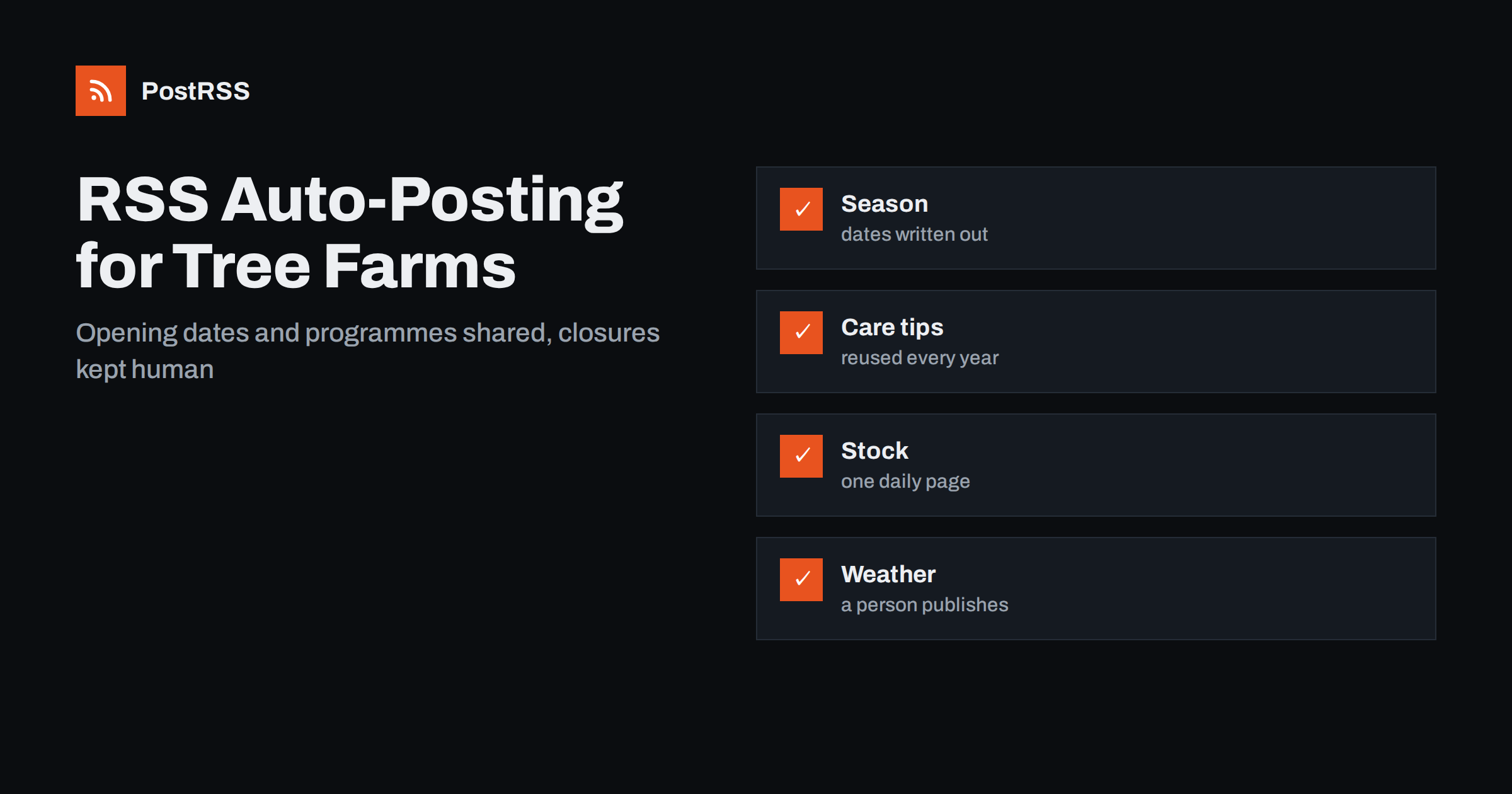
Short answer: RSS auto-posting lets Christmas tree farms, tree lots and holiday market organizers share opening dates, tree varieties, care tips, event days, vendor calls and closing notices on social media automatically. Publish each item as a page on your website, let an auto-poster read the feed, and every new page appears on your Facebook Page, Telegram channel and other networks with its link and image. Families find out when the season starts and what is happening each weekend, while live stock levels, weather closures and traffic updates stay with a person who can check them.
The season of a Christmas tree farm is short and intense. For eleven months the business is quiet, then for a few weeks cars fill the parking field, children run between the rows and the staff handle hundreds of questions a day. Is the farm open on Sunday? Do you have tall trees left? Where do we park? Can we bring the dog? Most of the answers are the same every year and can be written once in clear pages. Holiday markets have a similar rhythm, with stalls to recruit, programmes to publish and weather that changes plans at the last minute. A feed turns each page into a post as soon as it is published, so that the people who run the place can spend their time with visitors. This guide explains what to publish, how to connect it and what must stay manual.
The advice fits many kinds of seasonal holiday businesses:
Each has a short season, a place and a website where news can be listed. That page becomes the source for every other channel.
Most of what a seasonal business communicates can be turned into a short page:
Each page is written once and appears on your website, where a person who searches for a tree nearby can find it. The feed then announces it automatically.
Many seasonal businesses already use a system that creates feeds:
/feed/ and one for every category, such as /category/events/feed/. If you are unsure of the address, see how to find your WordPress feed link.Use categories to separate audiences: season news, events, care tips and vendors. Each category has its own feed, and each feed can go to the channel where it works best; season news and events to the Facebook Page, vendor calls to a channel for makers. Routing by category is explained in category filtering for auto-posting.
| Content | Automate? | Notes |
|---|---|---|
| Opening dates and hours | Yes | Dates written out, one permanent hours page |
| Variety guides and care tips | Yes | Written once, reused every year |
| Weekend programmes and vendor calls | Yes | Dates, places and how to apply |
| Stock levels | Not alone | Update a stock page by hand each day |
| Weather closures and traffic | No | A person publishes at once |
| Prices for one customer or group | No | Answer by phone or message |
A simple rule: if it is a general notice that helps many visitors and sits on a finished page, automate it. If it changes by the hour or concerns one booking, a person decides.
The most common question in December is whether you still have trees. A feed cannot know, but your team does. Keep a single stock page at a fixed address, edit it each morning with the date and the heights and varieties left, and link to it from every post that mentions availability. When the last tree is sold, publish a clear thank-you page and say when you open again. Do not leave posts online that invite people to a farm that has nothing left, because visitors who drive an hour and find an empty field do not come back next year.
Snow, rain and wind change the day, and a farm with a muddy field may have to close the car park. Weather notices must be published by a person, immediately, and they should appear on the website, the telephone message and the pinned post before the feed carries anything else. Prepare a template with the date, the reason, the new hours and when the next update will come, so that anyone on duty can fill it in. For traffic, agree on one source of truth with the local authority or the venue and link to it, and do not try to describe queues in posts.
A farm is a place with tools, uneven ground and many children. Publish a short page of visitor rules: stay on the paths, hold the hand of a child near the cutting area, keep dogs on a lead where the rules require it and follow the signs on the day. Add a fire safety note about fresh trees at home, and refer readers to the guidance of local fire services for details. Photographs of children need the agreement of a parent. Prefer pictures of trees, rows and families seen from behind or at a distance, and never publish a child’s name next to a face.
A holiday market has two audiences: visitors and sellers. For sellers, publish the call for applications early, with the dates, the pitch types, the rules about products and what the organizer provides, and the deadline for answers. For visitors, publish the programme in pages that each have a date, such as the opening ceremony, the choir concert and the night of lights. Introduce a few stallholders with their agreement, with a picture of their products and a link to their own page. Each introduction reaches the followers of the seller as well, which multiplies your reach without any cost.
Some of your most valuable visitors come in groups: nurseries, schools, clubs and companies that order trees for offices and shops. They need information earlier than families and in a different tone. Publish a page that explains how to book a group visit, the number of people you can host, the days that suit large groups and how delivery works for company orders. Share it in October with a short notice, and again before the busiest weekends. Group organizers plan weeks ahead, so a clear page and a named contact make it easy for them to say yes. Keep names of children and the names of customers out of the posts.
The weeks after Christmas are an opportunity that many farms skip. Publish a page about tree recycling, with the collection or drop-off dates, the rules about decorations and tinsel, and what happens to the trees afterwards. Follow with a thank-you page that mentions the number of visitors in general terms, thanks the staff and volunteers and gives the date of the next opening, if you know it. People who see that the place is still alive in January remember it in November, and the same pages remain searchable all year.
Most farms do best with a Facebook Page and a simple email list that uses the same pages. Two active channels beat five forgotten ones.
/feed/, and check that it lists recent items.PostRSS has been automating RSS posting since 2014. It checks your website feeds as often as every minute and publishes each new page, with its real image and link, to the channels you connect, from Facebook Pages and Telegram to LinkedIn, Bluesky, Mastodon and many more among its 66 supported networks. You can choose how each post is built, filter items by keywords, add UTM parameters and post only within chosen hours or at exact times in your time zone. See the PostRSS features page for everything it does and the pricing page for plan limits. More ideas for seasonal businesses are under the Local Business tag.
A tree farm or holiday market has a few weeks to meet its visitors. RSS auto-posting shares each opening date, care guide, weekend programme and vendor call as soon as it is published on your website, so that families can plan their visit. Keep stock levels, weather closures and traffic news out of the automated feed, link to one daily stock page, give anyone on duty a template for closing notices, protect children’s privacy and let your team spend the season in the field and not at the keyboard.
Yes. If your website has a news section, its RSS feed can be connected to an auto-poster that shares each new page on your Facebook Page and other channels. Weather closures and stock news should be published by a person.
Opening dates, variety guides, care tips, how the day works, weekend programmes, vendor calls and after-season recycling information.
Keep one stock page that you edit daily, link to it from posts and publish a thank-you page with next year opening plans when the last tree is gone.
Only with the agreement of a parent. Pictures taken from a distance or from behind, and pictures of the trees themselves, are safer choices.
Yes. PostRSS reads any valid RSS or Atom address that is reachable without a login. Paste the address, connect your channels and new pages are shared as soon as they appear.
What changed in the networks, what broke, and how to fix it before it costs you reach.
Do Internet Solutions, đội ngũ đứng sau PostRSS, phát triển. Mỗi sản phẩm giúp bạn tiết kiệm thời gian theo một cách riêng.
 English
 Lietuviškai
 Deutsch
 Français
 Русский
 Español
 Polski
 Italiano
 Українська
 Čeština
 Português
 日本語
 Latviešu valoda
 Eesti
 Magyar
 Bahasa Indonesia
 Türkçe
 हिन्दी
 Ελληνικά
 العربية
 ไทย
 Tiếng Việt
 Română
 Bahasa Melayu
 বাংলা