RSS tới 66 mạng xã hội: Facebook, Instagram, X, LinkedIn, Telegram và nhiều mạng khác Blog Tiếp thị liên kết Liên hệ
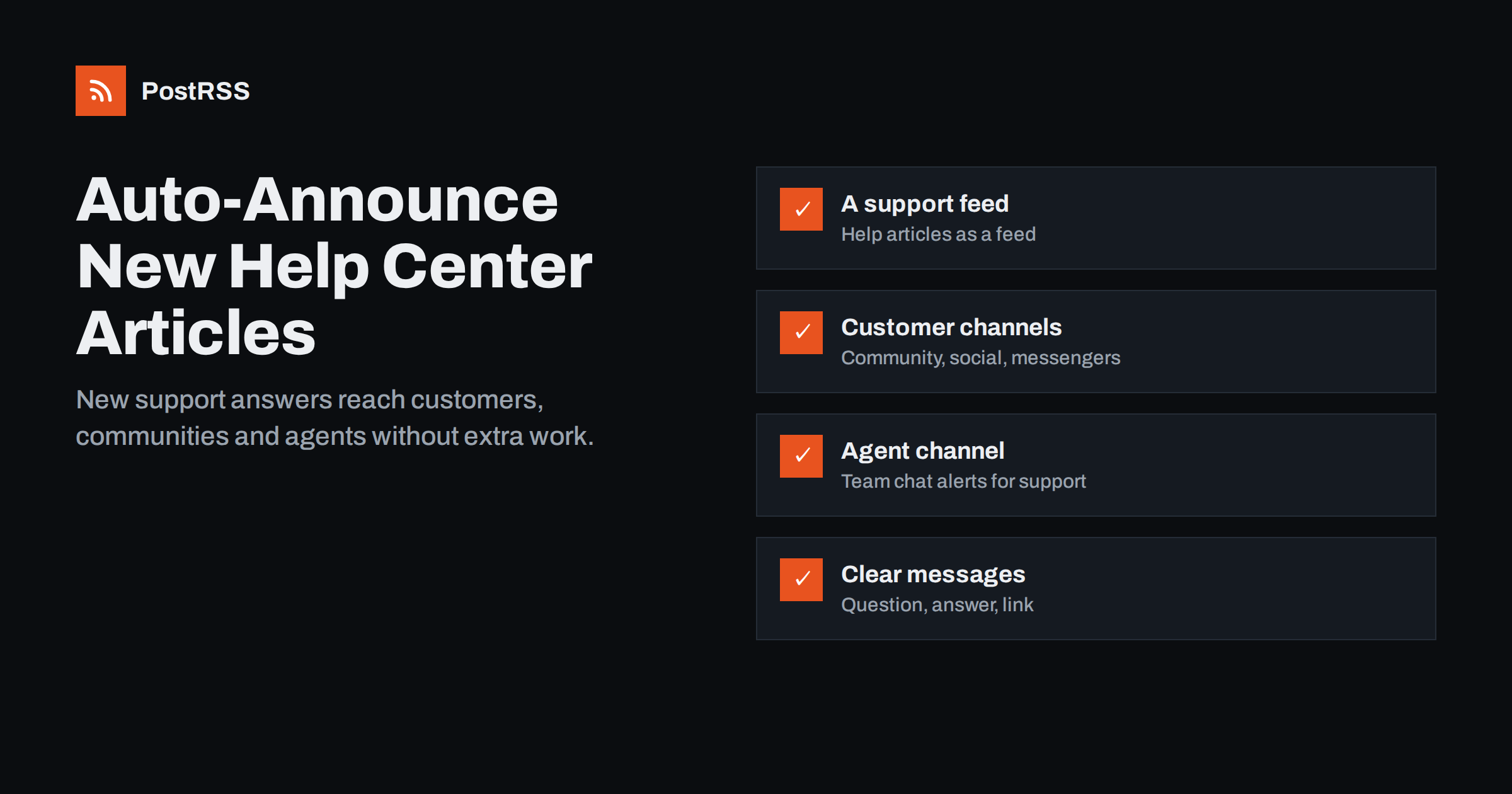
Short answer: New help center articles only reduce support tickets if customers and support agents know they exist. The simplest way to spread them is to publish support articles with a feed, either from the help center itself or from a support category on your blog, and let an auto-posting tool share each new article to your community channels, social accounts and the support team’s chat. Filter the feed so only customer-relevant articles go public, write titles as the questions customers ask, and include a short answer in the first sentence.
Support teams write help articles for a clear reason: to answer a question once instead of hundreds of times. Yet many help centers work like a library with no front door. Customers only find an article if they search for it at the exact moment they have the problem, and many do not search at all; they open a ticket or send a message instead.
The support team itself is part of the problem. When a new article is published, agents on other shifts or in other teams may not know it exists, so they keep writing answers from scratch. Sales, account managers and community moderators are even further away from the help center and rarely hear about new articles.
Announcing new help content does three things. It teaches customers that the help center is a good place to look. It gives your community places, such as a Discord server or a Telegram channel, a steady stream of genuinely useful posts. And it makes sure every person who talks to customers can link to the best available answer.
There is also a trust effect. When customers see regular, helpful articles appear in the channels they follow, the product feels actively supported. A community channel where questions are answered by links to clear, recent guides looks very different from one where every question waits hours for a personal reply.
Not every change to a help center deserves an announcement. A typo fix or a reorganised category is noise. Good candidates are:
Internal-only articles, draft troubleshooting notes and articles for a single customer should never be in a public feed. Keep them in a separate, private space.
How you get a feed depends on where your help content lives:
Whichever route you choose, make sure the feed contains only published, public articles, uses absolute links, and has stable identifiers for each item. An article whose identifier changes on every edit may be announced again each time it is updated.
Customers and users. Your community channels are the most natural place: a Discord server, a Telegram channel, a forum on Discourse or a Mastodon or Bluesky account for product news. Social accounts such as LinkedIn or X work for B2B products where users follow the company. Keep the tone practical: “New guide: how to export your invoices to a spreadsheet.”
The support team. A dedicated channel in Slack, Microsoft Teams, Google Chat or another team chat, where every new article appears automatically, keeps agents informed across shifts. It also becomes a searchable list of recent articles when an agent needs to answer a question quickly.
Customer-facing colleagues. Account managers, sales and community moderators benefit from the same alerts, often in the same channel or a separate one with a narrower filter.
Your product itself. Some products show a “what’s new” or help panel inside the app. If yours can read a feed or receive a webhook, the same announcement feed can populate it, so users see new guides without leaving the product. Even a simple link to the latest articles in a dashboard sidebar helps.
You do not have to send everything to every audience. The support team may want all new articles, while public channels receive only the ones with broad relevance.
Use the structure of your help center to decide what goes where:
If your product is used in several languages, route articles by language too. A feed per language section of the help center, connected to the channels for that language community, avoids announcing an article in a language most followers of a channel cannot read.
Start with a narrow public filter. It is easy to widen later, and much harder to regain trust in a channel that became noisy.
Here is a practical way to set this up in an afternoon, assuming your help articles already have a feed or a support category:
Running the team channel first is a low-risk way to test the feed. Mistakes are seen by colleagues, not customers, and agents often suggest improvements to article titles that make the public announcements better.
Because the announcement is usually built from the article title and its opening text, a few writing habits make a big difference:
These habits help the help center itself as well. Articles written this way are easier to scan, easier to find in search and easier for agents to share.
Announcements should reduce repeated questions over time. A few ways to tell whether they work:
Be patient with the numbers. Ticket volume depends on many factors, including new customers, product changes and seasons, so a single month rarely proves anything. Look for trends over a quarter and for clear drops on specific topics after their articles were announced.
Use what you learn to improve articles and to decide which kinds of help content deserve announcements.
PostRSS reads an RSS or Atom feed, checking it every 5 minutes (every minute on Enterprise plans), and posts each new item with its title, text, image and link to the targets you connect. The features page lists 66 networks, including Discord, Telegram, Discourse, Mastodon, Bluesky, LinkedIn and X for customer-facing channels, and team chats such as Google Chat, Mattermost, Zulip and Webex, plus a webhook option for Slack and Microsoft Teams.
One feed can go to several targets with different settings, keyword filters can include or exclude items, and UTM parameters can be added to every link. That covers the typical setup: all articles to the support team channel, a filtered selection to public channels. See the PostRSS features page for details.
A help center reduces support work only when people find its answers. Put your support articles into a feed, route new articles automatically to the support team’s chat and a filtered selection to your community and social channels, and write titles and openings that answer the question directly. Customers learn where to look, agents always know the latest answer, and each article you write keeps paying for itself.
Some help center platforms provide feeds for recent articles or sections, and others do not. Check the documentation or the page source for a feed link. If there is none, a support category on your CMS, a feed generator or the platform’s API can provide one.
No. Announce articles that many customers will find useful, such as new features, common problems and important changes. Minor edits and niche articles are better shared only with the support team.
That depends on the feed and the tool. If the item’s identifier stays the same, most tools treat it as already posted. If the identifier or link changes on edit, it may appear as a new item, so test with a small edit first.
A dedicated channel in the team chat they already use works best. It keeps alerts out of busy general channels and gives agents a searchable list of recent articles.
Yes, if the article has a featured image or an image the tool can detect. Make sure screenshots contain no customer names, email addresses or other personal data.
What changed in the networks, what broke, and how to fix it before it costs you reach.
 English
 Lietuviškai
 Deutsch
 Français
 Русский
 Español
 Polski
 Italiano
 Українська
 Čeština
 Português
 日本語
日本語 Latviešu valoda
 Eesti
Eesti Magyar
 Bahasa Indonesia
 Türkçe
 हिन्दी
 Ελληνικά
 العربية
 ไทย
ไทย Tiếng Việt
 Română
 Bahasa Melayu
 বাংলা
বাংলা