RSS'den 66 sosyal ağa: Facebook, Instagram, X, LinkedIn, Telegram ve daha fazlası Blog Satış Ortaklığı İletişim
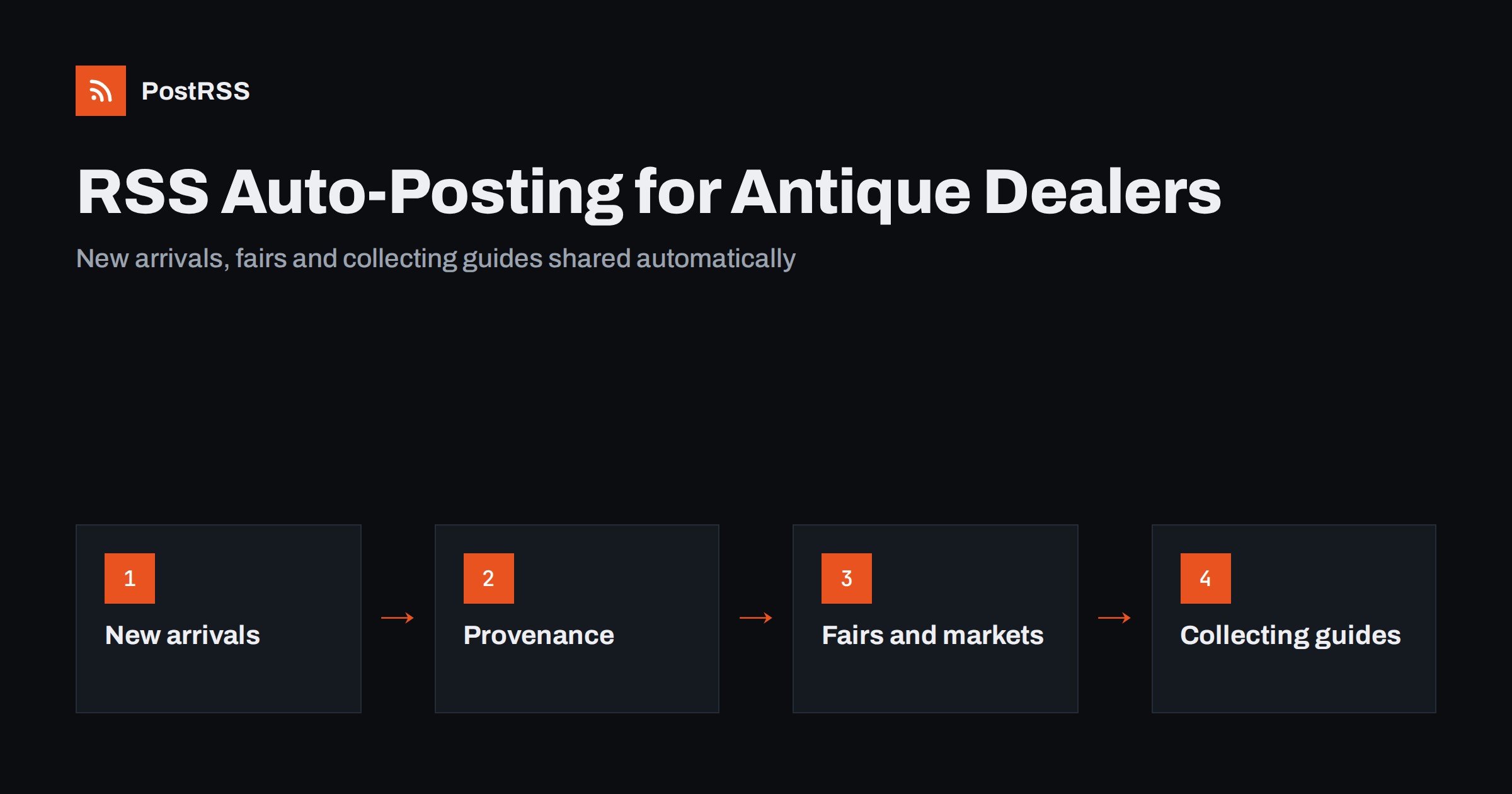
Short answer: RSS auto-posting lets antique and vintage dealers share every new arrival, provenance story, fair appearance, valuation day and collecting guide on social media automatically. Add each item or announcement as a page on your website, let an auto-poster read the RSS feed, and it appears on your Facebook Page, Pinterest boards and other channels with its photograph and link. You keep searching, restoring and talking to collectors while your stock reaches buyers the day it goes on the shelf.
Antiques are one-of-a-kind goods. A Georgian mirror, a mid-century lamp or a set of silver spoons exists once, and the buyer who wants it is probably not in your shop today. The people who love such things follow dealers online, and they watch for new arrivals the way others watch for football results. A dealer who posts fresh stock promptly sells faster and builds a following of collectors who return. But the business of antiques is time-hungry: buying trips, cleaning, research, condition checks, photography, pricing and customers. Writing posts comes last, and good pieces wait weeks before anybody outside the shop hears about them. This guide shows how to turn the stock pages you create anyway into steady posts, and where a personal conversation remains essential.
A dealer creates a surprising amount of material in a normal week:
Each of these can be a short page on your website. When the page is published, the feed announces it. You write once, in a place that you own, and the automation spreads the news. Timing matters especially for antiques, because the buyer who sees a piece first often buys it. A feed makes sure that the announcement leaves at the moment the page is live, even when you are at a fair three hundred kilometres away.
Most dealer websites run on platforms that publish feeds without extra work:
/feed/ and a feed for every category, such as /category/new-arrivals/feed/. WooCommerce and other shop plugins can add a feed of new products. If you are unsure of the address, see how to find your WordPress feed link.Use categories to separate the audiences: new arrivals, furniture, silver and jewellery, art and prints, events and guides. Each category has its own feed, and each feed can go to the channel where it works best. Routing by category is explained in category filtering for auto-posting.
| Content | Automate? | Notes |
|---|---|---|
| New arrivals | Yes | Photographs, size, age, condition and how to enquire |
| Provenance and maker stories | Yes | Only what you can support with evidence |
| Fairs, markets and open days | Yes | Dates, stand number and what you will bring |
| Collecting and care guides | Yes | Evergreen pages that keep bringing visitors |
| Negotiation and valuations | By hand | Each object and each seller is different |
| Customers’ names and addresses | Never | Do not share who bought or sold what |
A simple rule: if it is a finished page on your website, automate it. If it is a price negotiation or concerns a private seller or buyer, handle it personally.
A good listing page tells the buyer everything they would ask over the counter. Give each piece its own page with a clear title, for example “Edwardian oak writing desk with leather top”. State the period and place of origin if known, the materials, the dimensions in the units your customers use, the weight of heavy items and the condition. Describe flaws honestly: a repaired leg, a chip on the rim, a replaced handle, a later finish. Honest condition notes build the trust that antiques depend on, and they reduce returns and disputes. Say what you know about the maker, marks and age, and separate fact from opinion with phrases such as “in the style of” or “believed to be”. Add photographs of the whole object, every side, any marks and every flaw, plus one image showing scale. Use the best photograph as the featured image, since each network builds its preview card from it. End with a simple way to ask questions, reserve the piece or arrange viewing and delivery.
The antiques trade runs on trust, and one careless claim can damage a reputation built over years. Only describe a piece as a particular maker’s work, a certain age or a specific origin when you have evidence, and explain what the evidence is. Use plain language to show uncertainty. Mention restorations and replacements. If a piece has a documented history, such as an invoice, an old photograph or a label, show it and describe it. Be careful with materials whose sale is regulated in many places, such as ivory, certain woods, tortoiseshell or items that count as weapons, and follow the rules of your country and the countries you ship to. Never publish a statement that you would not repeat to a buyer’s face. A feed spreads whatever your page says, so the page must be right before it is published.
Many dealers sell at fairs and markets and invite the public to bring items for assessment. Treat each event as a page. For a fair, give the dates, the venue, the opening hours, the stand number and a hint of what you are bringing, such as “a new selection of Scandinavian glass”. For a valuation day, explain what you can and cannot do. Say whether you give informal opinions, whether you buy on the day, whether an appointment is needed and what to bring, such as photographs, measurements and any papers. Do not promise values. A valuation depends on condition and demand, and an unrealistic hint raises false hopes. Publish the page several weeks before the event and a short reminder a few days ahead. Cancellations and last-minute changes need a person and a direct message.
Collectors search for knowledge as well as objects. Pages such as “How to date a chest of drawers by its handles”, “Hallmarks on silver: a first guide” or “How to care for old oil lamps” bring visitors from search engines who may later buy. Write them from your own experience, with photographs of your own examples, and link to the relevant pieces in stock. Update them when you learn something new. These pages are evergreen, and the feed shares each one when it is published. Over time they turn the website into a small reference library, which gives the shop an authority that a marketplace listing cannot match. Keep the advice honest about its limits and recommend a specialist or an auction house when a piece may be valuable and unusual.
Keep file sizes reasonable so pages load quickly; see image optimization for RSS auto-posting. If a network shows the wrong picture, check the Open Graph tags of the page as described in why auto-posted links show the wrong image.
An out-of-date stock page frustrates collectors. When a piece sells, update its page the same day: mark it as sold, keep the photographs and add a line such as “sold, similar pieces are welcome”. Sold pages are useful. They show the range and quality of what you handle, they support future pricing and they bring search visitors who may leave their details for the next one. Leave a short note on the page about how to be informed when something similar arrives. Because the feed shares new pages and not edits, the stock list on your site stays accurate without extra posts, and the next arrival gets its own announcement.
Most dealers do best with a Facebook Page and one more channel. Add others only if you can keep them active.
/feed/, and check that it lists recent items.PostRSS has been automating RSS posting since 2014. It checks your website feeds as often as every minute and publishes each new arrival, fair date and guide, with its real image and link, to the channels you connect, from Facebook Pages and Pinterest to Telegram, Bluesky and many more among its 66 supported networks. You can choose how each post is built, filter items by keywords, add UTM parameters and post only within chosen hours or at exact times in your time zone. See the PostRSS features page for everything it does and the pricing page for plan limits. More ideas for small businesses are under the Small Business tag.
Antique and vintage dealers already have what collectors look for: unique objects, knowledge and a story for every piece. RSS auto-posting shares each new arrival, fair appearance and collecting guide automatically on Facebook, Pinterest and your other channels, on time and with the right image, while you keep searching and restoring. Give every piece its own page, describe condition honestly, support your claims, update sold items, leave negotiations to personal conversations and route content by category.
Yes. If your website has a stock or news section, its RSS feed can be connected to an auto-poster that shares each new arrival, event and guide on your Facebook Page, Pinterest and other channels. Negotiations and valuations are still best handled personally.
New arrivals, stories about makers and provenance, fairs and markets, valuation days, restoration projects and collecting guides. Each item should have its own page on your website.
Plainly and completely. Mention repairs, replacements, chips, wear and later finishes, and photograph them. Honest descriptions build the trust that the trade depends on.
Update the page and mark it as sold. The feed shares new pages, not edits, so the page stays accurate on your site, and the next arrival gets its own announcement.
Yes. Rules on materials such as ivory, certain woods and weapons differ between countries, and descriptions of age and origin can create legal obligations. Check the requirements of your own authority.
{“@context”: “https://schema.org”, “@type”: “FAQPage”, “mainEntity”: [{“@type”: “Question”, “name”: “Can an antique dealer automate social media posts?”, “acceptedAnswer”: {“@type”: “Answer”, “text”: “Yes. If your website has a stock or news section, its RSS feed can be connected to an auto-poster that shares each new arrival, event and guide on your Facebook Page, Pinterest and other channels. Negotiations and valuations are still best handled personally.”}}, {“@type”: “Question”, “name”: “What should a vintage shop post about?”, “acceptedAnswer”: {“@type”: “Answer”, “text”: “New arrivals, stories about makers and provenance, fairs and markets, valuation days, restoration projects and collecting guides. Each item should have its own page on your website.”}}, {“@type”: “Question”, “name”: “How should I describe condition?”, “acceptedAnswer”: {“@type”: “Answer”, “text”: “Plainly and completely. Mention repairs, replacements, chips, wear and later finishes, and photograph them. Honest descriptions build the trust that the trade depends on.”}}, {“@type”: “Question”, “name”: “What happens to the post when a piece sells?”, “acceptedAnswer”: {“@type”: “Answer”, “text”: “Update the page and mark it as sold. The feed shares new pages, not edits, so the page stays accurate on your site, and the next arrival gets its own announcement.”}}, {“@type”: “Question”, “name”: “Are there legal limits on what I can sell and describe?”, “acceptedAnswer”: {“@type”: “Answer”, “text”: “Yes. Rules on materials such as ivory, certain woods and weapons differ between countries, and descriptions of age and origin can create legal obligations. Check the requirements of your own authority.”}}]}
What changed in the networks, what broke, and how to fix it before it costs you reach.
PostRSS'in arkasındaki ekip Internet Solutions tarafından geliştirildi. Her biri size farklı bir şekilde zaman kazandırır.
 English
 Lietuviškai
 Deutsch
 Français
 Русский
 Español
 Polski
 Italiano
 Українська
 Čeština
 Português
 日本語
日本語 Latviešu valoda
 Eesti
Eesti Magyar
 Bahasa Indonesia
 Türkçe
 हिन्दी
 Ελληνικά
 العربية
 ไทย
ไทย Tiếng Việt
 Română
 Bahasa Melayu
 বাংলা
বাংলা