RSS to Facebook, Instagram, X, LinkedIn, Telegram and 11 more networks Блог Партнерская программа Контакты
Most of the time, an RSS feed behaves exactly the way you’d expect: newest post first, in the order things were actually published. Then, occasionally, something strange happens — an editor backdates a post to fix its publish date, a “sticky” post gets pinned to the top, or a bulk import drops fifteen old articles into the feed at once, and suddenly an auto-posting tool starts sharing content that’s months or years old as if it were brand new. Understanding why this happens takes the mystery out of one of the stranger, more disorienting auto-posting bugs publishers and site owners run into, and it usually turns out to have a simple, mechanical explanation once you know what to look for.
An RSS feed doesn’t have an inherent, protocol-level concept of “order” the way a numbered list would. Instead, most CMS platforms, including WordPress, generate the feed dynamically each time it’s requested, typically sorted by publish date descending — newest first. That means the “order” of a feed is really just a live query result, re-sorted fresh every time, based on whatever date value each post currently has in the database.
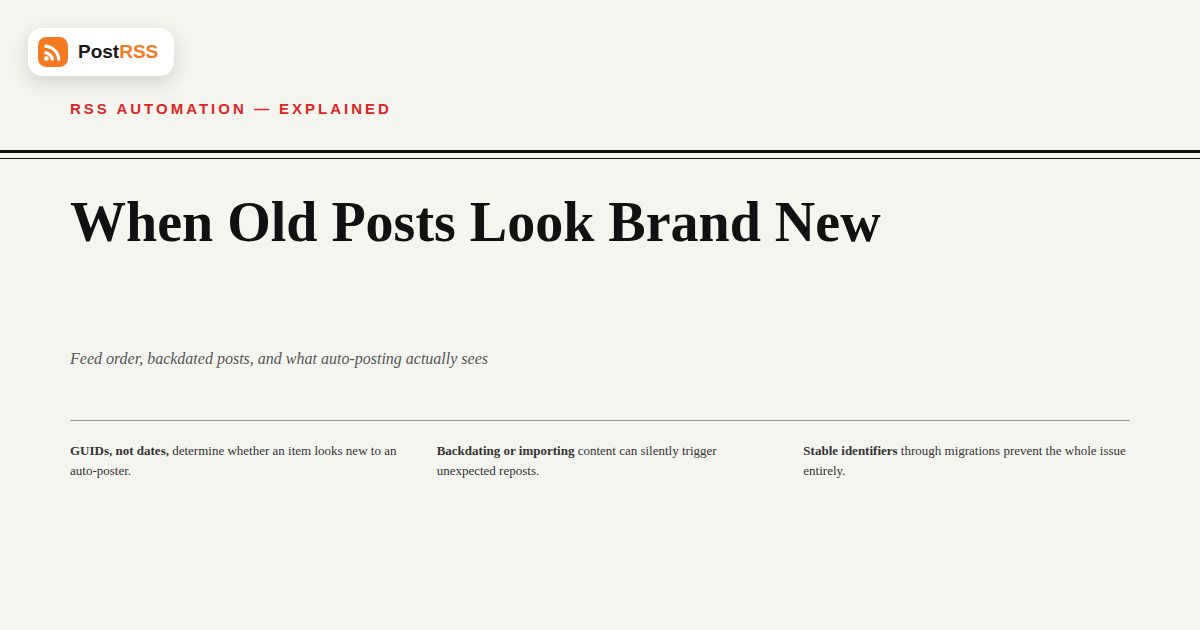
This detail matters enormously: the feed’s order isn’t fixed at the moment a post was originally published. It’s recalculated on every fetch, using whatever the post’s current date field says right now — which is exactly what creates the backdating problem.
If an editor changes a post’s date to something in the past (common when fixing a typo in the original publish timestamp, or when migrating content from an old system and wanting posts to appear at their “true” historical date), the post drops down in feed order, but here’s the part that surprises people: if that post’s GUID hasn’t been seen by the auto-posting tool before — for instance because it was just imported, or because it was previously excluded and is now included — the tool has no way of knowing the content is “old.” It only knows it hasn’t posted this specific item before, so it treats it as new and shares it.
| Scenario | What Happens to Feed Order | Auto-Posting Risk |
|---|---|---|
| Post’s date is changed to today | Jumps to the top of the feed | Gets treated and posted as brand-new content |
| Post is marked “sticky” in WordPress | Pinned to top of site displays; RSS feed order is typically unaffected | Usually low risk, since most feed generators don’t reflect sticky status in feed order |
| Bulk import of old content | All imported posts enter the feed with their import-time GUIDs | Can trigger a wave of auto-posts for content the auto-poster has never seen, regardless of actual publish date |
| Post is unpublished then republished | Re-enters the feed at its current date | Frequently treated as a new item, especially if the GUID changed on republish |
It’s tempting to blame the auto-posting tool when this happens, but the tool is behaving exactly as designed: check the feed, compare item GUIDs against a history of what’s already been posted, and post anything unrecognized. The tool has no independent way to know a post’s “true” original publish date beyond exactly what the feed itself reports at the moment it’s fetched, and if the feed says an item is new (because its GUID has never been seen, regardless of the date attached to it), posting it is the correct, expected behavior — not a malfunction.
A GUID is meant to be a stable, unique identifier for a feed item, and it’s what most auto-posting tools use to avoid re-sharing the same content twice. The trouble is that not every CMS handles GUIDs consistently:
If a batch of old content just got auto-posted unexpectedly, most auto-posting dashboards provide a way to review recent posting activity, and some allow deleting or hiding specific auto-posted items after the fact from the connected social accounts. Beyond cleanup, the more useful step is figuring out which of the causes above triggered it, specifically so the same import or date-editing habit doesn’t repeat the problem with the next batch of content.
Imagine a small business migrating five years of blog content from an old CMS to WordPress. The migration tool preserves the original publish dates displayed on each post (so visitors still see “Published March 2021” correctly) but assigns every imported post a brand-new GUID as part of the import process, since the old system’s identifiers weren’t compatible with WordPress’s format. Three days later, when auto-posting is connected to the site’s main feed, the tool checks the feed, finds 200 posts it has never seen a GUID for, and dutifully starts posting all 200 of them — a five-year-old product announcement right alongside yesterday’s actual news, in whatever order the feed happens to return them. Nothing in this chain was a bug; each system did exactly what it was built to do, and the mismatch between “old content” and “new GUID” is what produced the surprising result.
The GUID-based “have I seen this before” logic described here is close to universal across RSS-to-social tools, not something specific to any one platform, because it’s the most reliable general-purpose way to solve the “don’t repost the same thing twice” problem across arbitrary, unpredictable feed sources. Where different tools do genuinely differ somewhat is in how they handle these specific edge cases — some offer a setting to ignore items older than a certain date entirely regardless of GUID status, which acts as a safety net specifically against this kind of situation.
Anyone planning a CMS migration, bulk content import, or large batch of date corrections can avoid nearly all of this by working through a short checklist beforehand:
| Шаг | Why It Matters |
|---|---|
| Pause or disconnect active auto-posting feeds | Prevents the tool from polling mid-migration and catching content in a half-imported state |
| Confirm whether the migration tool preserves or regenerates GUIDs | Determines whether imported content will look “new” to any watching auto-poster |
| Spot-check the feed’s raw XML after import | Confirms GUIDs and dates look as expected before re-enabling automation |
| Re-enable auto-posting only after verifying the feed looks correct | Avoids a burst of unintended posts hitting live social accounts |
It’s worth noting this same mechanism has a legitimate, sometimes intentional use: if you deliberately want to reintroduce an old, evergreen piece of content to your social audience (a comprehensive guide that’s still fully relevant, for instance), some publishers manage this by intentionally assigning it a fresh GUID or moving it to a new URL, then letting the RSS auto-posting pipeline pick it up as if it were new. Used deliberately, this is a legitimate content republishing strategy; the issue in this article is specifically when it happens by accident during routine content management rather than as a planned decision.
Almost always because that post’s GUID hadn’t been seen before by the tool, whether from a fresh import, a database migration, or a manual edit that altered its identifier, even though its content and original publish date are old.
Not necessarily — if the GUID stays the same and the auto-posting tool has already recorded that GUID as posted, most tools won’t repost it regardless of the date change. The risk is specifically when the GUID is new or has been regenerated.
Many tools offer this as a safety setting, and it’s worth enabling if you regularly import or backdate historical content, since it provides a straightforward guardrail independent of GUID behavior.
By default, no — standard WordPress behavior keeps a post’s GUID stable through ordinary edits, including date changes. Certain migration plugins or manual database edits are the more common source of GUID changes.
Generally not, since most feed generators (including WordPress’s default one) sort by publish date rather than sticky status, so a sticky post typically doesn’t move within the feed itself even though it displays at the top of the site.
Yes, if the migration involves importing a meaningful volume of older content. Pausing the connection, completing the import, verifying GUIDs look correct, and then resuming avoids a burst of unintended reposts hitting your social accounts all at once.
View your feed’s raw XML directly (most feed URLs are viewable in any browser) and look for the <guid> tag inside that post’s <item> block, which will show you exactly what value your auto-posting tool is using to track it.
No — once a post has been shared to a social platform, it stays there until manually deleted, and future polling cycles won’t retroactively remove it. The auto-posting tool will, however, correctly recognize that specific GUID as already-posted going forward, so it won’t repeat the same mistake for those exact items on subsequent checks.
Yes, in principle — if a podcast host migration or bulk episode import regenerates GUIDs for older episodes, the same “looks new to the auto-poster” effect can happen there too, for exactly the same underlying reason.
A sudden wave of old content getting auto-posted almost always traces back to GUIDs, not a broken auto-posting tool — something in the publishing, editing, or import process caused previously-unseen identifiers to enter the feed, and the tool did exactly what it’s supposed to do with unrecognized items. Understanding this mechanism turns a confusing, seemingly random bug into a predictable, avoidable outcome: keep GUIDs stable through content migrations and date corrections, and your automated distribution will keep matching what you actually intend to share, rather than what a database field happens to say at the moment the feed gets checked and re-sorted.
What changed in the networks, what broke, and how to fix it before it costs you reach.
 English
 Lietuviškai
 Deutsch
 Français
 Русский
 Español
 Polski
 Italiano
 Українська
 Čeština
 Português
 日本語
日本語 Latviešu valoda
 Eesti
Eesti Magyar
 Bahasa Indonesia
 Türkçe
 हिन्दी
 Ελληνικά
 العربية
 ไทย
ไทย Tiếng Việt
 Română
 Bahasa Melayu
 বাংলা
বাংলা