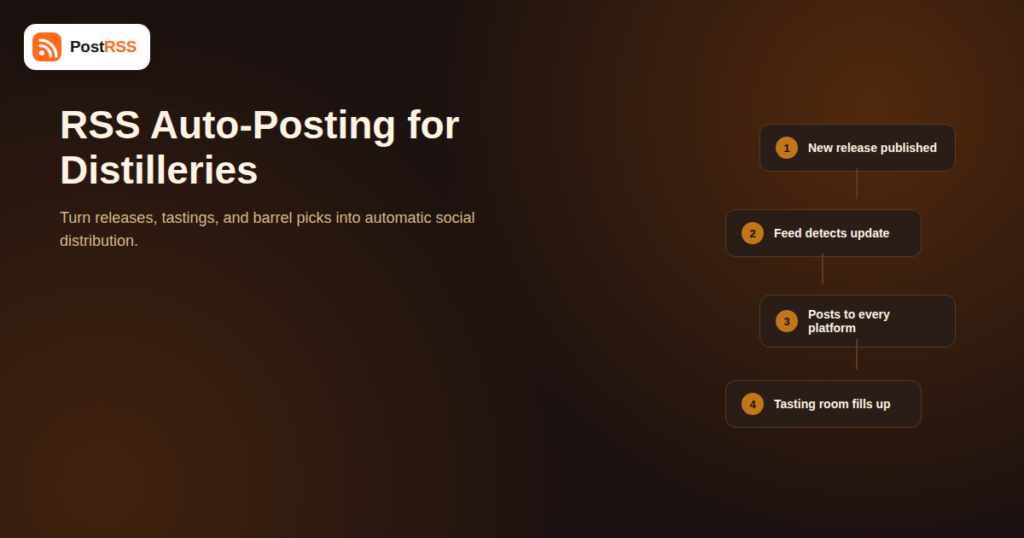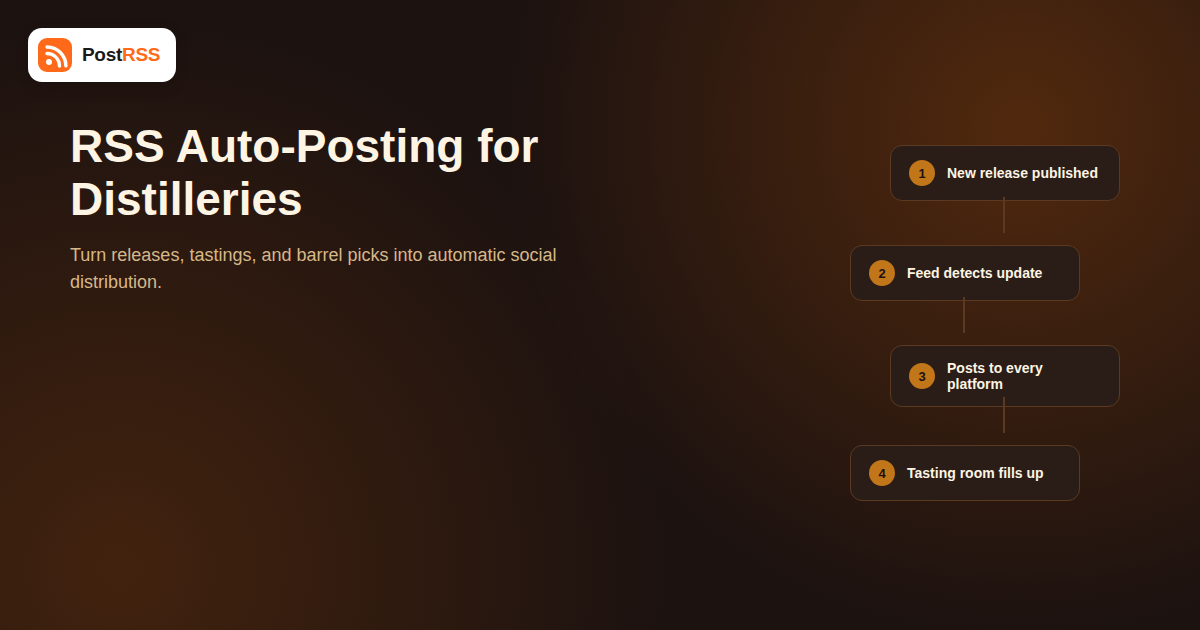
Craft distilleries sit in an odd spot in the social media landscape: they’re producing exactly the kind of visually compelling, story-rich content that performs well online — barrel warehouses, small-batch releases, cocktail recipes, tasting room events — but most distillery teams are small, often just one or two people wearing a marketing hat alongside production, sales, and compliance duties. Local business automation makes an outsized difference here, because it’s usually the difference between social media happening consistently and it happening only when someone remembers.
Spirits carry a different regulatory and cultural weight than beer or wine in most markets. Distribution is often more restricted, release cycles are longer and more deliberate (a bourbon or single malt might age for years before it ever gets announced), and many jurisdictions apply stricter advertising rules to spirits than to beer or wine — including tighter restrictions on how alcohol content, health claims, and youth-oriented imagery can be presented. A social media strategy built for a brewery’s weekly tap list doesn’t map cleanly onto a distillery’s slower, higher-stakes release cadence.
What this means practically: distilleries generally post less frequently than breweries, but each post — a new release, a barrel-pick partnership, an award — carries more weight and deserves wider distribution the moment it’s ready, rather than being confined to whichever platform someone happened to be logged into that day.
| Platform | Best Use for Distilleries | Auto-Posting Fit |
|---|---|---|
| Product photography, tasting room atmosphere, barrel aging visuals | Strong — image-first content matches distillery photography well | |
| Event promotion, local community engagement, tour bookings | Strong — older demographic that actively visits tasting rooms | |
| Cocktail recipes featuring your spirits | Strong — long content lifespan, high purchase intent | |
| X (Twitter) | Release announcements, industry conversation, distributor updates | Moderate — useful for trade audience, less for consumers |
| Distributor and retail partner announcements, hiring, industry recognition | Moderate — B2B-facing content only |
Every major platform requires alcohol brand pages to be configured as age-restricted, and most jurisdictions require some form of responsible-drinking messaging or age statement in alcohol advertising. This doesn’t prevent auto-posting — it just means the underlying content itself, whatever feed item is triggering the post, needs to already include compliant language before it goes out, since an automation tool posts what’s in the feed rather than adding legal disclaimers of its own. Building your standard blog post or press release template to always include the required disclosure means every auto-posted item inherits compliance automatically, rather than requiring a manual compliance check on every single post.
It’s also worth confirming, before setting up automation, that each connected platform’s business account is correctly flagged as an alcohol brand where the platform requires it — Meta in particular has specific alcohol-industry advertising policies that apply regardless of whether a post is organic or paid.
Most distilleries already generate content in more places than they realize: a “News” or “Releases” page on the website, an events calendar for tasting room bookings, and sometimes a separate blog for cocktail recipes or production stories. Rather than trying to manually track all three, the more efficient setup is to make sure each of those sections publishes to a page your RSS-based automation can watch, so a new item anywhere in that ecosystem — a new release, a new event, a new recipe post — triggers distribution automatically without someone having to remember which channel needs updating.
| Mistake | Why It Happens | Fix |
|---|---|---|
| Announcing a release on one platform only | Whoever’s available posts to whichever app they have open | Auto-post every release to all connected platforms at once |
| Forgetting to promote tasting room events | Events get set up weeks in advance, then forgotten by post time | Feed events from a calendar so promotion happens automatically closer to the date |
| Going silent between releases | No content plan for the gaps between major announcements | Auto-post evergreen content like cocktail recipes and behind-the-scenes posts on a steady cadence |
| Missing compliance language on a rushed post | Manual posting under time pressure skips the disclaimer | Bake required disclosures into the source content template so every auto-posted item inherits them |
Spirits sales are seasonal in ways that map well onto an automated posting calendar, since much of the seasonal content can be prepared in advance and simply scheduled to publish on the right dates:
| Season | Content Focus | Why It Works |
|---|---|---|
| Late Fall / Holiday Season | Gift sets, cocktail recipes for gatherings, limited holiday releases | Peak spirits gifting and entertaining season |
| Winter | Barrel-aged and warming cocktail content, whiskey/brandy features | Cold-weather spirits consumption patterns |
| Spring | Tasting room reopening promotions, lighter spirits (gin, vodka) cocktails | Seasonal shift toward outdoor and lighter drinking occasions |
| Summer | Patio and outdoor event promotion, tour bookings, refreshing cocktail recipes | Peak tasting room visitor season for most distilleries |
Because much of this content can be written weeks ahead of time, a small business team can batch-write seasonal posts during a slower production week and let the automation handle the actual publishing dates, rather than trying to remember to write and post seasonal content in the moment when the team is busiest with production or events.
For a distillery team without a dedicated marketing hire, manually posting a single piece of content to four platforms — writing platform-specific captions, resizing images, and actually publishing to each app — typically takes fifteen to twenty-five minutes per item once you account for switching between apps and double-checking each platform rendered correctly. At even a modest pace of eight to ten pieces of content per month (new releases, events, recipes, behind-the-scenes posts), that adds up to three to four hours of pure posting mechanics every month, on top of the time spent actually creating the content itself.
Automating that distribution step doesn’t reduce the value of the content or the thought that goes into it — it removes the repetitive mechanical work of publishing the same thing four or five times in four or five different places. For a two-person distillery team where one person handles both production and marketing, reclaiming even three hours a month is often the difference between social media getting consistent attention and it becoming the first thing that slips when production gets busy.
Many distilleries co-market with the bars, restaurants, and retailers that carry their products — a barrel-pick program, a featured cocktail at a partner bar, a limited allocation at a specific retailer. These partnership announcements benefit from the same treatment as a direct-to-consumer release: publish the announcement once on your own site, and let automation handle distributing it across every platform where both your audience and your partner’s audience might see it, rather than manually coordinating separate posts for each partnership as they come up.
No — age-gating is a platform-level account setting, and required disclosure language needs to live in the source content itself. Auto-posting distributes what’s already compliant; it doesn’t add compliance on its own.
Quality and consistency matter more than raw frequency. A steady mix of major announcements as they happen plus one or two pieces of evergreen content (recipes, behind-the-scenes) per week tends to outperform sporadic bursts of posting followed by silence.
Most distilleries mix both on their main channels, but if trade communication becomes frequent, a dedicated LinkedIn presence focused purely on partner and industry news keeps that content from diluting the consumer-facing feed.
Yes — if events are managed through a calendar or events page that generates a feed, new and upcoming events can be auto-posted on a schedule that pushes them out as the date approaches, rather than relying on someone to remember.
Square and portrait-oriented images tend to perform best across Instagram and Pinterest, so product photography shot with those crops in mind — rather than only wide landscape shots — gives auto-posted content the best chance of displaying well without platform-side cropping.
Yes, as long as the source content (a blog post or press release) is scheduled to publish at the exact drop time, the connected auto-posting tool will typically pick it up and distribute it within minutes, keeping the announcement tightly timed across every platform.
Yes — local and regional distilleries often rely even more heavily on tasting room visits and direct-to-consumer sales than nationally distributed brands, which makes consistent local audience engagement, not broad national reach, the primary goal, and automation is exactly what keeps that day-to-day consistency going without eating into the limited staff time a small production team actually has available.
Social media reach for alcohol brands is often more restricted than for other consumer categories — algorithmic distribution can be inconsistent for age-restricted content, and organic reach on some platforms is deliberately throttled for alcohol-flagged accounts. Because of this, most successful distillery marketing programs treat social auto-posting as one channel in a broader mix rather than the only channel, and pair it with an email list built from tasting room visitors and website signups. The same release announcement or event post that feeds your social automation can just as easily feed an email newsletter, giving you a second, algorithm-independent way to reach people who’ve already shown interest in the brand.
Distilleries that operate more than one tasting room — a production facility plus a satellite tasting room in a different city, for example — face a coordination problem that automation handles well: each location has its own events and hours, but the core brand content (new releases, awards, general brand story) should go out everywhere. A practical setup tags content by location where relevant, so location-specific event posts route to that location’s social accounts while brand-wide announcements distribute to every connected account, keeping local audiences from being spammed with events they can’t attend while making sure no location misses a major release announcement.
Distilleries have genuinely compelling content to share, more than most small businesses realize once they start cataloguing it: release stories, aging processes, tasting room moments, and recipe content that spirits enthusiasts actively seek out — long aging stories, small-batch releases, a physical space people want to visit — but a small team rarely has the bandwidth to manually post that content everywhere it deserves to be seen. Auto-posting from the sources you already maintain, your website’s release page, your events calendar, your blog, turns social media from one more task competing for attention into something that simply happens in the background every time you publish something worth sharing, leaving the people who actually make the spirits free to spend their limited hours on production and the tasting room floor instead of juggling four different social apps every single week, release after release, year after year.
What changed in the networks, what broke, and how to fix it before it costs you reach.