Pharmaceutical and medical device companies operate under a level of regulatory scrutiny on public communications that most industries never encounter. Every social media post touching a product name, an indication, a clinical claim, or adverse event language can trigger FDA, EMA, or other regulatory review requirements — which makes “just auto-post everything from our RSS feed” a genuinely risky default rather than a convenience. That doesn’t mean automation is off the table; it means the automation has to be built around what’s safe to automate and what isn’t.
This guide covers where RSS-driven automation fits safely into a pharma or medtech communications program, what content categories need to stay manual regardless of how efficient automation looks, and how to structure feeds so the compliance-safe content flows without a bottleneck.
For a typical business, RSS automation removes a repetitive task with minimal downside risk: if a post goes out a few minutes early or the wording is slightly off, nothing serious happens. For a pharmaceutical company, the stakes are categorically different:
| Content Type | Automation Safety | Why |
|---|---|---|
| Corporate press releases (earnings, partnerships, leadership changes) | Safe, once MLR/legal approved and published | No product claims or clinical content typically involved |
| Investor relations updates | Safe, once compliance-cleared | Governed by securities disclosure rules already requiring pre-publication review |
| Corporate social responsibility / sustainability content | Safe | Low regulatory sensitivity, similar to any general business content |
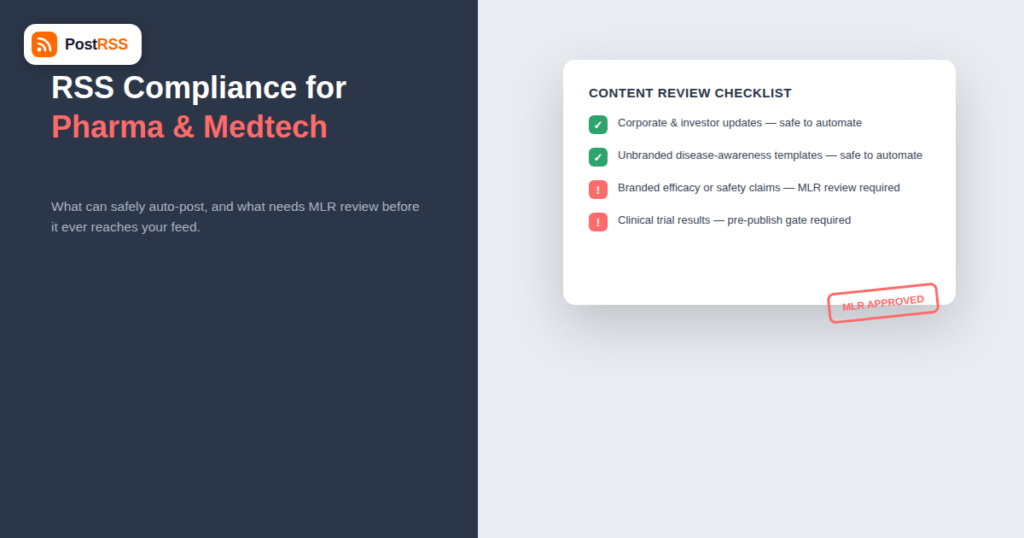
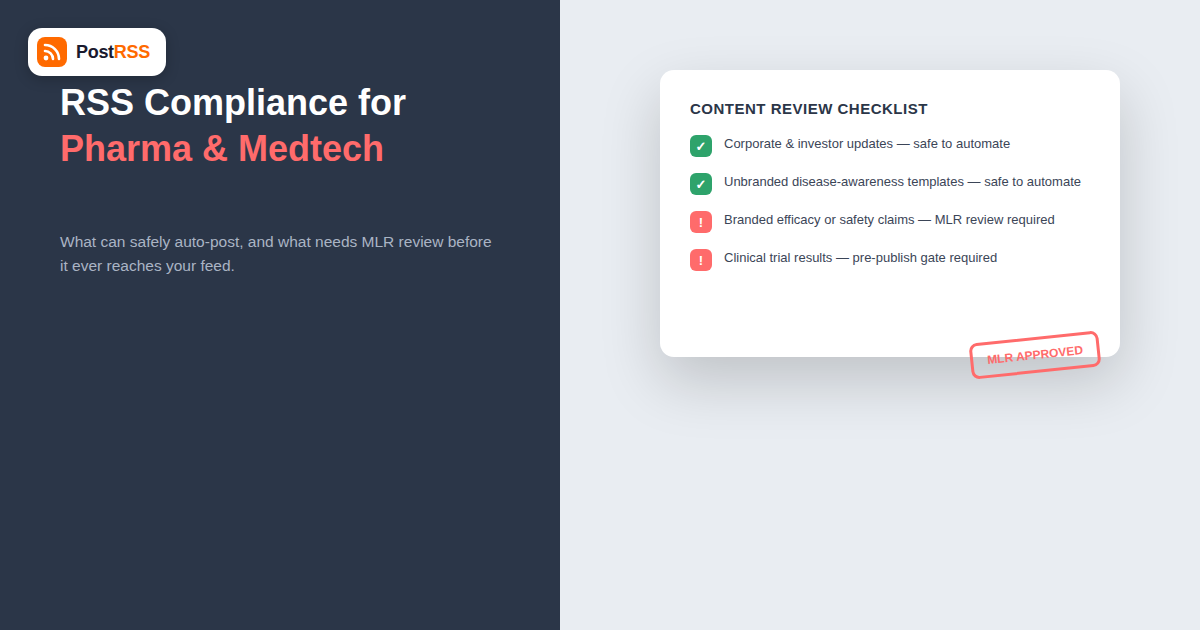
| Disease-state awareness content (unbranded) | Usually safe, with standing MLR-approved templates | Educational content not tied to a specific product can often follow pre-cleared formats |
| Product-specific efficacy or safety claims | Not safe for full automation | Requires fair-balance language and per-post MLR review |
| Clinical trial results announcements | Not safe for full automation without a review gate | Often needs specific disclaimer language and coordinated timing with disclosure rules |
The workable model for regulated industries is the same principle that applies to hospitals, just with a stricter gate: MLR review happens before content is published to the source CMS or newsroom, and RSS automation only ever distributes what’s already cleared and live. This means the compliance team’s job is reviewing content once, at the point of publication to your own website or newsroom, rather than reviewing (or worse, discovering after the fact) every individual social post. Structure your CMS workflow so nothing reaches the public-facing, RSS-generating page without going through the existing MLR process your organization already has — at that point, automated distribution via PostRSS or a similar tool is simply propagating already-approved content faster and more reliably than manual copy-paste would.
Rather than one company-wide feed mixing corporate news with product content, regulated companies benefit from splitting content into distinct feeds by review pathway:
This separation lets the genuinely low-risk majority of a pharma company’s public content (which is often more voluminous than people expect — investor updates, hiring announcements, CSR initiatives, unbranded awareness campaigns) move through full automation, while the smaller, higher-risk category of branded product content keeps its manual or semi-manual review step without slowing down everything else.
Because pharmacovigilance obligations apply regardless of which channel a potential adverse event surfaces through, companies running any social automation — including RSS-driven distribution — need a monitoring process for comments and replies on auto-posted content, not just for the posts themselves. This is a monitoring and response workflow layered on top of automation, not a reason to avoid automation: the posting itself doesn’t create adverse event risk, but an unmonitored comment section on an auto-posted update could delay a report your organization is obligated to file on a specific timeline. Most regulated companies solve this with a dedicated pharmacovigilance monitoring tool watching all public-facing social accounts, automated or not, rather than trying to build AE detection into the posting tool itself.
| Region | Key Consideration for Automated Social Content |
|---|---|
| United States (FDA) | Fair-balance requirements for any efficacy claim; strict off-label promotion rules |
| European Union (EMA + national bodies) | Direct-to-consumer prescription drug advertising is generally prohibited, unlike the US |
| Canada (Health Canada) | Similar DTC advertising restrictions to the EU, stricter than US rules |
| Global/multi-market companies | Often need region-specific feeds or content flags so a US-compliant post doesn’t automatically reach an EU audience where it would violate local rules |
For multinational pharma companies, this often means maintaining separate RSS feeds and separate destination social accounts per region, precisely because content that’s compliant in one regulatory jurisdiction may not be compliant in another — a company-wide global feed auto-posting everywhere is a real compliance risk for multi-market organizations specifically, and mirrors the same region-specific routing logic covered in our guide to healthcare marketing automation for multi-location organizations more broadly.
The biggest practical objection compliance teams raise to any automation proposal is timing: “what if something gets approved for the website but shouldn’t have gone to social.” The fix is making the CMS publication step itself the compliance gate, rather than adding a second review specifically for social distribution. In practice this looks like:
This structure means the vast majority of routine, template-following content moves through automation without incremental compliance overhead, while genuinely novel or high-risk content still gets the individualized attention it needs — without that individualized review becoming a bottleneck for everything else the company publishes.
Regulated industries typically need to demonstrate, after the fact, that a given piece of public content went through proper review before publication. RSS automation tools generally aren’t the system of record for this — that responsibility sits with the CMS and MLR review platform, which should already log who approved what and when. When evaluating an automation tool for a regulated environment, confirm it doesn’t strip or alter your existing audit trail (for example, by modifying content after it’s already been approved) and that its own logs of what was posted, when, and to which account can be cross-referenced against your compliance records if a question arises later. This is less about the automation tool having special compliance features and more about it staying a faithful, traceable distribution layer on top of a review process your organization already owns.
No — automation tools distribute content, they don’t evaluate regulatory compliance. Compliance has to be built into the content review process before publication; the automation tool’s job is reliable distribution of already-approved material.
Medical device companies face similar promotional review requirements (often under FDA’s device-specific regulations rather than drug regulations), and the same content-separation principle applies: corporate content can typically be automated, while device-specific claims need the same pre-publish review gate.
Employee reshares of already-compliant, already-published content are generally lower risk than original employee posts, but companies should still provide clear guidance on what employees can and can’t add as personal commentary when resharing, since personal framing of a branded post can itself introduce compliance risk.
Automation handles publishing, not retraction — removing a post from live social accounts is a manual action regardless of how it was originally published, which is exactly why the review gate belongs before publication rather than being treated as a catchable-after-the-fact step.
Trial recruitment content typically has its own specific regulatory requirements (IRB-approved language, eligibility criteria disclosure) and works well with automation once a standing, pre-approved template exists for how recruitment announcements are worded — the risk comes from ad hoc wording, not from the distribution mechanism.
Executive personal accounts fall into a gray area many companies handle with specific social media policies and training, since executives posting in a personal capacity about company products can still trigger the same promotional review obligations as official corporate channels, depending on how the content is framed.
For a pharma or medtech company just beginning to evaluate RSS automation, the lowest-risk entry point is corporate and investor relations content — press releases, earnings updates, leadership announcements — since this content already goes through a review process (often for securities disclosure reasons) before it’s public at all. Prove the automation setup works reliably on this feed for a few weeks, then expand to unbranded, template-based disease-awareness content once the process is trusted. Branded product content should be the last category considered for any level of automation, and even then, only with an explicit per-post approval flag built into the workflow rather than blanket auto-posting. This staged approach lets compliance, legal, and marketing teams build confidence in the system incrementally rather than betting the entire program on day-one full automation.
Pharmaceutical and medical device companies can and should use RSS automation for the substantial share of their public content that carries low regulatory risk — corporate news, investor updates, CSR content, and MLR-templated unbranded awareness campaigns — while keeping branded product and clinical content behind a pre-publish review gate rather than trying to automate around it. Splitting feeds by content sensitivity, keeping the compliance checkpoint before publication rather than after, and accounting for regional regulatory differences lets automation handle the bulk of the workload without introducing the risks that make this industry different from every other business PostRSS serves.