RSS do 66 sieci społecznościowych: Facebook, Instagram, X, LinkedIn, Telegram i innych Blog Program partnerski Kontakt
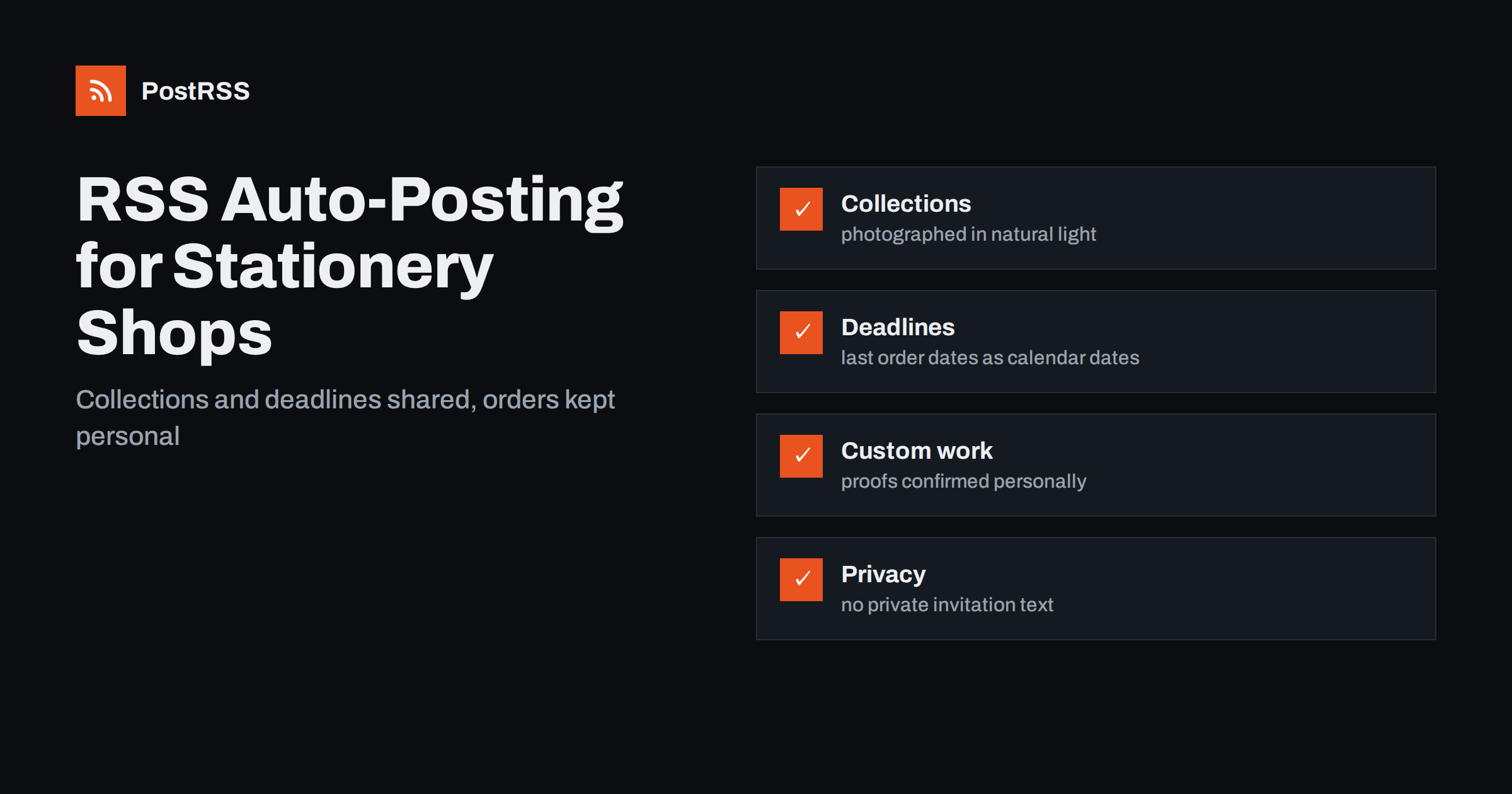
Short answer: RSS auto-posting lets stationery and greeting card shops share new collections, seasonal card ranges, custom printing services, workshops and opening hours on social media automatically. Publish each item as a page on your website, let an auto-poster read the RSS feed, and every new page appears on your Facebook Page, Telegram channel and other networks with its link and image. Customers see what has arrived before the next birthday, wedding or school term without anyone retyping it, while custom orders, proofs and stock promises stay in a conversation with your staff.
A stationery shop sells small pleasures and practical tools: a notebook that feels right, a pen that writes smoothly, a card that says what the sender cannot. The business runs on seasons, because cards, planners and school supplies each have a few weeks in which they are needed. A good shop also offers services, such as custom printing, wedding invitations and personalized stamps, and customers want to know what is possible and how long it takes. The people behind the counter are busy wrapping, printing and advising. Most general questions can be answered once, on a page of the website, and the page can be shared automatically. This guide explains what to publish, how to connect your website to an auto-poster and which topics need a person.
The advice fits many kinds of paper and gift business:
Each has a catalogue that follows the seasons, a set of opening hours and a website where news can be listed. That page becomes the source for every other channel.
Most of what a paper shop does can be turned into a short page:
Each page is written once and appears on your website, where someone who searches for a gift or a shop nearby can find it. The feed then announces it automatically.
Many shops already use a system that creates feeds:
/feed/ and one for every category, such as /category/new-in/feed/. If you are unsure of the address, see how to find your WordPress feed link.Use categories to separate audiences: new in, cards, custom orders, workshops and jobs. Each category has its own feed, and each feed can go to the channel where it works best; new items and cards to the Facebook Page, workshops to a local channel, jobs to LinkedIn. Routing by category is explained in category filtering for auto-posting.
| Content | Automate? | Notes |
|---|---|---|
| New collections and card ranges | Yes | Photograph, short description and where to find it |
| How-to pages and workshop dates | Yes | Date, time and how to book |
| Opening hours and holiday changes | Yes | Dates written out, one permanent hours page |
| Custom orders and proofs | No | Confirm text, colours and dates with the customer |
| Private invitation text and names | No | Never in a feed or a public post |
| Stock promises near a deadline | Not alone | Check the shelf before you confirm |
A simple rule: if it is general information that helps many people and sits on a finished page of your website, automate it. If it concerns one order, one proof or one promise about a date, it needs a human channel.
Paper goods have deadlines that customers cannot move. Holiday cards must be posted weeks before the day, wedding invitations are ordered months ahead and school supplies are needed in the last days of summer. Build a calendar of the dates when each page should appear: write the pages in a quiet period, set their dates and let the auto-poster share them gradually as the occasion approaches. Be explicit about the last date for orders and for shipping, written as a calendar date and not as a vague phrase. Update or unpublish the page when the deadline has passed, so that nobody orders something that you can no longer deliver on time.
Custom stationery is a service of details: wording, fonts, colours, paper types and quantities. Give it a permanent page that explains the steps, from the first enquiry to the proof and the final order, with the typical lead times written as ranges and not as promises. Say who owns the right to the design, how corrections are handled and what happens if a proof is approved with a mistake. Never publish the text of a customer’s invitation or the names on it without their permission. A post about a finished project, with the agreement of the client, shows the quality of your work, and it should use their words only if they have said that you may.
Stationery is tactile, and photography has to suggest texture. Use natural light, show the paper thickness at an edge, and photograph pens and notebooks in use as well as flat on a table. Colours matter, so avoid filters and mention when a colour may differ on screen. Show the size with a familiar object, such as a hand or a cup. If a picture contains a handwritten text, make sure it is your own or that the writer agrees. A feed can carry the photograph as the featured image of the page, and the auto-poster will use it as the preview image. See how to control which image gets auto-posted to choose the right one.
Many stationery shops grow a community around lettering, journaling and card making. A workshop page with the date, the level, what is included and what to bring costs little to write and fills a room. Share the page when booking opens and again a week before, and publish a short recap afterwards with photographs of the finished work, with the permission of the participants. Invite local artists and calligraphers to teach, and credit them by name, so that they share the page with their own followers. A small community of regulars is worth more to a paper shop than any amount of one-off traffic.
Offices, schools and small companies buy notebooks, branded stationery and thank-you cards in quantity, usually with a budget and a date. Give them a page that explains how to ask for a quote, the minimum quantities that you can handle, the time you need for printing and how artwork should be supplied. Keep it short and factual, and share it a few times a year, before the periods when companies plan gifts. A post on LinkedIn that links to that page can reach office managers and human resources teams who never visit a paper shop, and every quote should be confirmed in writing.
Most stationery shops do best with a Facebook Page and a simple email list that uses the same pages. Two active channels beat five forgotten ones.
/feed/, and check that it lists recent items.PostRSS has been automating RSS posting since 2014. It checks your website feeds as often as every minute and publishes each new page, with its real image and link, to the channels you connect, from Facebook Pages and Telegram to LinkedIn, Bluesky, Mastodon and many more among its 66 supported networks. You can choose how each post is built, filter items by keywords, add UTM parameters and post only within chosen hours or at exact times in your time zone. See the PostRSS features page for everything it does and the pricing page for plan limits. More ideas for local businesses are under the Local Business tag.
A stationery shop sells small things that matter on specific days. RSS auto-posting shares each new collection, card range and workshop automatically on your Facebook Page and other channels. Give every page a real photograph in natural light and the facts people need, state deadlines as calendar dates, keep one permanent page for custom printing and returns, handle proofs and private text personally and let your team spend the busy weeks wrapping, printing and advising.
Yes. If your website has a blog or news section, its RSS feed can be connected to an auto-poster that shares each new page on your Facebook Page and other channels. Custom orders and private wording should stay with staff.
New card ranges, seasonal pages, gift ideas, workshop dates and opening hours. Keep customer orders and private text out of public posts.
Early enough for customers to order and post their cards, usually several weeks before the occasion. State the last order date as a calendar date.
Yes, with the permission of the client. Do not publish names or the text of private invitations without agreement.
Yes. PostRSS reads any valid RSS or Atom address that is reachable without a login. Paste the address, connect your channels and new pages are shared as soon as they appear.
What changed in the networks, what broke, and how to fix it before it costs you reach.
Tworzy je Internet Solutions, zespół stojący za PostRSS. Każdy produkt oszczędza czas na swój sposób.
 English
 Lietuviškai
 Deutsch
 Français
 Русский
 Español
 Polski
 Italiano
 Українська
 Čeština
 Português
 日本語
 Latviešu valoda
 Eesti
 Magyar
 Bahasa Indonesia
 Türkçe
 हिन्दी
 Ελληνικά
 العربية
 ไทย
 Tiếng Việt
 Română
 Bahasa Melayu
 বাংলা