RSS do 66 sieci społecznościowych: Facebook, Instagram, X, LinkedIn, Telegram i innych Blog Program partnerski Kontakt
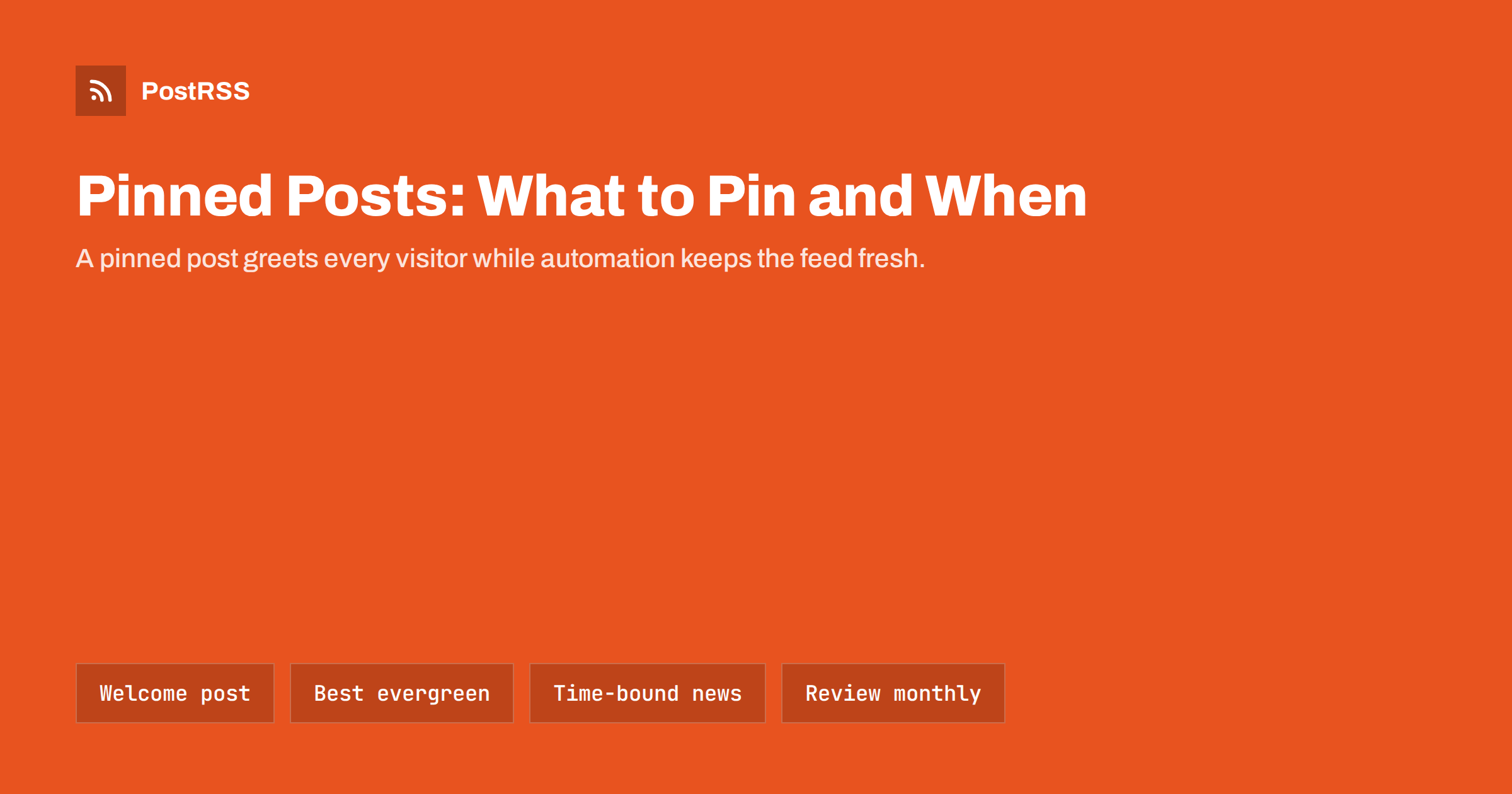
Short answer: A pinned post is the first thing many visitors see on your profile, so use it as a welcome sign: pin either a short introduction to who you are and what the account shares, your single most useful evergreen article, or a time-bound announcement such as a launch, event or important change. Review the pin at least once a month and remove anything outdated. Pinning works well alongside automated posting: the pin stays fixed at the top while new posts from your website keep the rest of the profile fresh.
Most social networks show posts in reverse chronological order on a profile. That is fine for followers who see your posts in their feeds, but less helpful for a new visitor who arrives on your profile for the first time. They see whatever you happened to post last, which may be a minor update, a reply or a reshared link that says little about your business.
Pinning changes that. A pinned post stays at the top of your profile, above newer posts, until you unpin it. It is your chance to choose the first impression, instead of leaving it to chance.
Visitors arrive on profiles more often than many businesses realise: after seeing a shared post, after a mention by someone else, from a link on your website or email signature, or after searching for your name. Many of them decide within seconds whether to follow, visit your website or leave. A good pinned post makes that decision easier.
Pinning is available on most major networks, although the details differ and change over time:
Check each network’s current help pages for the exact limits, as they are adjusted from time to time. The principle is the same everywhere: one or a few posts stay visible regardless of what you publish afterwards.
A welcome post is the safest choice for most small businesses and publishers. It tells a new visitor, in a few sentences:
For example: “We are a family-run bike shop in the old town. Here we share repair tips, new arrivals and weekend group rides, usually two or three times a week. Book a service or browse bikes on our website.” Add a strong image, such as your shop, team or product, and one link.
A welcome post is especially useful on accounts where you publish automatically. Visitors see immediately that the account is maintained by real people and understand what the regular stream of posts is about. On messaging channels such as Telegram, a pinned welcome message can also explain how to contact you, since channel followers often cannot reply directly.
A few more examples show how the same structure adapts to different accounts. A local accountant might write: “Practical tax and bookkeeping tips for small businesses in our city, published every week. Free first consultation: book on our website.” A recipe blogger: “New tested recipes every Tuesday and Friday, with step-by-step photos. Start with our 20 most popular weeknight dinners.” A software company: “Product news, release notes and practical guides from the team behind the app. Need help? Our support centre is linked below.” Each one says what, how often and where next, in under forty words.
Write the welcome post as if it were the only post a visitor will read, because for many of them it will be.
If you have one piece of content that represents your expertise better than anything else, pinning it can be more persuasive than an introduction. Good candidates are:
Choose content that will still be accurate in six months. If you pin an article, check that the page itself is up to date, because a pinned post keeps sending visitors to it for a long time.
Sometimes the most important thing a visitor should know is temporary:
Time-bound pins are powerful but need discipline. The moment the event is over or the change is old news, the pin becomes a sign of neglect. Put a reminder in your calendar for the day after the event to replace the pin with your welcome post or evergreen content.
Pins are easy to measure in a simple way. Add UTM parameters to the link in each pinned post, for example with utm_content=pinned, so your website analytics shows how many visits came specifically from pinned posts on each network. Compare that with visits from regular posts over the same period.
Also look at what networks report for profile visits and link clicks, where that information is available for business accounts. If profile visits are high but clicks on the pinned link are low, the pin probably does not give visitors a strong enough reason to go further. Try a clearer call to action, a better image or a different piece of content, and compare the next month.
Finally, listen to questions. If people keep asking the same thing in comments or messages, such as opening hours, prices or how to order, the answer probably belongs in the pinned post.
You do not need the same pinned post everywhere. Each network’s visitors arrive with different expectations:
On networks with several pin slots, such as Instagram, think of the pins as a small set that works together: one introduction, one piece of your best work and one practical post about how to buy, book or get in touch. Together they answer the three questions most visitors have without any scrolling.
Keep the core message consistent, though. Visitors who see you on several networks should recognise the same business, the same offer and the same website.
If you publish automatically from your website’s RSS feed, pinning becomes even more valuable. Automation keeps a steady flow of new posts on every connected channel, which shows that the account is active. The pinned post adds the context that automated posts cannot: a human introduction, a clear next step and a highlight you chose deliberately.
A few practical points:
Pins are easy to forget. A short monthly check keeps them useful:
If several people manage your accounts, agree who owns the pins. Otherwise one colleague pins an event while another assumes the welcome post is still there, and nobody removes the event afterwards. Adding “check pinned posts” to an existing monthly task, such as reviewing analytics, makes it much more likely to happen.
The whole routine takes a few minutes per network and prevents the most common problem: a pinned “Join us on Saturday!” post that is still there six months later.
PostRSS publishes new items from your RSS or Atom feed to the accounts and channels you connect, checking the feed every 5 minutes (every minute on Enterprise plans); the features page lists 66 networks. It keeps the regular stream of posts flowing, with the image and link from each article, while you handle the pins by hand. When an automated post turns out to be your best recent article, you can simply pin it on each network. See the PostRSS features page for how feeds, targets and message formats work.
A pinned post is a small feature with a big effect on first impressions. Pin a clear welcome post, your best evergreen content or a current announcement, tailor it to each network’s visitors, and review it every month. Combined with automated posting from your website, the pin gives each profile a human introduction at the top and a steady flow of fresh content underneath.
It depends on the network. Many allow one pinned post on a profile, Instagram allows up to three on the grid, and Mastodon lets you feature several. Check each network’s help pages for current limits.
Review it monthly and change it whenever it becomes outdated. A welcome post or evergreen guide can stay pinned for months, while event announcements should be replaced as soon as the event is over.
Pinning is usually done manually in each network’s app or website. Automation handles the regular stream of posts, and you pin the one that matters most by hand.
Pinning mainly affects what visitors see on your profile, not how the post is distributed in feeds. Its value is the first impression it creates for people who visit your profile directly.
Not necessarily. Keep the message consistent, but adapt the pin to each network’s audience, such as a business guide on LinkedIn and opening hours on a local Facebook Page.
What changed in the networks, what broke, and how to fix it before it costs you reach.
 English
 Lietuviškai
 Deutsch
 Français
 Русский
 Español
 Polski
 Italiano
 Українська
 Čeština
 Português
 日本語
日本語 Latviešu valoda
 Eesti
Eesti Magyar
 Bahasa Indonesia
 Türkçe
 हिन्दी
 Ελληνικά
 العربية
 ไทย
ไทย Tiếng Việt
 Română
 Bahasa Melayu
 বাংলা
বাংলা