RSS to 66 social networks: Facebook, Instagram, X, LinkedIn, Telegram and more Blog Program partnerski Kontakt
Updated: 2026-09-28
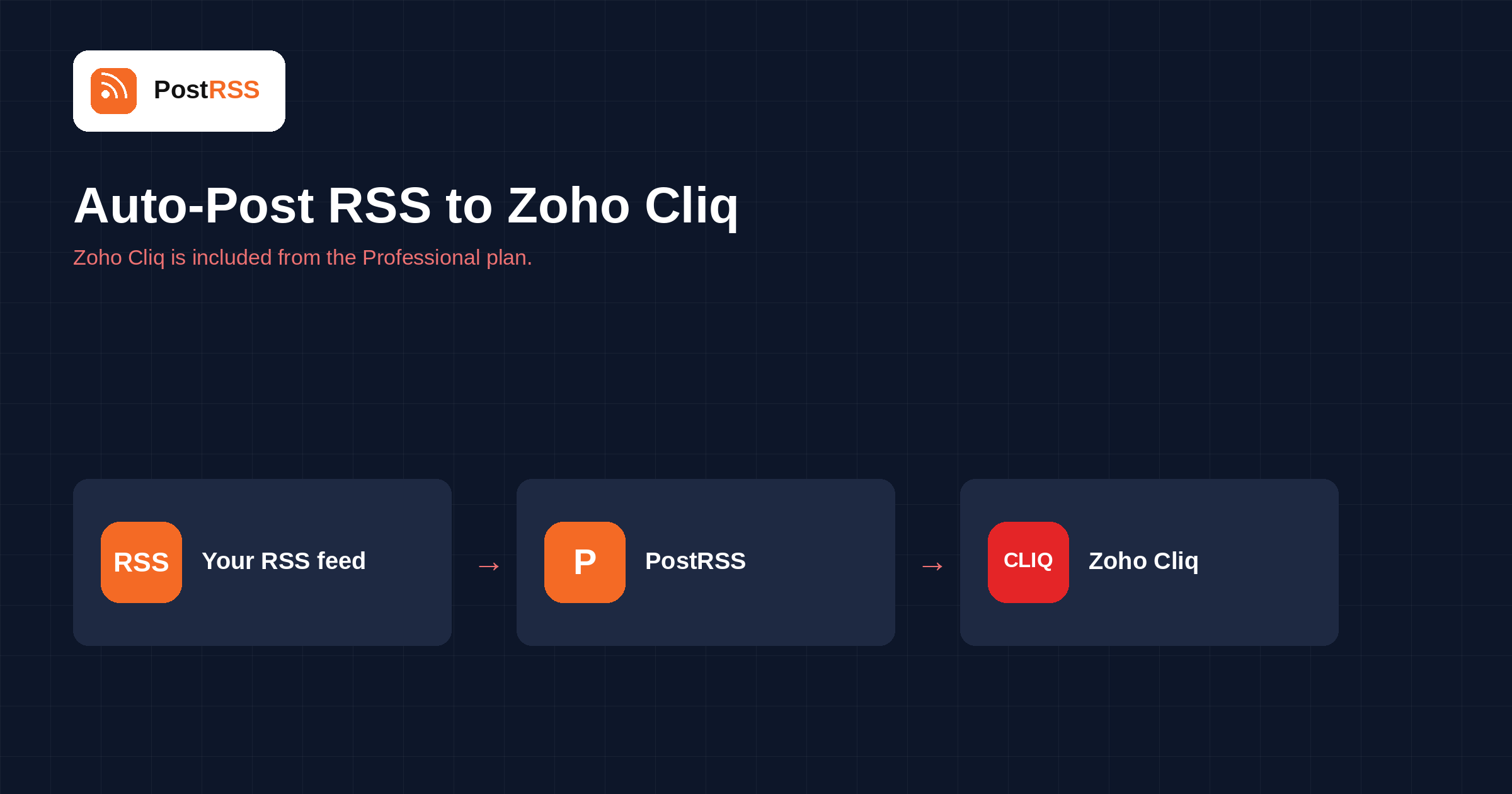
Short answer: copy the incoming webhook URL of your Zoho Cliq channel and paste it into PostRSS under Accounts → Add new Zoho Cliq account. Then open Cele → Add feed, choose Zoho Cliq in Target settings and add your feed under Add source (Type = RSS feed, Link = your feed address). Each new item is shared in the channel with its text and a link. Zoho Cliq is included from the Professional plan.
Zoho Cliq is the chat application inside the Zoho suite, and for companies that run their whole operation on Zoho it is where the working day happens. Getting your feed into it means your updates arrive in the same window as everything else the team is doing. This guide is the long version; the auto-post RSS to Zoho Cliq page has the short one.
All of these connect the same way, and it is worth being clear about what that means. An incoming webhook is created inside the channel or workspace by somebody who can administer it, the platform returns a URL, and anything holding that URL can post into that one place. There is no developer account, no application to submit and nothing to get approved.
The security consequence is blunt: the URL is the credential. No username, no token exchange, no second factor. Keep it out of public repositories, shared documents and support tickets, and treat regenerating it as the way to revoke access.
Zoho Cliq is rarely adopted on its own. It arrives with Zoho One, alongside CRM, Desk, Books and the rest, and the organisations running it tend to have deliberately put everything in one place. A feed landing in Cliq therefore reaches people in the same window where they already handle deals, tickets and invoices.
That is an argument for being selective about what you send. In a workspace where the chat tool sits next to the CRM, a channel full of blog links competes with work that has a deadline attached. The feeds that earn their place are the ones tied to something the team acts on: product announcements that sales will be asked about, status incidents that support will field calls about, release notes that change how a process works.
In a Zoho-centred organisation, the feeds that fit are the ones tied to work already happening in the suite:
Feeds that are purely informational tend not to survive in a workspace where the same window holds deals and tickets. Send the ones somebody has to act on.
Every incoming webhook belongs to exactly one Cliq channel, which makes routing explicit rather than clever. If you want a feed in two channels, you create two webhooks and two Targets. There is no shared configuration to get wrong and nothing to unpick later if one of the channels is retired.
It also makes revoking access simple. Deleting the webhook in Cliq stops delivery immediately, with no change needed on the PostRSS side and no effect on anything else you have connected.
Most "it stopped working" reports turn out to be feed problems rather than webhook problems, so open the feed URL in a browser first.
All four are fixed in the content system rather than in Cliq or in PostRSS.
Each new feed item arrives as a message with its text and a link back to your article. It is deliberately compact: a working channel scrolls, and the job of the message is to say that something exists, not to reproduce it.
PostRSS publishes items that appear in the feed after the Target starts running. It does not import the back catalogue — the alternative would be a destination flooded with years of archive on its first day.
Zoho Cliq is included from the Professional plan. Each destination you connect counts as one Target, and your plan decides how many Targets and how many posts a month you get. An annual subscription is cheaper than paying monthly. Current limits per tier are on the pricing page, and the full lineup of 66 networks is on the supported networks page. The Zoho Cliq page has the short version of the setup.
No. A channel's incoming webhook URL is the whole connection. There is nothing to develop or publish in the Zoho marketplace.
In the channel's own settings in Zoho Cliq, under its incoming webhook option. Copy it and paste it into PostRSS.
Yes. Anyone holding it can post into that channel, so treat it like a password.
Yes. Each channel is a separate Target with its own webhook URL, and the same feed can be a source for all of them.
No. An incoming webhook is send-only; PostRSS has no visibility into the conversation.
The Professional plan, together with the other team-chat destinations.
No. Only items that appear in the feed after the Target starts running are posted, so connecting an established blog does not dump its archive into the channel. If you want the archive somewhere, that is a different job with a different tool.
Yes. Deleting or regenerating the webhook in Zoho Cliq stops posts immediately, because the URL is the entire authorisation. Nothing needs changing on the PostRSS side for delivery to end.
Zoho Cliq takes a channel webhook and nothing else: copy the URL, paste it into PostRSS, and point a Target at the feed that concerns that channel. It is included from the Professional plan.
What changed in the networks, what broke, and how to fix it before it costs you reach.
 English
 Lietuviškai
 Deutsch
 Français
 Русский
 Español
 Polski
 Italiano
 Українська
 Čeština
 Português
 日本語
日本語 Latviešu valoda
 Eesti
Eesti Magyar
 Bahasa Indonesia
 Türkçe
 हिन्दी
 Ελληνικά
 العربية
 ไทย
ไทย Tiếng Việt
 Română
 Bahasa Melayu
 বাংলা
বাংলা