Ghost has quietly become one of the first mainstream publishing platforms to build native ActivityPub support directly into its core product, rather than leaving federation to a plugin or a third-party bridge. If you publish on Ghost and already use RSS auto-posting to reach Facebook, X, LinkedIn, and Pinterest, it’s worth understanding exactly what this native fediverse integration does, what it doesn’t do, and where it fits alongside the automated distribution you’re probably already running.
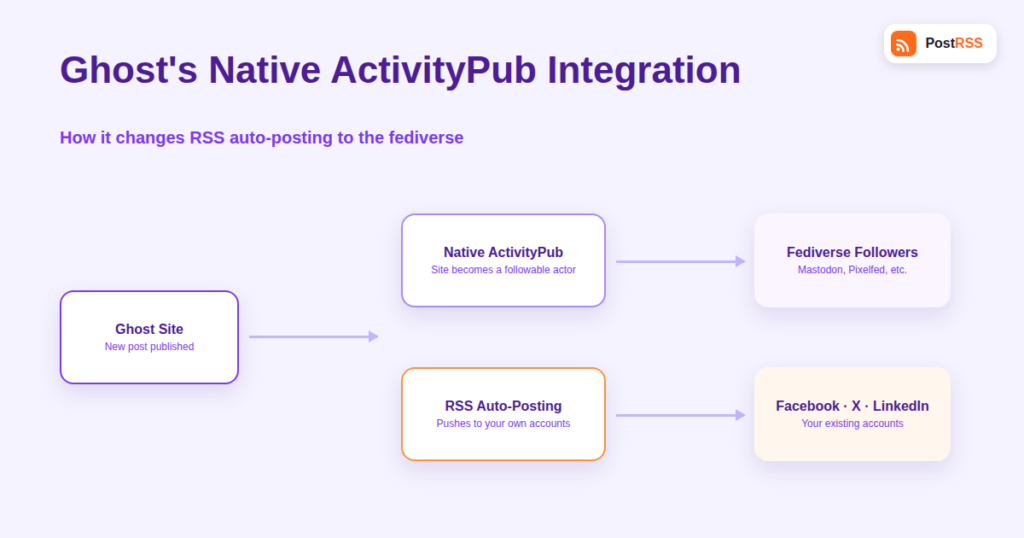
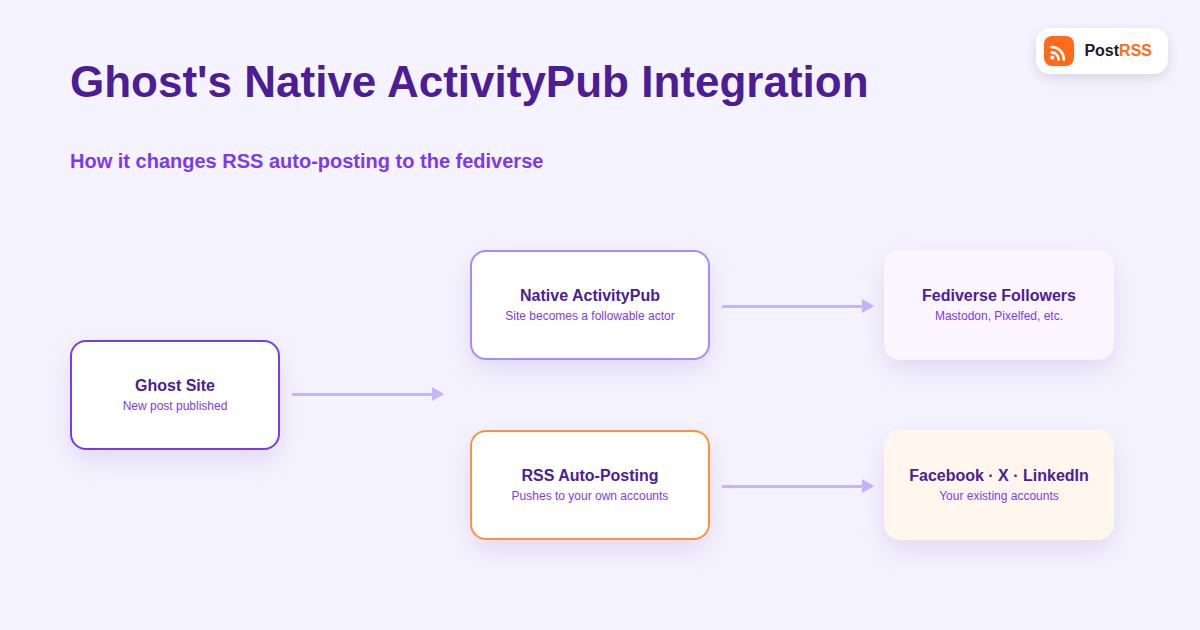
ActivityPub is the open protocol behind Mastodon, Pixelfed, and the wider fediverse — it’s the same protocol referenced throughout guides on auto-posting to fediverse platforms. Ghost’s integration turns every Ghost publication into its own fediverse “actor” that people can follow directly from Mastodon or any other ActivityPub-compatible app, the same way they’d follow a person or a Mastodon account. When you publish a new post on your Ghost site, it gets federated out automatically to everyone following your site’s fediverse identity, appearing in their timeline as a native post rather than a shared link.
This is a meaningfully different mechanism from RSS auto-posting. RSS auto-posting tools read your feed and push new items out to accounts you already control — your own Facebook Page, your own X account, your own LinkedIn Company Page. Ghost’s ActivityPub feature instead turns your site itself into a followable identity that anyone in the fediverse can subscribe to directly, without you needing to set up or maintain a separate Mastodon account at all.
| Aspect | Ghost’s Native ActivityPub | RSS Auto-Posting to Mastodon |
|---|---|---|
| What gets followed | Your Ghost site itself, as its own fediverse identity | A separate Mastodon account you set up and manage |
| Setup requirement | Built into Ghost; largely automatic | Requires creating a Mastodon account and connecting it to your feed |
| Where followers come from | New, fediverse-native audience discovering your site directly | Existing followers of a Mastodon account you’ve built over time |
| Content format | Native ActivityPub post, closely mirroring the original article | Customizable caption plus a link, styled like your other automated posts |
| Covers other platforms too? | No — fediverse only | No — Mastodon specifically, but part of a wider multi-platform setup |
Not really, and the reason comes down to audience overlap, or the lack of it. Ghost’s ActivityPub feature reaches people who specifically choose to follow your site’s own fediverse identity — a new discovery channel, but one you’re building from zero. An existing Mastodon account you’ve grown over time, and that you keep updated through RSS auto-posting, already has its own accumulated followers who chose to follow you there specifically, often with different expectations around tone, engagement, and community norms than someone who follows a publication’s raw feed.
Running both isn’t redundant — it’s closer to having two separate front doors into the fediverse. Some readers will prefer following your Ghost site directly and seeing everything you publish with no curation; others will prefer following your established Mastodon persona, where you might reply to comments, add commentary, or mix in posts that never came from your RSS feed at all. Turning on Ghost’s ActivityPub feature costs you nothing to test alongside your existing Mastodon automation.
When Ghost publishes a new post with ActivityPub enabled, the site’s underlying software constructs a signed “Create” activity — a structured JSON object describing the new content — and delivers it to every fediverse server that has at least one follower of your site’s identity. Each receiving Mastodon or Pixelfed instance then renders that activity in its own native timeline format, which is why a Ghost post can show up looking just like any other post in someone’s Mastodon feed, complete with your site’s display name and avatar, rather than as an external link card.
This is architecturally similar to how Mastodon-to-Mastodon federation works, and it’s also why Ghost’s implementation required real engineering investment rather than being a simple RSS-to-social bridge: your Ghost installation now has to behave as a full ActivityPub server in its own right, complete with follower management, activity delivery, and (depending on the implementation) reply and boost handling — capabilities a basic blogging platform never previously needed.
Publishers who’ve turned the feature on tend to report a similar early pattern: a modest but genuinely new stream of fediverse followers who wouldn’t have found the site through any of its existing channels, arriving faster for niche technical, open-source, and independent-media publications than for general-interest blogs. That tracks with what’s generally true of fediverse adoption overall — Mastodon and its neighboring platforms still skew toward technically engaged, privacy-conscious audiences, which maps closely onto the kind of readers Ghost itself has always attracted as a self-hosted-friendly, developer-adjacent publishing platform. Publishers with an already-large audience on Facebook or Instagram shouldn’t expect ActivityPub follower counts to approach those numbers; it’s additive reach in a specific, smaller community, not a replacement channel.
For publishers weighing Ghost against WordPress, Substack, or other platforms partly on the basis of fediverse reach, this native integration is a genuine differentiator — most competing platforms require either a plugin or an external bridge service to get any ActivityPub presence at all, and even then it’s rarely as tightly integrated as a first-class follow button. That said, ActivityPub reach is still a fraction of the audience available on Facebook, Instagram, X, LinkedIn, and Pinterest combined, so it shouldn’t be the deciding factor in a platform migration on its own. It’s a meaningful bonus channel, not a replacement for the broader distribution strategy most publishers still need.
Ghost has always positioned itself heavily around email newsletters as the primary relationship a publisher has with their audience, and it’s worth being clear that ActivityPub followers are a genuinely separate group from newsletter subscribers, not an overlapping subset. A fediverse follower sees your new posts appear in their Mastodon timeline the moment you publish; they haven’t handed over an email address, aren’t part of your subscriber list or its analytics, and can unfollow as casually as they’d unfollow anyone else on Mastodon. For publishers whose business model depends on growing an owned email list, ActivityPub followers should be treated as a discovery and reach channel — useful for exposing new readers to your work — rather than as a substitute for the newsletter growth that funds many independent Ghost publications.
This distinction also matters for how you think about content strategy. Some publishers deliberately federate only free posts via ActivityPub while keeping paid, subscriber-only content out of the fediverse feed entirely, mirroring how they might handle a public RSS feed differently from full-content delivery to paying subscribers. If your Ghost site runs paid subscriptions, it’s worth checking exactly how the ActivityPub integration handles gated content before turning it on.
Opening a native fediverse presence also means opening a new, occasionally noisy front door for interaction. Depending on how deeply your Ghost version has implemented reply handling, comments and replies from Mastodon users can surface as engagement tied to your post, which functions similarly to comments on a blog but arrives from an entirely different moderation surface than anything a typical Ghost publisher has had to manage before. Unlike a curated comments section, fediverse replies come from an open network with its own norms and, occasionally, its own trolls — worth budgeting a little moderation attention for if your ActivityPub following grows past a trivial size.
Ghost’s move reflects a broader trend of publishing platforms treating fediverse compatibility as a baseline feature rather than a niche add-on, mirroring how RSS itself became a near-universal, built-in expectation for blogging platforms two decades ago. WordPress has had ActivityPub plugin support for some time, and pressure is likely to grow on other CMS platforms to follow Ghost’s example of building it in natively rather than relying on third-party plugins. For now, though, Ghost remains one of the few mainstream platforms where this is a switch you flip on rather than a plugin you have to find, install, and configure separately.
No. Your Ghost site becomes its own followable fediverse identity independent of any personal or brand Mastodon account you may or may not already have.
Broadly yes — fediverse apps like Mastodon display federated posts from Ghost sites in the same timeline format as posts from Mastodon accounts, since they all speak the same ActivityPub protocol.
No, your RSS feed continues to work exactly as before, and any auto-posting tool reading it, including PostRSS, is unaffected by the ActivityPub feature being enabled or disabled.
Depending on how Ghost’s implementation handles replies, interactions from the fediverse can surface back as comments associated with your post, which is a genuinely new engagement channel most publishers haven’t had to moderate before.
Not directly — ActivityPub federation is a distribution and discovery mechanism within the fediverse, not a search engine signal. Any SEO benefit would be indirect, through additional traffic and backlinks generated by new readers.
Availability has varied as Ghost has rolled the feature out; check your specific plan’s current feature list in Ghost’s own documentation, since platform features like this are updated more frequently than pricing tiers themselves.
Only if you’re comfortable losing your existing Mastodon followers’ feed, since Ghost’s ActivityPub identity is a separate audience, not a continuation of an existing Mastodon account. Most publishers get more total reach by running both.
Not automatically. ActivityPub does support account migration between fediverse identities in some implementations, but this typically requires manual configuration on both the old and new accounts, and support for it varies by platform version. Treat your Ghost identity as a new, separate presence to grow rather than assuming a seamless transfer.
The feature is part of Ghost’s core platform, so it’s available in principle on both self-hosted installations and Ghost’s own managed Ghost(Pro) hosting, though exact rollout timing and default settings can differ between self-managed upgrades and the managed platform’s release schedule. Check your installation’s version and settings panel to confirm current availability.
Ghost’s native ActivityPub support is a genuinely useful addition for publishers who want an easy, built-in foothold in the fediverse, but it’s a new discovery channel rather than a replacement for the RSS-powered automation that already reaches your existing Mastodon audience and every other platform outside the fediverse entirely. The two work well side by side: let Ghost handle your site’s own fediverse identity, and keep RSS auto-posting handling everywhere else.
What changed in the networks, what broke, and how to fix it before it costs you reach.