RSS verso 66 social network: Facebook, Instagram, X, LinkedIn, Telegram e altri Blog Affiliazione Contatti
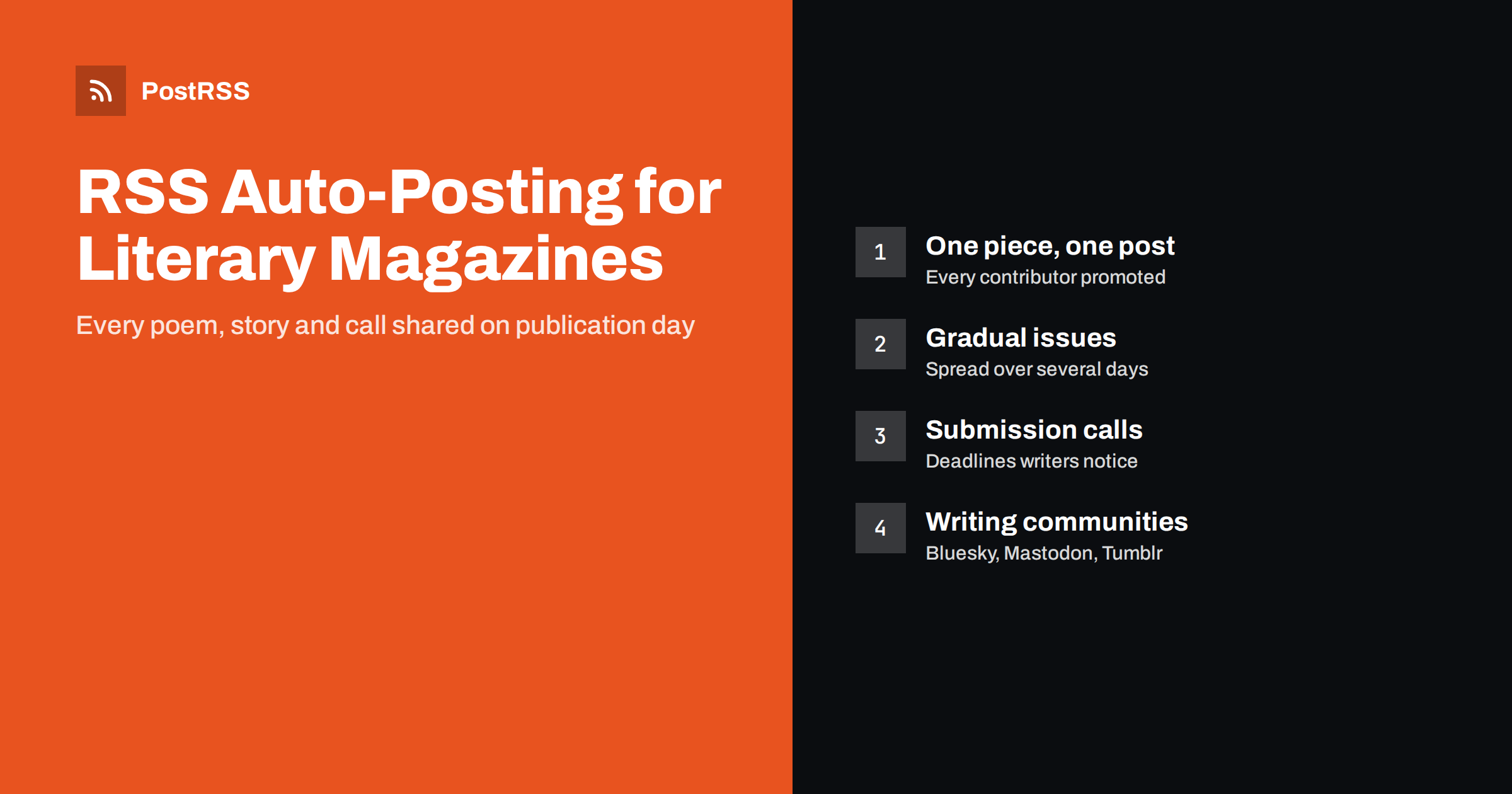
Short answer: RSS auto-posting lets literary magazines, poetry journals and small online reviews share every new poem, story, essay, interview and submission call automatically. Publish the piece on the magazine website, and an auto-poster reads the site’s RSS feed and posts it to Bluesky, Mastodon, a Facebook Page, Tumblr, Telegram and other channels with the title, a short excerpt, the author’s name and a link. Editors stop copying links by hand, contributors see their work promoted on publication day, and the magazine stays visible between issues.
Most literary magazines are run by volunteers or a very small paid team. Editors read submissions, edit accepted pieces, lay out issues, organise readings and answer contributors, usually around other jobs. Social media promotion is important, because readers, writers and other editors discover new work there, but it is also the task that gets postponed. When an issue goes live with twenty pieces and only three are ever shared, the other contributors notice. This guide explains how RSS automation fits the rhythm of a literary publication, how to release an issue gradually, how to handle poems without images, and which channels writing communities actually use.
A literary publication produces a steady stream of content, and almost all of it is already published on the website:
Each of these has an audience on social media: readers who want new writing, writers who want to submit, and the contributors themselves, who want to share their publication with friends and followers. Automation makes sure every piece gets the same basic promotion on publication day, whoever is on duty and however busy the week is.
There is also a fairness argument. When promotion depends on an editor remembering to post, well-known contributors tend to get more attention than first-time authors. A feed treats every piece the same.
Most platforms used by literary magazines publish RSS without any setup:
/feed/, one per category, such as /category/poetry/feed/, and one per tag. Many magazines use categories for genre and tags for issue numbers./rss/, with feeds for tags and authors. See how to find your Ghost or Webflow feed.Before connecting anything, open the feed in a browser and check that new pieces appear at the top with a correct title, author name and date. The feed format itself is defined in the RSS 2.0 specification, which is useful if your web developer needs to add fields.
The single biggest decision is whether each piece has its own page. Some magazines publish an issue as one long page or a PDF. That is easy to produce, but it gives you only one link to share and nothing for search engines to find per author. Publishing each poem, story and essay as its own page, with the issue as a table of contents linking to them, works much better:
Put the author’s name in a consistent place. If the auto-poster builds posts from the title and description, an excerpt that begins with the author’s name, such as a new poem by Jane Doe, makes the post useful on every network without editing.
When a full issue goes live at once, twenty posts in one evening will flood your followers and bury most of the pieces. There are two clean ways to spread an issue out:
The first approach is usually better for literary magazines, because it also gives the website a steady stream of new pages. Why bursts happen and how to prevent them is explained in why auto-posting sometimes publishes many posts at once.
Literary work rarely comes with a photo, and many networks show a link without an image as a small, easily ignored line. A few simple habits fix that:
If a feed has no images at all, see how to auto-post RSS feeds with no images for what each network does and how to add a fallback.
Content notes matter too. If a piece deals with difficult subjects, put a short content note at the start of the excerpt so it also appears in the social post. Readers appreciate it, and it reflects well on the editors.
A small team should choose two or three channels where it can also answer comments and share contributors’ reposts.
Calls for submissions are the content writers look for most. Publish each reading period, themed call and contest as its own page in a calls category, with the theme, the genres, the deadline and any fee or payment information in the first lines. Connect that feed to the channels where writers are, and add reminder posts a week before the deadline as separate items, because a single announcement is easily missed. When the reading period closes, update the page so old posts never send writers to a closed call.
Contest longlists, shortlists and winners make good posts as well, and contributors share them widely. Launch readings, open mic nights and festival appearances can each have an event page; the feed announces them in advance and an editor adds photos afterwards. Professional resources such as the Community of Literary Magazines and Presses offer guidance on running and promoting independent literary publications.
Contributors are a magazine’s best promoters. Automation helps them by producing a clear, attractive post on publication day that they can repost, quote or link. A few practices increase the effect:
Some contributors prefer not to be tagged or publicised, for example when publishing under a pseudonym. Respect that in the page text, because the excerpt will travel to every channel.
A magazine archive is a valuable library that rarely gets attention after publication. You can bring it back gradually: an anniversary series, a weekly from the archive post, or a themed selection linked to current events and seasons. Publish each selection as a new page that links to the older pieces, and the feed shares it like any other item. This keeps old contributors visible and introduces new readers to the magazine’s history without reposting old links blindly. Track which channels bring readers with UTM parameters, as explained in tracking RSS automation with UTM parameters.
PostRSS has been automating RSS posting since 2014. It checks your magazine’s feeds on the schedule you set, as often as every minute on Enterprise plans, and publishes each new poem, story, interview or submission call, with its image and link, to the channels you connect, from Bluesky, Mastodon, Tumblr and Facebook Pages to Threads, Telegram, Discord and many more among its 66 supported networks. You can choose the post format from the title, the description or both, turn categories into hashtags, set the maximum number of posts per update and the posting order, and post only within chosen hours in your time zone. Official plugins are available for WordPress. See the PostRSS features page for everything it does and the pricing page for plan limits. More publishing guides are collected under the Media tag.
Literary magazines and poetry journals already publish the work their readers want. RSS auto-posting shares each piece on publication day, on every channel, with the author’s name and a real excerpt, so every contributor gets the same promotion and the editors get their evenings back. Give each piece its own page, release issues gradually, keep submission calls up to date and spend the saved time on the conversations that build a literary community.
Yes. If each poem, story or essay is published as its own page, the website feed can be connected to an auto-poster that shares every new piece on Bluesky, Mastodon, Facebook, Tumblr and other channels with its excerpt and link.
Schedule individual pieces on the website over several days, or limit the number of posts per update in the auto-poster so the issue is shared gradually. Posting windows keep the posts to hours when readers are online.
The issue cover is a simple default for every piece. Designed text cards with the title and author name, or commissioned artwork for themed issues, work well for highlighted pieces.
Bluesky, Mastodon and Tumblr have active writing communities, Facebook reaches many readers and local events, and Threads and X still reach authors and agents. A Telegram channel or Discord server suits a loyal core audience.
Yes. Publish each call as a page in a dedicated category with the theme and deadline in the first lines, connect that feed to the channels where writers are, and add separate reminder items before the deadline.
What changed in the networks, what broke, and how to fix it before it costs you reach.
Realizzati da Internet Solutions, il team dietro PostRSS. Ognuno ti fa risparmiare tempo in modo diverso.
 English
 Lietuviškai
 Deutsch
 Français
 Русский
 Español
 Polski
 Italiano
 Українська
 Čeština
 Português
 日本語
日本語 Latviešu valoda
 Eesti
Eesti Magyar
 Bahasa Indonesia
 Türkçe
 हिन्दी
 Ελληνικά
 العربية
 ไทย
ไทย Tiếng Việt
 Română
 Bahasa Melayu
 বাংলা
বাংলা