RSS verso 66 social network: Facebook, Instagram, X, LinkedIn, Telegram e altri Blog Affiliazione Contatti
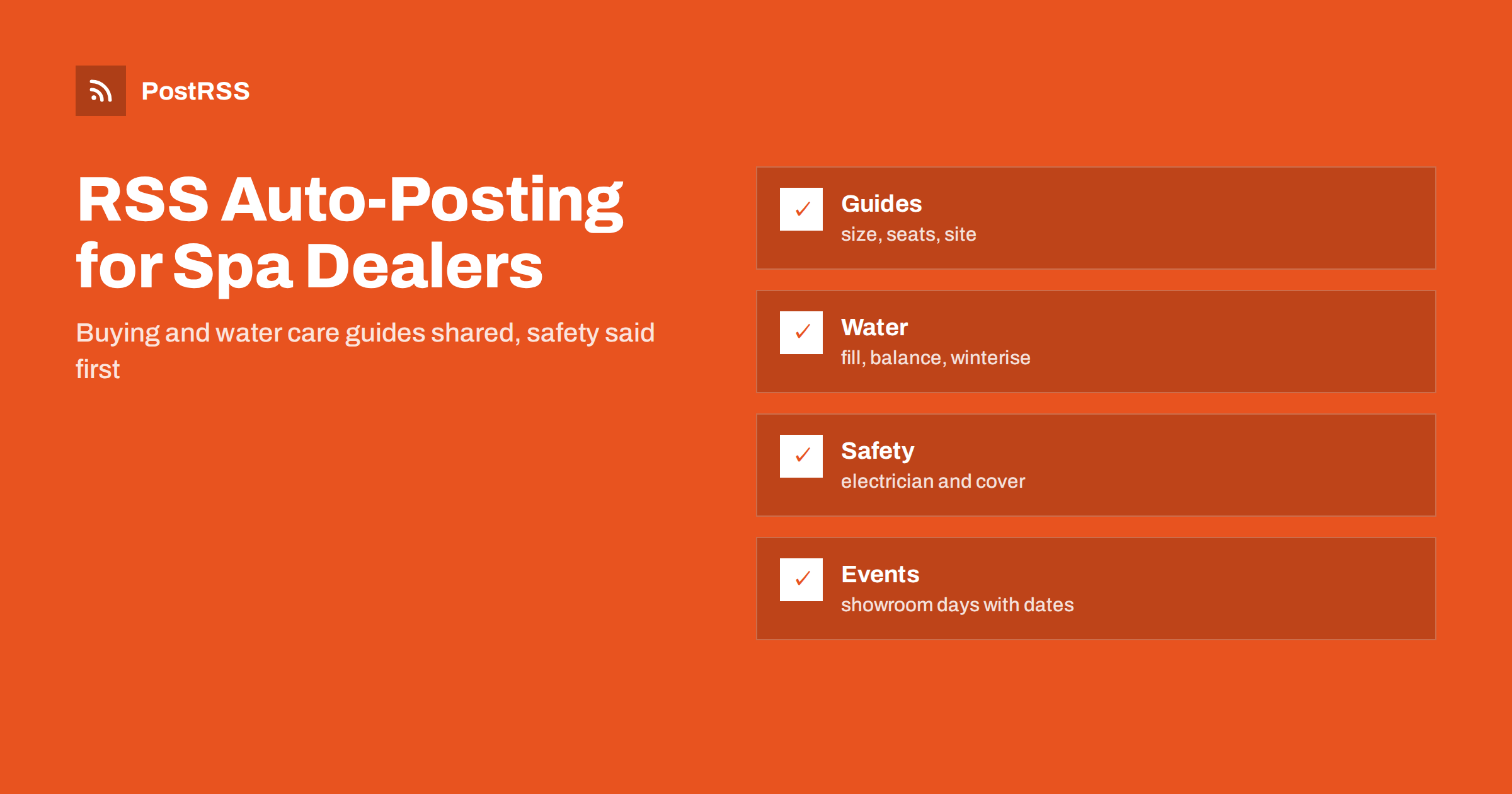
Short answer: RSS auto-posting lets hot tub, spa and sauna dealers share buying guides, water care advice, delivery and installation pages, showroom events and seasonal reminders on social media automatically. Publish each guide or announcement as a page on your website, let an auto-poster read the RSS feed, and every new page appears on your Facebook Page, Pinterest boards, LinkedIn and other networks with its link and image. Buyers who plan a major purchase find clear answers first, while health promises, unsafe installation tips and out-of-date offers stay out of your posts.
A hot tub is a purchase that people dream about for months. They look at pictures in the cold season, ask neighbours how much work it is and wonder whether the garden, the electricity supply and the family will cope. A dealer who answers those questions in plain words earns trust long before the first showroom visit. The challenge is time. The showroom is busy at weekends, the delivery crew is booked weeks ahead and the owner is also the accountant. Automation closes the gap. Each guide is written once and the feed carries it to every network where future customers browse. This guide explains what to publish, how to connect your site to an auto-poster and which limits keep a spa business credible and safe.
The advice fits many kinds of spa and wellness equipment dealer:
Each has a long list of questions from customers and a website where the answers can live. The guides or blog section of that website is the source for everything else.
A spa dealer knows how to turn an exciting but complicated decision into a sequence of simple steps, and that is exactly the content buyers search for:
Each can be a short page on your own website. When the page is published, the feed announces it. A page also appears in search results when someone types a question such as how much space a hot tub needs, which a social post cannot do. The guide stays useful for years, and it reaches a new audience each time the season returns.
Most dealer websites run on a system that publishes feeds without extra work:
/feed/ and one for every category, such as /category/water-care/feed/. If you are unsure of the address, see how to find your WordPress feed link.Use categories to separate topics: buying guides, water care, installation, events and company news. Each category has its own feed, and each feed can go to the channel where it works best; buying guides to Pinterest and Facebook, event announcements to the Facebook Page, hiring pages to LinkedIn. Routing by category is explained in category filtering for auto-posting.
| Content | Automate? | Notes |
|---|---|---|
| Buying and water care guides | Yes | Evergreen pages that return every season |
| Range and brand pages | Yes | One page per range, with real photographs |
| Events and open days | Yes, with a date | Update or unpublish the page afterwards |
| Hiring pages | Yes | One page per role, closed when filled |
| Customer photographs of their garden | Only with permission | Remove house numbers and neighbours |
| Health or therapy promises | Never | Describe features, not cures |
A simple rule: if the content helps many buyers and sits on a finished page of your website, automate it. If it makes a promise you cannot prove, or concerns one customer, keep it out.
Water, electricity and heat are a serious combination, and a spa dealer is trusted to explain the risks. Use your guides to say clearly that the electrical connection must be installed by a qualified electrician according to local rules, that the base must carry the weight of a full tub, that a locked cover keeps children and pets out and that the water temperature should be limited according to the manufacturer’s instructions. Remind readers that alcohol, medication and long soaks do not mix, and that people with medical conditions or pregnancy should ask their doctor before using a hot tub or a sauna. Never publish do-it-yourself wiring advice. A dealer who talks about safety in public looks professional and avoids the worst kind of publicity.
Hot water feels good, and it is tempting to write that a spa relieves pain, cures insomnia or lowers blood pressure. Those are medical claims, and they attract regulators and complaints. Describe what the product does in terms that anyone can verify: the number and type of seats, the way the jets are arranged, the temperature range and the way the cover keeps heat in. If you refer to relaxation, keep the wording modest and personal, such as many owners enjoy a soak at the end of the day. When you cite a study, name it, say what it studied and link to the source. A cautious tone is a strength in this category; readers learn to trust a dealer who explains rather than promises.
Sale and finance pages are the most perishable content on a dealer website. Give every offer its own page with a visible start and end, write the end date in the text and update or unpublish the page when the event is over. If you promote payment plans, follow your local rules for credit advertising, state the conditions plainly and link to the full terms, and avoid headline figures that depend on conditions most buyers will not meet. Keep prices on a page and in the shop in step, because an auto-poster shares exactly what the page says. Many shops also run a spring and autumn showroom event; give each one a page with the date, the time and what visitors can expect, so that people who arrive know what they will see.
Interest in spas rises when the evenings turn cold, and a few weeks before the holidays. Plan a small calendar of pages: a guide to choosing a tub in late summer, a site preparation guide in early autumn, a gift and finance guide before the holidays, a winter care guide when the temperature falls and a sauna guide for people who want something smaller. Write them weeks ahead, schedule them on your website and let the feed share each one when the season begins. A steady rhythm of useful pages gives your offers a context, so that they feel like part of a conversation and not like constant advertising.
Most spa dealers do best with a Facebook Page and Pinterest. Two active channels beat five forgotten ones.
/feed/, and check that it lists recent items.PostRSS has been automating RSS posting since 2014. It checks your website feeds as often as every minute and publishes each new guide, event and announcement, with its real image and link, to the channels you connect, from Facebook Pages and Pinterest boards to LinkedIn, Telegram, Bluesky, Mastodon and many more among its 66 supported networks. You can choose how each post is built, filter items by keywords, add UTM parameters and post only within chosen hours or at exact times in your time zone. See the PostRSS features page for everything it does and the pricing page for plan limits. More ideas for retailers are under the Local Business tag.
A hot tub is a considered purchase, and buyers reward the dealer who explains it. RSS auto-posting shares each new guide, event and offer automatically on your Facebook Page, Pinterest boards and other channels. Answer the questions buyers ask most, talk openly about safety and installation, describe products without health promises, give every offer a visible end date, plan pages around the seasons, route content by category and let your team spend their time with customers.
Yes. If your website has a guides or blog section, its RSS feed can be connected to an auto-poster that shares each new page on your Facebook Page, Pinterest boards and other channels. Offers should always carry an end date.
Buying guides, water care and winterising pages, site preparation advice, range pages, showroom events and hiring notices. Guides tend to perform best because buyers research for weeks before they visit.
Be very careful. Health claims need evidence and are regulated in many countries. Describe the features and the way the product is used, and suggest that people with a medical condition ask their own doctor.
Publish site preparation guidance and explain what your team will do, but never give do-it-yourself wiring advice. The electrical connection must be made by a qualified electrician.
Yes. PostRSS reads any valid RSS or Atom address that is reachable without a login. Paste the address, connect your channels and new pages are shared as soon as they appear.
What changed in the networks, what broke, and how to fix it before it costs you reach.
Realizzati da Internet Solutions, il team dietro PostRSS. Ognuno ti fa risparmiare tempo in modo diverso.
 English
 Lietuviškai
 Deutsch
 Français
 Русский
 Español
 Polski
 Italiano
 Українська
 Čeština
 Português
 日本語
 Latviešu valoda
 Eesti
 Magyar
 Bahasa Indonesia
 Türkçe
 हिन्दी
 Ελληνικά
 العربية
 ไทย
 Tiếng Việt
 Română
 Bahasa Melayu
 বাংলা