LinkedIn’s feed algorithm rewards early engagement more heavily than almost any other major platform — the first 60-90 minutes after you post largely determine how far it travels. That makes timing a bigger lever on LinkedIn than on networks like Pinterest or Facebook, where content can resurface gradually over days. This guide breaks down the current data on when LinkedIn engagement actually peaks, how that varies by audience type, and how to build a posting schedule around it using RSS automation rather than manual daily scheduling.
This matters for a wider range of accounts than just individual professionals building a personal brand. Company Pages, B2B SaaS marketing teams, recruiting departments, and thought-leadership programs all compete for attention in the same narrow windows, which means the cost of bad timing compounds across an entire content calendar rather than affecting just one post. Getting the schedule right once, and then automating around it, pays off far more on LinkedIn than on platforms with a more forgiving discovery model.
LinkedIn’s feed ranking runs in stages. First, a post enters a small initial test pool — largely your first-degree connections and followers who are active at that moment. The platform measures signals like dwell time, comments (weighted more heavily than likes), and shares within roughly the first hour. If those early signals are strong relative to your account’s baseline, the post graduates into a wider distribution pool that can reach second- and third-degree connections through the algorithm’s recommendation layer. If early engagement is weak, the post effectively plateaus at that small initial audience and rarely recovers, even if a handful of people engage with it hours or days later.
This staged model is why timing and reach are so tightly linked on LinkedIn specifically: publishing when your actual audience is online and likely to engage within that first hour directly determines whether a post gets the chance to reach anyone beyond your existing followers at all.
LinkedIn’s ranking system leans heavily on “dwell time” and early comment velocity in the first hour after publishing to decide how widely to distribute a post beyond your immediate connections. If a post underperforms in that initial window, LinkedIn generally stops pushing it further, regardless of how good the content is. This is different from Instagram or Pinterest, where a post can gain steady traction over days or weeks through search and hashtag discovery. On LinkedIn, missing the window your audience is actually online largely caps your reach for that post permanently.
Based on current engagement pattern data and LinkedIn’s own audience behavior reporting, these windows consistently outperform others for most B2B and professional audiences:
| Day | Best Time Window (Recipient’s Local Time) | Why |
|---|---|---|
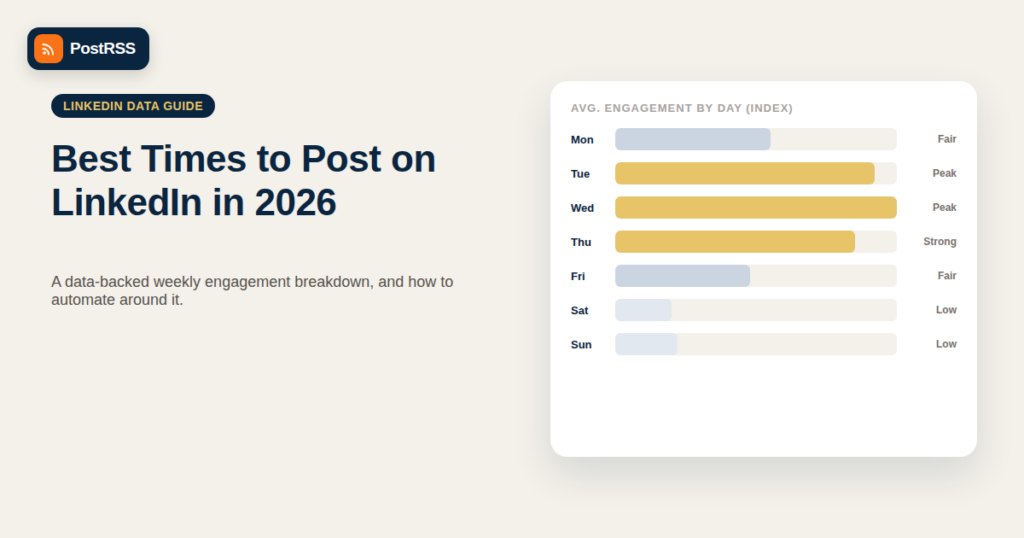
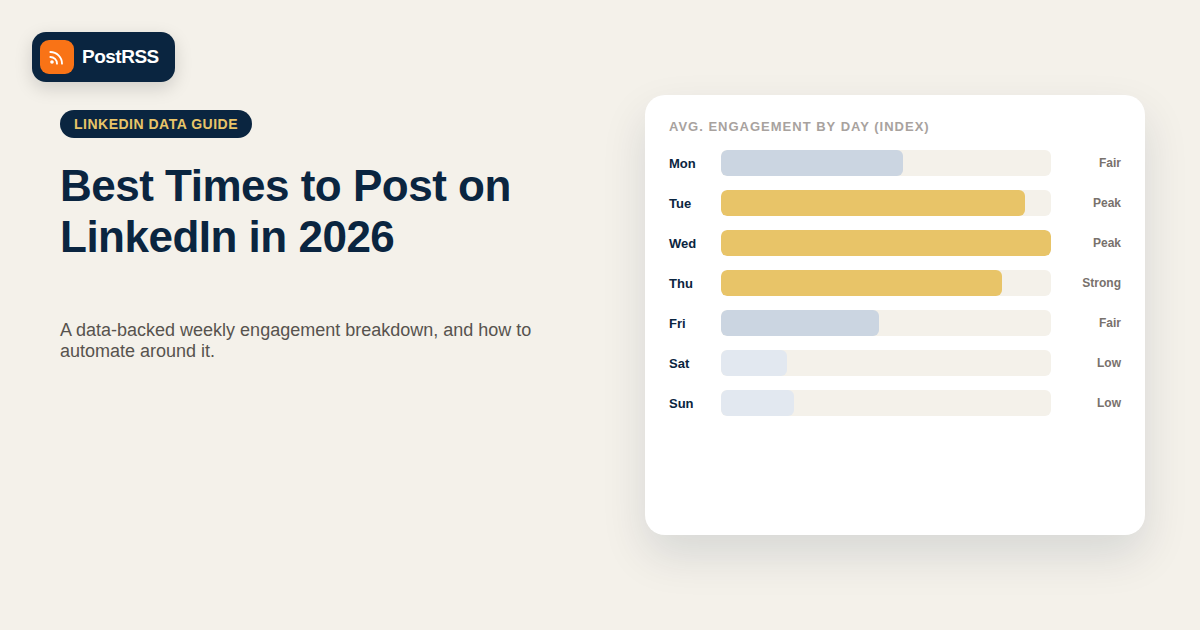
| Tuesday | 8:00–10:00 AM, 12:00–1:00 PM | Peak weekday engagement; users catching up before and during lunch |
| Wednesday | 8:00–10:00 AM, 1:00–2:00 PM | Consistently the highest average engagement day across industries |
| Thursday | 9:00–11:00 AM | Strong for thought-leadership and long-form posts |
| Monday | 10:00–11:00 AM | Lower than midweek; avoid early morning (inbox triage time) |
| Friday | 9:00–11:00 AM | Engagement drops sharply after midday |
| Weekends | Avoid unless niche is weekend-active (recruiting, some B2C) | Professional audience largely offline |
Tuesday through Thursday mornings remain the strongest overall window, with a secondary peak around lunch as professionals check the feed on a break. Early mornings before 7 AM and evenings after 6 PM consistently underperform for most B2B audiences, since LinkedIn usage still tracks closely with the traditional workday even as remote work has reshaped other platforms’ peak times.
Skews most tightly to the Tuesday-Thursday, 8-11 AM local time window described above, since this audience checks LinkedIn primarily during structured work hours.
Shows a secondary peak on Monday mornings and slightly higher weekend activity than other segments, since job searching often happens outside standard work hours.
Tends to perform well slightly later in the day (11 AM-1 PM) and shows less of a hard drop-off on Fridays compared to enterprise-focused content.
If your audience spans multiple time zones, a single “best time” doesn’t exist — you need to either pick the time zone with your largest audience concentration or stagger multiple posts across zones, which is where automated scheduling becomes essential rather than optional.
Because the engagement window is narrow and unforgiving, hitting it consistently — every time you publish, across whatever days you happen to write content — is hard to do by hand. Most people write when inspiration strikes, not necessarily at 9 AM on a Wednesday, and LinkedIn’s own native scheduler requires you to be the one setting that time manually for every single post. An RSS-driven auto-posting workflow solves this by decoupling when you write from when it publishes: your blog or content feed captures the post whenever it’s ready, and your automation tool holds it until the next optimal window rather than publishing immediately or requiring you to remember to schedule it.
| Platform | Peak Window Tightness | Content Decay Speed | Manual Timing Effort Required |
|---|---|---|---|
| Narrow (1-2 hour window) | Fast — mostly capped after first hour | High | |
| X (Twitter) | Moderate | Very fast — hours | Moderate-High |
| Moderate | Moderate — a day or two | Moderate | |
| Wide | Slow — weeks to months | Low |
This comparison is exactly why LinkedIn benefits disproportionately from a dedicated timing strategy inside your social media automation setup, rather than using one blanket posting schedule across every network.
| Industry | Typical Peak Shift | Notes |
|---|---|---|
| Technology / SaaS | Standard Tue-Thu 8-10 AM | Audience closely tracks general benchmark |
| Finance / Legal | Slightly earlier (7-9 AM) | Early-workday professional habits |
| Creative / Marketing Agencies | Slightly later (10 AM-12 PM) | More flexible schedules, later starts common |
| Education / Academia | Midday and early evening | Class schedules shift typical browsing windows |
| Healthcare | Early morning or evening | Shift-based schedules reduce midday availability |
These shifts are usually modest — an hour or two at most — but for an algorithm as sensitive to early engagement as LinkedIn’s, even a one-hour miss can meaningfully change how far a post travels. If your account serves a specific vertical, weighting your automation schedule toward that industry’s typical pattern rather than the generic benchmark is worth the small extra setup effort.
Tuesday or Wednesday between 8-10 AM in your audience’s primary time zone consistently shows the strongest average engagement across most B2B accounts, though your own analytics should always take priority over general benchmarks.
Yes, if posts are spaced too closely together — LinkedIn’s algorithm can treat rapid consecutive posting as a signal to reduce distribution, so spacing important posts by at least several hours, ideally a full day, tends to perform better than back-to-back posting.
Late evenings, very early mornings (before 7 AM), and most of the weekend consistently underperform for professional/B2B content, since LinkedIn usage still closely tracks the standard workday for most audiences.
Yes — if a meaningful share of your audience sits in a different time zone, either prioritize the zone with the largest concentration or schedule separate posts timed to each region rather than relying on a single “best time.”
Yes, that’s the core advantage of scheduled auto-posting over manual publishing — once you set the target windows, every new item from your content feed queues into the next available optimal slot without requiring you to remember or manually time it.
Somewhat — text and image posts tend to benefit most from the tight morning windows described above, while native video and documents can sometimes sustain engagement a bit longer into the day since LinkedIn’s video feed behaves slightly differently from the main feed.
Review your own account’s analytics at least quarterly, since LinkedIn periodically adjusts its ranking algorithm and audience behavior shifts gradually over time — treat published benchmarks like this one as a starting point, not a permanent rule.
LinkedIn doesn’t publish exact hour-by-hour engagement benchmarks publicly, so guidance like this is built from aggregated third-party engagement studies and platform behavior patterns rather than an official LinkedIn source — always weight your own account’s analytics more heavily than any general benchmark.
Largely yes, though Articles tend to have a longer engagement tail than standard feed posts, so while the initial publish window still matters, a well-performing Article can continue gathering views and shares for days through LinkedIn’s search and notification surfaces in a way a standard post typically doesn’t.
Most accounts see the best reach-to-effort ratio publishing 2-4 times per week rather than daily; consistent quality within the optimal time windows tends to outperform higher-frequency posting that dilutes each individual post’s audience attention. Pushing beyond that, especially with automated or repurposed content, risks the frequency-based reach suppression discussed above without a corresponding gain in total engagement.
If your LinkedIn content originates from a blog, newsletter, or company update feed, the practical implementation looks like this: connect that feed to your auto-posting tool, then instead of a “post immediately” rule, configure a queue that holds new items and releases them at the next available Tuesday-Thursday morning slot. Most tools that support optimal-time scheduling let you define these windows once and apply them to every future item automatically, so you’re not manually timing each post as new content gets published.
LinkedIn rewards early engagement more aggressively than most other platforms, which makes hitting the right posting window — generally Tuesday through Thursday mornings — genuinely consequential rather than a minor optimization. Because that window is narrow and content decays fast outside it, this is one of the clearest cases where automated, schedule-aware posting outperforms manual publishing: set your content pipeline once, and every new post lands in the window that gives it the best shot at real reach.