Nostr — short for “Notes and Other Stuff Transmitted by Relays” — has quietly grown from a niche cryptography experiment into a real, if still small, decentralized social network with a loyal user base, mostly overlapping with the Bitcoin and privacy-tech crowd. If you already auto-post your RSS feed to Facebook, X, and LinkedIn, it’s natural to wonder whether you can add Nostr to that list. The answer involves understanding how fundamentally different Nostr’s architecture is from every other platform on this list — and why that difference is exactly what makes auto-posting to it harder than flipping a switch.
Every platform PostRSS typically connects to — Facebook, X, LinkedIn, Pinterest, VKontakte — uses OAuth: you log in once, grant an app permission, and a token lets that app post on your behalf without ever touching your password. Nostr has no OAuth, no central server, and no company-issued API keys at all. Instead, a Nostr identity is a cryptographic keypair: a public key (npub) that acts as your username, and a private key (nsec) that acts as both your password and your posting credential simultaneously. Whoever holds the private key can sign and publish notes as you — permanently and irrevocably, since there’s no company to call for a password reset.
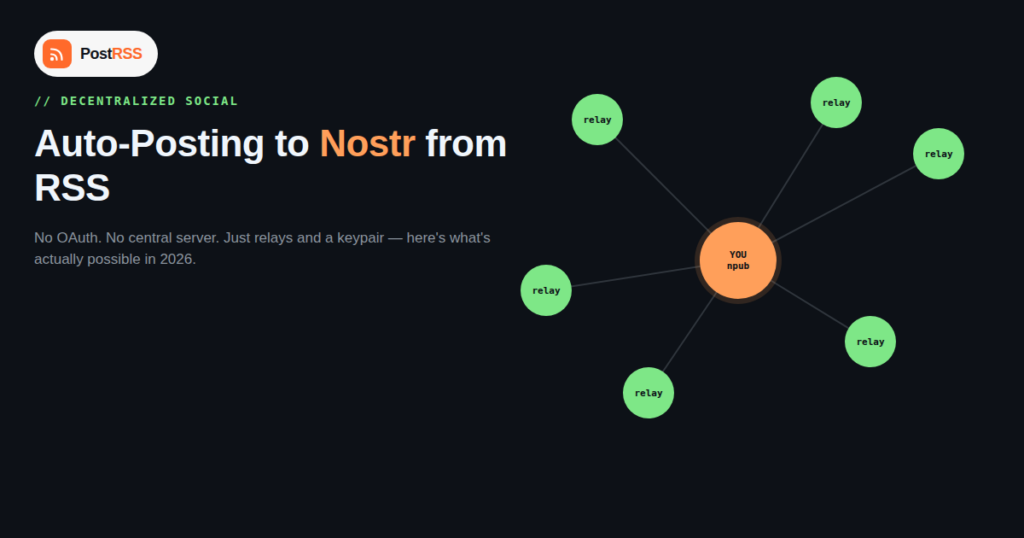
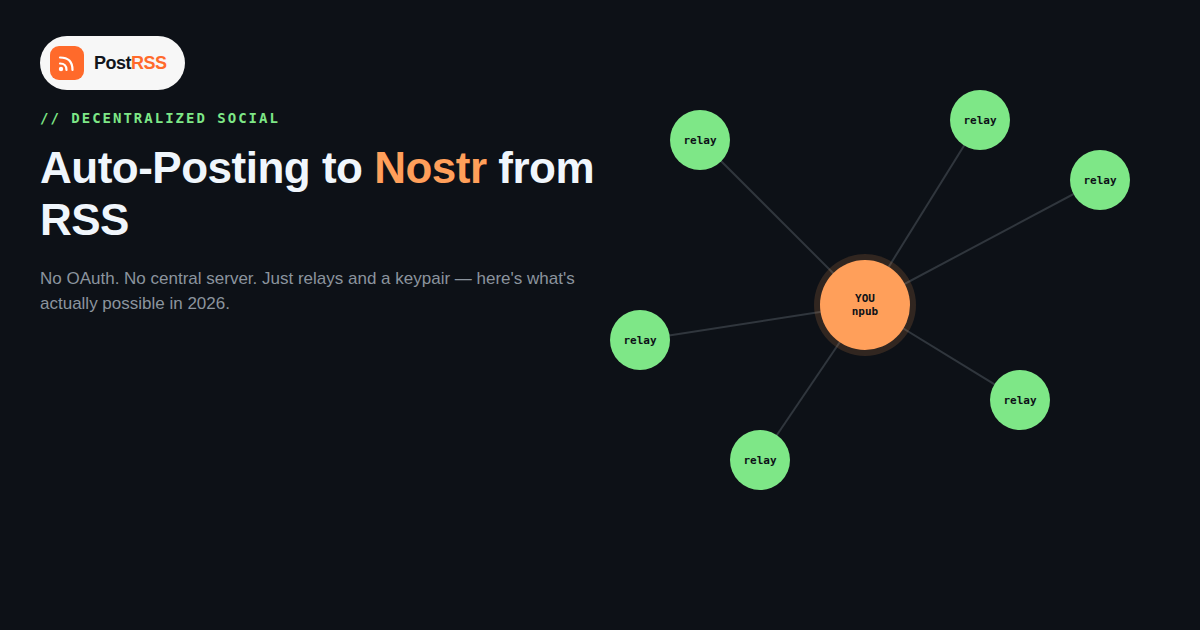
Posts (“notes”) aren’t stored on a central server either. They’re signed events broadcast to a network of independently run relays — servers that store and forward notes to anyone who asks. There’s no single “Nostr, Inc.” to build an official auto-posting API against, because there’s no single entity that controls the protocol.
For a tool to auto-post to Nostr on your behalf, it needs one of two things: your actual private key (nsec), or a connection to a remote signer that holds the key for you and approves signing requests (a protocol extension called NIP-46, often nicknamed “Nostr Connect” or a “bunker”). Handing your private key to any third-party service is a much higher-stakes decision than granting an OAuth token, because a leaked or misused nsec can’t be revoked or rotated the way a compromised access token can — you’d have to abandon that identity and everyone who follows it.
This is the core reason most mainstream RSS-to-social automation tools, PostRSS included, don’t currently list Nostr among their one-click integrations the way they do OAuth-based platforms. It’s not that Nostr posting is technically impossible to automate — it’s that doing it safely requires a different trust model than the “connect your account” flow that works everywhere else.
If you specifically want your RSS feed flowing into Nostr, here’s what’s realistic:
A number of open-source “RSS to Nostr” bridge scripts exist, typically built on libraries like nostr-tools (JavaScript) or rust-nostr. These run on your own server, read your feed on a schedule, construct a kind-1 text note event containing your post title and link, sign it with a private key you generate and store yourself, and broadcast it to a list of relay URLs over WebSocket connections. This keeps full custody of your key in your hands but requires you to run and maintain a small always-on service — not a drag-and-drop setup for a non-technical site owner.
Several community-run bridge bots let you paste in your feed URL and an npub, then handle the relay broadcasting for you — but you’re still generating a keypair specifically for this purpose (never your primary identity’s nsec) and trusting a third party with it, so treat any such bot as you would treat a burner account, not your main presence.
The safest emerging pattern is a remote signer (“bunker”) that holds your key in an app you control (like Amber on Android or a self-hosted nsecBunker instance), while an automation tool sends unsigned event requests to it for approval. This avoids ever handing your raw private key to a third-party server, but tooling that supports this flow for scheduled, unattended RSS posting is still immature — most NIP-46 implementations assume a human is present to approve each request, which defeats the point of automation.
| Platform | Identity Model | Auto-Posting Mechanism | Custody Risk for Automation |
|---|---|---|---|
| Nostr | Cryptographic keypair (npub/nsec) | Sign and broadcast events to relays directly, no central API | High — private key controls the identity permanently |
| Mastodon (ActivityPub) | Account on a chosen server instance | OAuth-style app tokens issued by that instance | Low — tokens are revocable per-app |
| Bluesky (AT Protocol) | Handle + app password or OAuth | REST API with app-specific passwords, revocable | Low to moderate — app passwords are revocable |
| Farcaster | On-chain-anchored identity (FID) plus signer keys | Signer keys authorized per app, revocable on-chain | Moderate — signer keys can be revoked but setup is technical |
| Traditional platforms (X, Facebook, LinkedIn) | Company-issued account | OAuth access tokens via official APIs | Low — standard, revocable, company-supported |
The pattern is clear: Nostr sits at the far end of the “no central authority” spectrum, which is exactly the feature its users value most and exactly what makes turnkey automation harder to build responsibly.
Notes are plain text at their core (NIP-01), with URLs auto-linked by most clients but no native “card” preview system controlled by a central company the way Twitter or Facebook renders Open Graph tags — rendering varies by which client (Damus, Primal, Amethyst, Nostrudel) the reader uses. Images and media attach via URLs pointing to externally hosted files (NIP-92), meaning your auto-posted note will typically be a short text excerpt plus a link back to your article, similar in spirit to a plain-text tweet rather than a rich Facebook link card.
Because relays are independently operated and many reject or de-prioritize obvious bot spam, some require a small proof-of-work stamp on each event (NIP-13) before accepting it, and most enforce their own rate limits. An automated RSS bridge needs to publish to a curated list of well-connected public relays — broadcasting to just one relay means most of the network never sees your note, since there’s no shared global timeline the way there is on centralized platforms.
If you decide the self-hosted bridge route is worth it, here’s roughly what the process actually involves, so you can judge the time commitment honestly before starting:
nostr-tools or deploy an existing open-source bridge, it needs to poll your RSS feed on an interval, track which items it has already posted (to avoid duplicates), and format each new item into a note under most relays’ informal length norms.None of these steps are exotic for someone comfortable running a small server-side script, but taken together they’re a meaningfully bigger lift than connecting an OAuth account in a settings panel, which is why this remains a “if your audience justifies it” decision rather than a default recommendation.
That depends entirely on your audience. If your readers or customers already have a real presence in Bitcoin, privacy-tech, or decentralized-web communities, Nostr’s audience is genuinely engaged and worth reaching, and being an early, consistent presence there carries more relative weight than it would on a network already saturated with automated content. If your audience is mainstream and general-interest, the setup cost — running your own signer or trusting a niche bridge bot with a dedicated keypair — is hard to justify next to the near-zero-friction automation you already have for platforms like Facebook, X, and LinkedIn through PostRSS.
One feature worth understanding before you invest effort here: Nostr’s native tipping system, “zaps,” lets readers send Bitcoin Lightning payments directly against a note, with the amount and sender often displayed publicly alongside likes and replies. There’s no equivalent on Facebook, X, or LinkedIn, and it changes the incentive calculus for publishers — a well-received auto-posted note can generate direct reader tips in a way no other platform on your distribution list supports natively. This is a genuine differentiator for creators whose audience already uses Lightning wallets, though it has no relevance if your readers don’t already participate in that ecosystem, and an automated bridge account won’t generate meaningful zap activity on its own without real engagement behind the content.
Not as a standard one-click OAuth integration, because Nostr has no OAuth or company-issued API to connect to. Reaching Nostr currently requires a separate, purpose-built bridge or self-hosted script that handles the key-signing model directly.
Only if it’s a dedicated key generated specifically for that automated presence — never your primary nsec. Treat any bridge or bot that asks for a private key the same way you’d treat handing over an admin password: assume it could be exposed, and scope what that identity can do accordingly.
Typically a short plain-text excerpt of your article title plus the article URL, since Nostr notes are fundamentally text events without a centrally-rendered link-preview card system — though many clients do generate their own preview from Open Graph tags on the linked page.
No, but you do need to post to several well-connected, popular public relays, since there’s no single shared timeline. Posting to only one obscure relay means most of the network simply never sees the note.
Only superficially — both are decentralized, but Mastodon still uses server-issued OAuth tokens that behave like a normal API, while Nostr’s key-based signing model is a fundamentally different trust and custody problem.
Not directly. Farcaster anchors identity on-chain with revocable signer keys issued per app, which is closer to a traditional API model than Nostr’s raw keypair signing, so the tooling and risk profile differ meaningfully between the two.
Possibly, if NIP-46 remote-signing tooling matures to the point where unattended, scheduled approvals are practical without a human present for every post. Until then, expect Nostr automation to remain a DIY or niche-bridge affair rather than a standard integration.
Nothing catastrophic — your notes remain available on every other relay they were broadcast to, since there’s no single point of failure by design. It’s good practice to periodically review your relay list and swap out any that have gone dark for a currently active, well-connected one.
Auto-posting your RSS feed to Nostr is technically possible today, but it isn’t a plug-and-play integration the way Facebook, X, or LinkedIn are — it requires generating and safely custodying a dedicated keypair, choosing well-connected relays, and either running your own bridge script or trusting a niche third-party bot. That’s a meaningfully higher setup cost than anything else on this list, so it’s worth it specifically for audiences that already live on Nostr, and probably not worth the effort otherwise until safer, unattended remote-signing tools mature.